

Are you wondering how to hire a Kotlin developer for your project?
While choosing Kotlin is an easy decision, finding skilled Kotlin developers is not. Choosing the right Kotlin development partner can make or break your app. Yet many companies underestimate how tricky this decision is.
I’ve seen a lot of founders or CTOs come to me after a failed hire. Or worse, after spending months with a developer who delivered code that looked fine, but didn’t work. And almost every time, the problem wasn’t a bad interview or a wrong technical call. It was a decision made earlier: the wrong scope, the wrong experience level, or no real structure around the first 30 days.
We’ve been building software teams for over ten years, across a wide range of industries. And we’ve watched clients make the same avoidable mistakes. This guide is what I want to share with every founder and product lead before they start the search. It covers the decisions that actually determine whether a Kotlin developer hire works – from defining what you need, to evaluating the right candidate, to structuring the first month so you have a clear answer at the end of it.
This guide is the most beneficial for those who are already defined with their hiring model of Kotlin developers. If you haven’t yet decided how you want to engage – hiring directly, through an outstaff partner, or otherwise – check out the article on hiring models for Android development.
Part 1 – Before you start looking for Kotlin developer
Having a clear, step-by-step process is critical – not just to find a good developer, but to set your Android development project up for success.
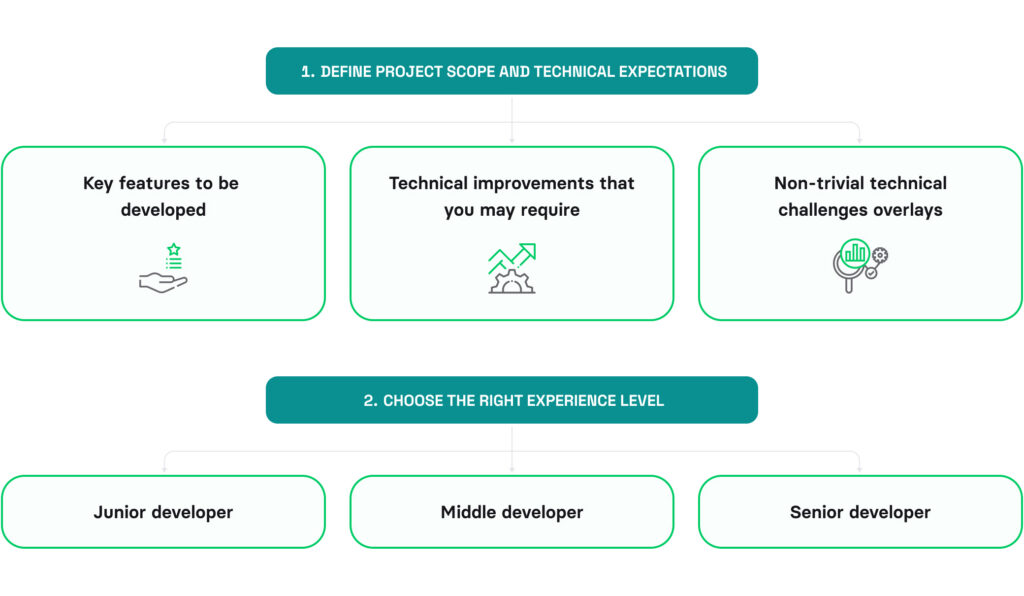
1. Define your Android app development project scope and technical expectations
Before you start looking for candidates, you need to be clear about what the developer will actually work on. It doesn’t matter if you’re building a new app or improving an existing one. What matters is having a clear understanding of your upcoming work.
Think about what you expect the developer to work on over the next 6 to 12 months:
- Key features or modules you plan to develop (e.g., onboarding flow, BLE device integration, real-time chat, in-app payments)
- Technical improvements that may be needed (e.g., migrating to Jetpack Compose, improving app performance, stabilizing background services)
- Non-trivial technical challenges (e.g., custom algorithms, working with external devices, advanced offline functionality)
Even if you don’t have a fully detailed specification, preparing a basic prioritized backlog or a rough roadmap is enough to guide the hiring process.
The earlier you identify special technical needs (like BLE integration or complex data synchronization), the easier it will be to find a professional Android developer with the right expertise.
2. Choose the right experience level for developing Android app
Once you have a clear idea of what the developer will be working on, the next big question is what level of mobile app development experience is actually required to do the job well?
This is one of the most important decisions in the hiring process – and one that often causes the most confusion.
Let’s take a look at the strengths each experience level brings and what to watch out for:
| Experience level | Best for | Risks |
|---|---|---|
Junior Developer (0–2 years) | Simple tasks, small features, working under close supervision | May struggle with problem-solving, unfamiliar with production-level architecture |
Middle Developer (2–4 years) | Independent feature development, moderate app complexity | May need technical guidance and Kotlin code reviews to ensure quality
|
Senior Developer (5+ years) | Complex apps, app architecture, integrations, mentoring others | Higher cost, but brings long-term value and stability |
Here are a few tips based on our experience that can help you make a smarter, more flexible decision and find right Kotlin developer for your project:
- You don’t always have to hire just one developer. Combining a Senior developer (for architecture and guidance) with a Middle or Junior developer (for execution) can often give you the best balance of quality and cost.
- Seniors don’t always need to be full-time. Part-time involvement for architecture reviews and code oversight is a legitimate and often cost-effective approach.
Be careful with first technical hires and low-quality companies
If you plan to hire remote Kotlin developers, the stakes depend heavily on where you’re starting from.
If you already have a technical team: let your technical leads define the specific skills and experience needed. They know your architecture, coding standards, and can clearly specify what’s required. This significantly reduces the risk of a bad hire.
If you don’t have a technical team yet: your first hire is critical. Hiring a Junior or Middle-level developer as your very first technical person is extremely risky. Without strong technical leadership in place, you’re exposed to weak app architecture, security vulnerabilities, and code that’s hard to maintain or scale.
This risk doesn’t only come from internal hiring decisions. The same danger applies when working with cheap offshore development companies that promise fast delivery at a low price. In many cases: A Senior Android developer is shown during the sales call, but Juniors or even Trainees actually do the work. The delivered code ends up unstable, hard to maintain, and difficult to scale. Clients lose money, time and the opportunity to enter the market quickly.
In either case, the safest paths are:
- Work with a verified, experienced development vendor who can deliver your MVP properly and has a track record you can actually check.
- Hire a proven Senior Kotlin developer with full-cycle experience: from app architecture setup to Play Store release.
We were once brought in to rescue a project – the Holy Quran app – originally developed by a budget offshore company. The original codebase had poor architecture, hidden performance issues, and serious limitations. We ended up completely rebuilding the application from scratch. And today, the Holy Quran app has over 1 million downloads and maintains a 4.8-star rating on the Google Play Store.
Part 2 – What to look for in a Kotlin developer
This section assumes your candidates already have a working foundation – they understand the mobile app lifecycle, backend API integration, and Kotlin principles. The points below focus on what truly separates a good Kotlin developer from a great one – the qualities that will make a real difference in your project’s success.
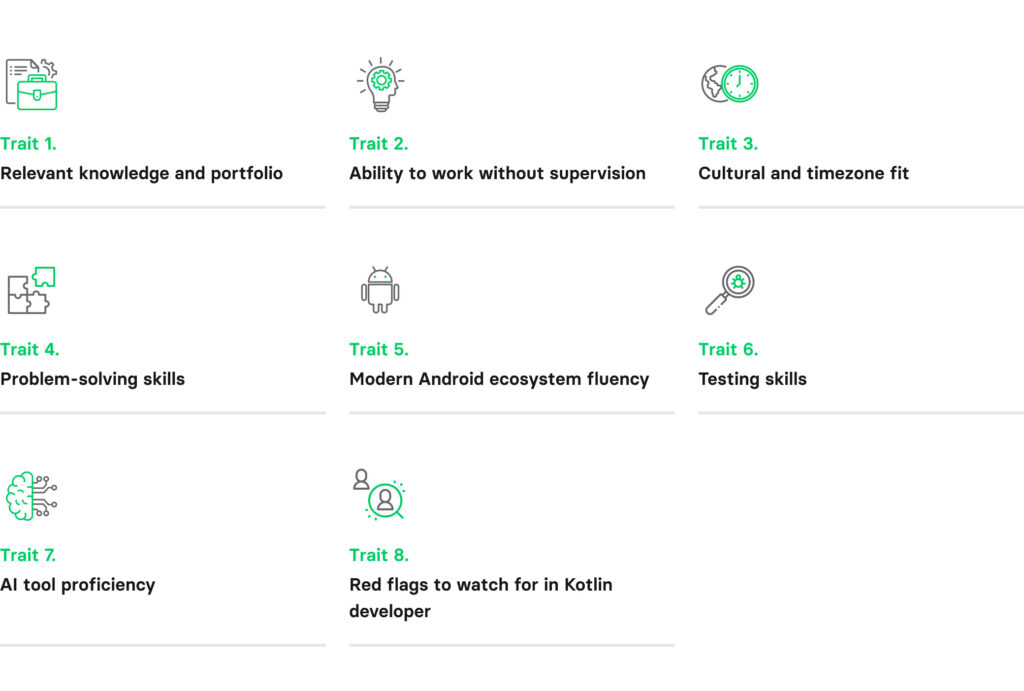
1. General and Kotlin-specific development experience, relevant portfolio
If this is your first developer – it’s crucial to hire a more experienced Kotlin developer, who can take ownership, make decisions, and drive the project forward without constant supervision.
If you already have a strong team – you can consider hiring a less experienced developer, who will grow under the mentorship and guidance of senior teammates.
Always review the developer’s portfolio. Many apps share common functionality like authentication, push notifications, API calls, and user profiles. A portfolio full of these doesn’t tell you much. If your project requires specific expertise (such as AR app development or indoor mapping), it’s much safer to choose a team or developer with proven experience in that domain.
Ask them to walk you through a project. Listen for how they describe the problem, the decisions they made, and what they’d do differently. The quality of their reasoning matters more than the impressiveness of the app.
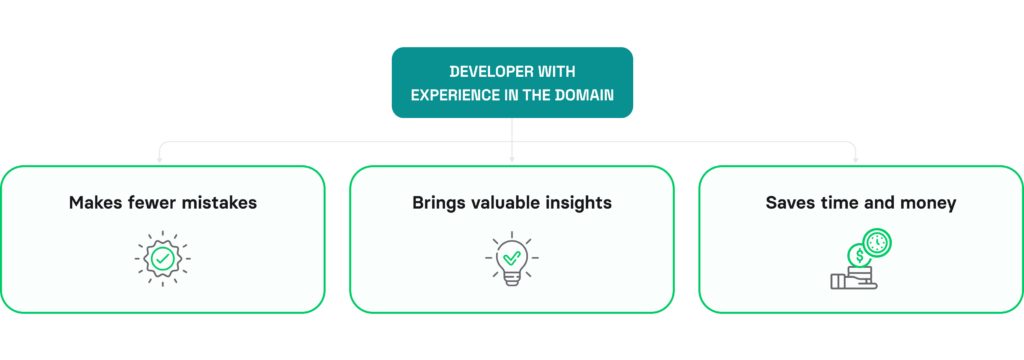
Why it’s important: Developers who have built similar solutions before are faster, make fewer mistakes, and often bring valuable insights that save you time and money.
2. Ability to work without supervision
If you have a dedicated product owner, business analyst, and detailed documentation – that’s perfect.
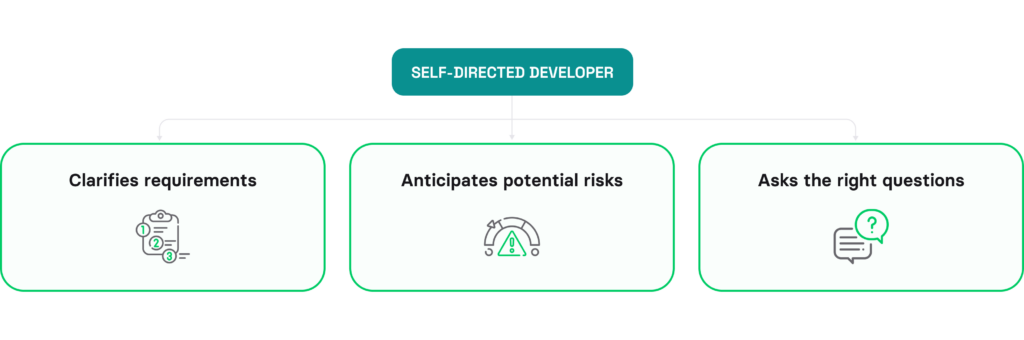
But if your project setup is less formal, you need a developer who can clarify requirements, anticipate potential risks, and proactively ask the right questions.
Why it’s important: Independence and strong communication save you from misunderstandings, delays, and expensive rework. And if you’re struggling with writing specifications, feel free to contact us! Volpis has outstanding business analysts who can help structure clear and effective project requirements.
3. Cultural and timezone fit
When working with remote or distributed teams, technical skills are only half the equation. The hiring process for Kotlin developers should include an evaluation of both their coding skills and their soft skills, such as communication and teamwork, to ensure a smooth integration into your project.
Timezone overlap matters more than it gets credit for. Even a two-hour daily overlap makes a meaningful difference compared to fully asynchronous collaboration on a fast-moving product.
Cultural fit affects team momentum in ways that are hard to measure and easy to underestimate. A developer who communicates well and takes ownership will outperform a stronger technical hire who doesn’t.
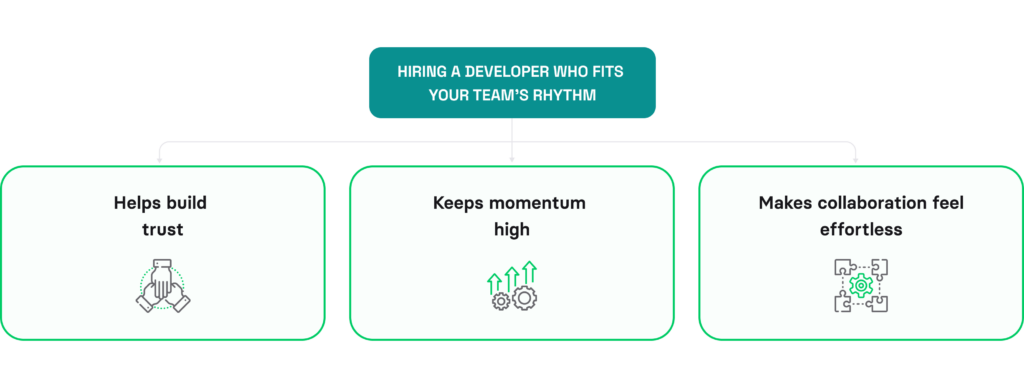
Why it’s important: Misaligned communication styles, slow responses due to timezone gaps, or differences in work culture can create hidden friction that slows down the entire project. Hiring a developer who fits your team’s rhythm helps build trust, keeps momentum high, and makes collaboration feel effortless.
4. Problem-solving skills
Technical knowledge is important, but real-world development always brings unexpected challenges. A great Kotlin developer doesn’t just follow instructions – they debug issues, optimize performance, and propose better alternatives when obstacles arise.
When you need to hire Kotlin developers, it is important to test both technical skills and problem-solving skills needed for building Android apps, ensuring that candidates can solve complex coding challenges effectively.
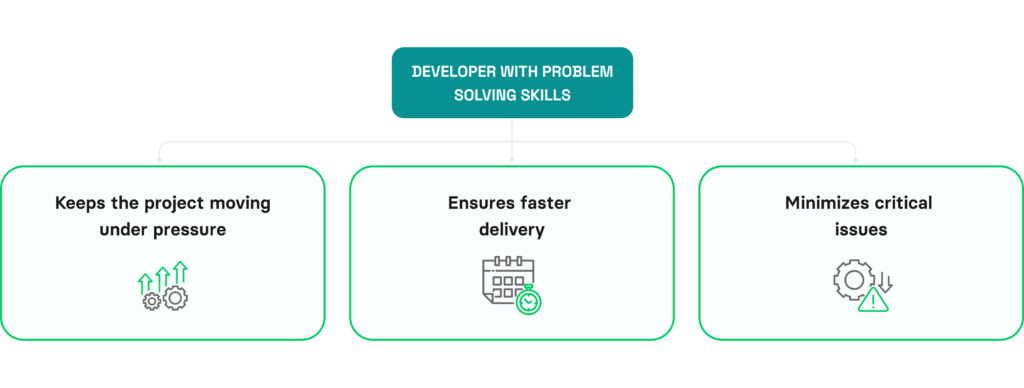
Why it’s important: Strong problem-solvers keep your project moving even under pressure, ensuring faster delivery and fewer critical issues.
The best way to evaluate this isn’t a standard coding test. Give developer a realistic problem from your domain and pay attention to how they approach it: do they ask the right clarifying questions, reason through tradeoffs, and acknowledge what they don’t know?
5. Modern Android ecosystem fluency
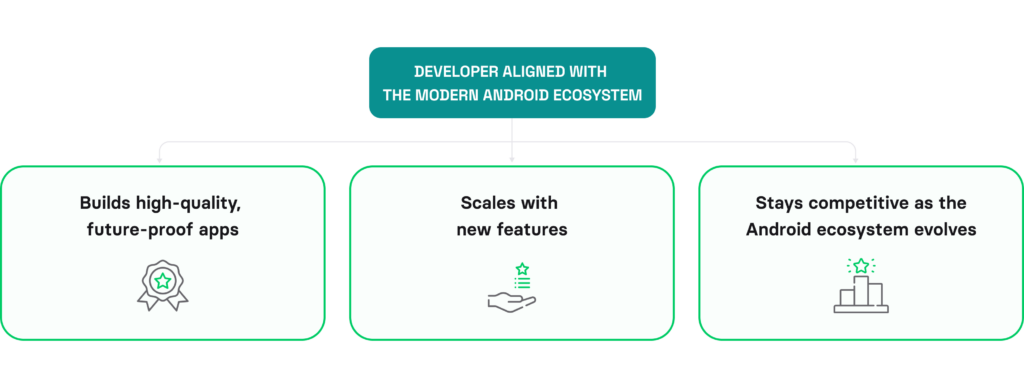
Hiring a Kotlin developer today means hiring someone who is fully aligned with the modern Android ecosystem.
A strong Android developer should be familiar with essential practices and tools such as:
- Jetpack Compose for UI development
- MVVM or Clean Architecture patterns
- Dependency injection with Dagger, Hilt, or Koin
- Navigation Component
- Room Database for local storage
Why it’s important: Android is no longer about just “getting it to work.” It’s about building high-quality, future-proof apps that are easy to maintain, scale with new features, and stay competitive as the Android ecosystem evolves. According to the Stack Overflow Developer Survey 2025, developers who adopt modern frameworks such as Kotlin and Jetpack Compose report higher productivity and fewer maintenance issues compared to legacy approaches. In our experience, it helps devs to be 2-5x more efficient in the long term – they build faster, reduce bugs, make collaboration easier, and save you thousands of dollars in future maintenance and refactoring.
6. Testing skills
A professional Kotlin developer should treat testing as a natural part of their development process, not something left entirely to QA. They should be comfortable with unit testing (JUnit, Mockito) and UI testing (Espresso), ensuring their code is stable before it reaches others.
But beyond tools, testing is also about mindset. A responsible developer takes ownership of their work, pays attention to detail, proactively catches issues early, and minimizes unnecessary “ping-pong” between development and QA.
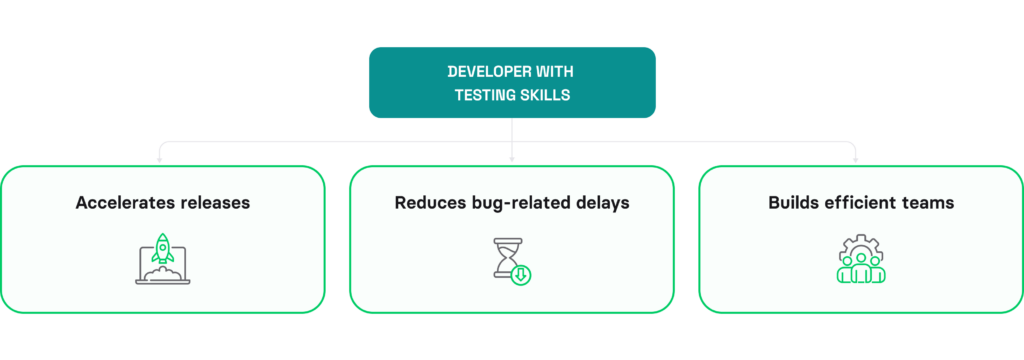
Why it’s important: Developers who prioritize quality help accelerate releases, reduce bug-related delays, and build stronger, more efficient teams.
7. AI tool proficiency
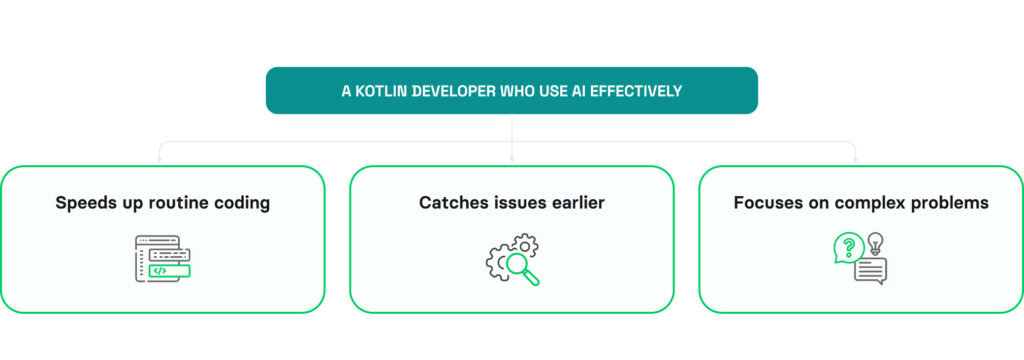
A Kotlin developer who isn’t actively using AI tools in their daily workflow is already working slower than they should be. GitHub Copilot, AI-assisted code review, and prompt-driven debugging are now standard in high-output teams. To see the scale, in GitHub and Microsoft experiment , developers using Copilot complete tasks up to 55% faster.
What you’re not looking for is someone who uses AI to generate code they don’t understand. What you are looking for is someone who uses it deliberately: accelerating repetitive work, catching issues faster, and focusing their attention where human reasoning is actually needed.
Why it’s important: A developer who uses AI tools deliberately can complete the same work measurably faster, catch more issues earlier, and free up their focus for the decisions that actually require human judgment – compounding into a significant output difference over a full project cycle.
Ask about it directly: “What AI tools do you use day-to-day? Walk me through how you’d use one on a task like this.” The specificity of the answer tells you whether it’s a real part of their workflow.
8. Red flags to watch for in Kotlin developer
Knowing what good looks like is useful. Knowing what bad looks like in practice is more immediately actionable.
- Can’t explain their own portfolio. If a developer can’t walk you through work they claim to own, they probably didn’t own it in the ways that matter.
- No opinions on testing. Every experienced developer has a view on testing. Vague or dismissive answers signal habits that will create problems in your codebase.
- Resistance to code review. Developers who push back on review culture create technical debt and friction. It’s a pattern that rarely improves on its own.
- No reflection on past failures. Every developer has had something go wrong. Those who can’t discuss what happened and what they learned haven’t processed it.
- Architecture reasoning by convention. “We used MVVM because that’s the standard” is a flag. “We chose it because of X tradeoff in our context” is not.
- Vague AI tool usage. “I sometimes use Copilot” isn’t a satisfying answer in 2026. Look for specificity about how and when they use these tools in real work.
Part 3 – Finding and attracting candidates
With a clear picture of what you need, the next step is putting that understanding into a format that attracts the right candidates – and filters out the wrong ones. Start with a budget, then build your job description around what you can realistically offer.
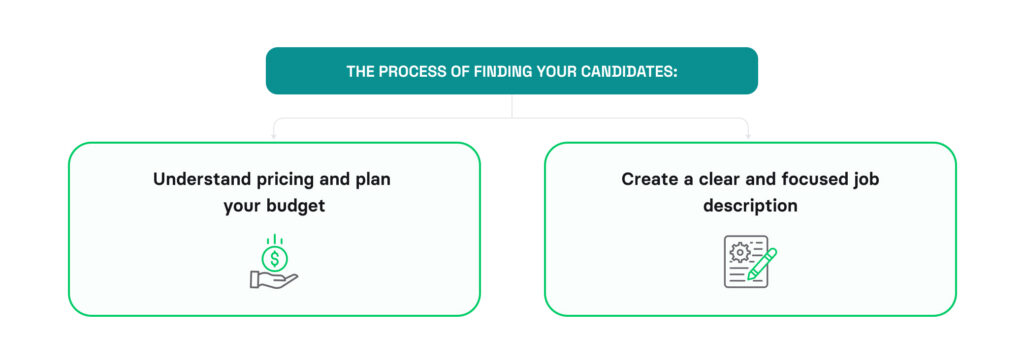
1. Understand pricing and plan your budget
Once you know your mobile app development project’s needs and the right collaboration model, it’s important to build a realistic understanding of costs.
Rates for Kotlin developers can vary significantly based on location, experience level, and the type of collaboration you choose. It’s important to look at all three together, not just at the hourly rate.
In general, here’s what you can expect for Kotlin developer rates:
| Region | Junior | Middle | Senior |
|---|---|---|---|
United States | $30–50/hour | $50–100/hour | $100–140+/hour |
Western Europe | $40–60/hour | $60–80/hour | $80–110/hour |
Eastern Europe | $25–30/hour | $30–40/hour | $40–50/hour |
India | $15–25/hour | $25–40/hour | $40–60/hour |
The table is based on data from hiring platforms and our previous project engagements
Location affects pricing, but when you need to find quality Kotlin development candidates, it’s not only about finding the cheapest option – but getting real value.
- Eastern Europe (Ukraine, Poland, Romania) often offers top Kotlin developers and a great balance of strong technical expertise when building Android mobile applications, good communication, and affordable rates.
- Western Europe and the US offer excellent Kotlin app development skills too, but at a much higher cost.
- India has lower prices for software engineering, but usually requires stronger internal management to ensure quality and good delivery standards.
Finally, don’t forget: the hourly rate of Kotlin app developers is just part of the full picture. You may also need backend developers, QA engineers, designers, and project managers, depending on your setup. Make sure you budget for the full product delivery, not just Kotlin programming alone.
2. Create a clear and focused job description
When you’re looking for Kotlin developers through a dedicated team or outstaffing model, a clear job description helps set the right expectations – both for the developer and for your future collaboration.
You don’t need to describe office perks or your internal culture. Outline what the developer will work on, what skills matter most, how your team is structured, and how you plan to collaborate during the development process.
So, let’s take a look at the key components of a Kotlin developer job description:
| Section | Details |
|---|---|
Project overview | Explain what kind of app you are building or maintaining. Is it a brand-new product, an upgrade of an existing one, or a full rebuild? If the app already exists, mention the tech stack. |
Required skills & experience | List required skills and experience. By this stage, you should already know what experience level you’re looking for – whether it’s a middle, senior, or a combination – based on the earlier steps we discussed. When describing Kotlin app development skills, it’s a good idea to split them into two parts: baseline skills and project-specific requirements.
|
Team setup and the developer’s role | Clarify whether the developer will be working alone or collaborating with backend developers, QA engineers, designers, or product managers. Mention if they will be supervised by a tech lead or expected to work independently. If they will be mentoring someone, leading small initiatives, or helping shape technical decisions, it’s important to state that clearly. |
Key responsibilities | Focus on the actual work the developer will be doing – for example:
|
3. Choose the right sourcing channel
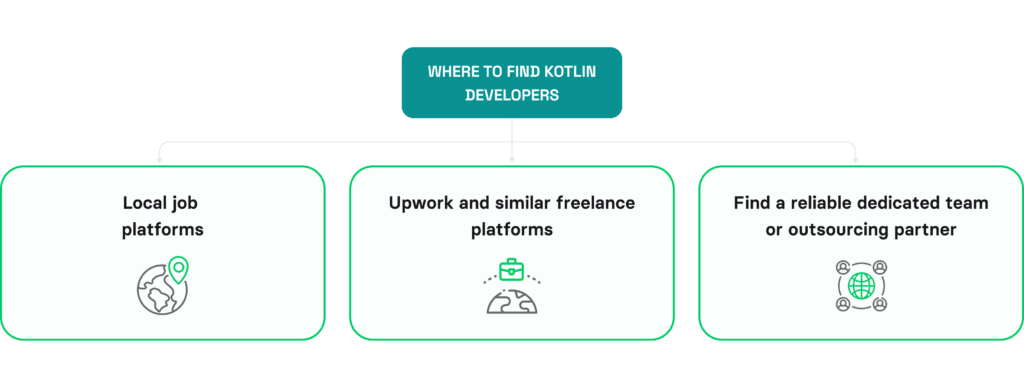
Finding skilled Kotlin developers for Android apps isn’t just about posting a vacancy and hoping for the best. The right channels can make a big difference – saving you time, money, and helping you connect with better Kotlin app developers faster. When you plan to hire remote Kotlin developers, here’s where you should focus depending on your needs:
1) Local job platforms
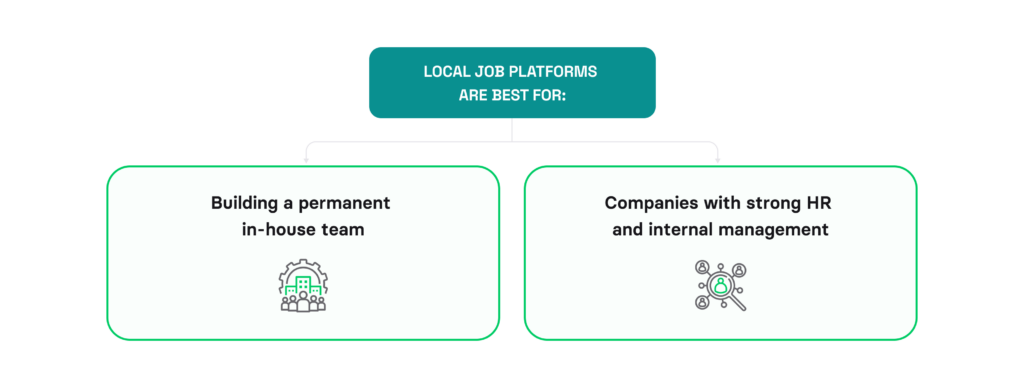
If your goal is to hire Kotlin app developers directly into your local office or region, traditional job platforms like LinkedIn, Glassdoor, or country-specific job boards can be useful. However, keep in mind that the hiring cycle is often longer, and competition for top Kotlin developers can be very high – especially if you’re located in a major tech hub.
Best for:
- Building a permanent in-house team
- Companies with strong HR and internal management
2) Freelance platforms
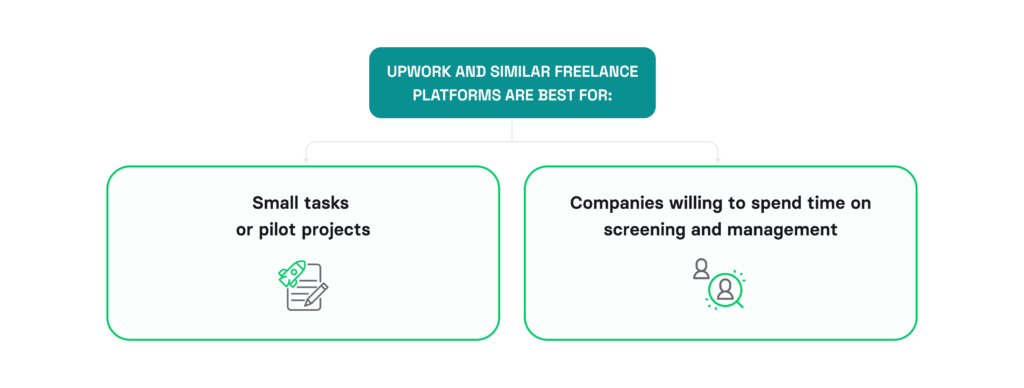
Freelance marketplaces like Upwork can sometimes be a quick way to find remote Kotlin developers for small tasks or short-term projects. However, there’s always a risk when working with freelance Kotlin developers – quality can vary dramatically, communication can be inconsistent, and freelancers often juggle multiple clients at the same time, which can impact reliability.
Best for:
- Small tasks or pilot projects
- Companies willing to spend time on screening and management
3) Reliable dedicated team or outsourcing partner
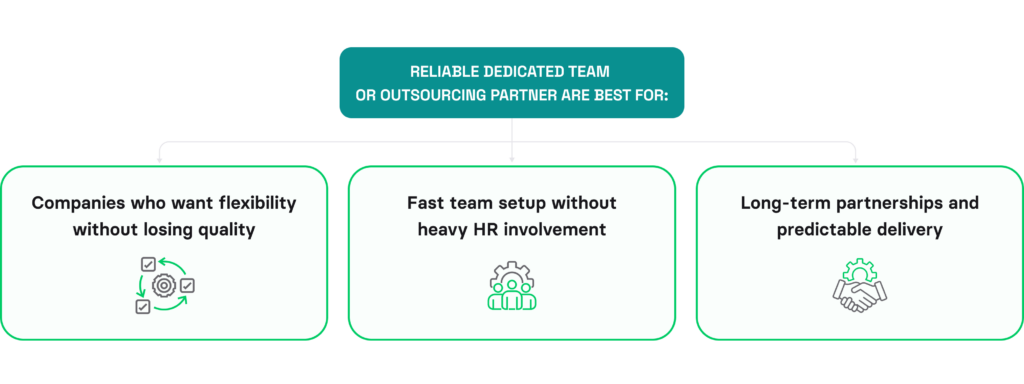
If you want more reliability, scalability, and quality control – you can hire dedicated Kotlin developers or find a trusted outsourcing partner. These are often the smartest choices. Look for software development companies with a proven track record of creating Android apps, verified Kotlin development reviews, and real-world Android development experience.
Best for:
- Companies who want flexibility without losing quality
- Fast team setup without heavy HR involvement
- Long-term partnerships and predictable delivery
And in case you don’t want to waste time looking and evaluating developers, explore the option of vetted Kotlin developers for hire from Volpis.
Part 4 – Evaluating candidates and onboarding
A good hire can still fail if the trial has no structure. The trial period works when both sides know in advance what success looks like. And that definition needs to be concrete, not assumed.
The expectations document consists of two parts, shared with the developer before day one:
Part 1 – Project Expectations (concrete deliverables for the initial onboarding period)
This part defines what the developer is expected to deliver in their first weeks. It should include specific, measurable outcomes. The exact expectations will vary depending on your project, team, and role, but they might include things like:
- Delivering X features from the backlog.
- Identifying and flagging technical risks.
The key principle: expectations should be concrete enough that at the end of the period, both sides can clearly say whether they were met or not.
Part 2 – Collaboration Expectations (concrete working standards)
This part defines how the developer is expected to work and communicate. Vague standards like “good communication” are hard to evaluate — something like “a daily 15-minute sync” leaves no room for interpretation
The key principle: collaboration expectations should be specific enough to be observable by both sides.
At the end of the onboarding period, review both parts together. Compare expectations vs. reality for both sides. This will either confirm the hire or surface the misalignment to act on.
FAQs
How long does the Kotlin developer hiring process typically take?
The timeline to hire Kotlin developers can range from a few days to a couple of weeks, depending on your project scope and urgency. If you’re working with an agency with a proven track record, they can often provide experienced Android developers ready to begin immediately. Using platforms that vet quality Kotlin developers worldwide helps streamline the hiring process. Most teams follow agile methodologies, so onboarding and kickoff happen quickly. Once your Kotlin developer begins, they usually set up the project using Android Studio and initiate sprint planning. This agile start ensures you can build Android apps efficiently with a clear timeline.
Should Kotlin developers still know Java in 2026?
Absolutely. While Kotlin programming language is preferred, many enterprise Android apps still include legacy codebases in Java. Skilled Kotlin developers should be able to read, refactor, and extend Java code when necessary – especially when integrating with older modules or libraries not yet ported to Kotlin.
What’s a good technical test or interview task for Kotlin developers?
A good technical test for Kotlin app developers should avoid algorithm puzzles and instead mimic real-world tasks, such as integrating with a sample REST API, adding offline support to a feature, or refactoring a poorly structured module using MVVM and dependency injection. These tasks reveal how a candidate thinks about architecture, handles code hygiene, and reasons through edge cases – offering a much clearer picture of their practical abilities.
How do I know if a candidate understands the Android SDK at a deep level?
When you hire Kotlin developers, ask how they’ve handled platform-specific challenges like background tasks, push notifications, or location updates. A surface-level dev will mention libraries; a deep one will reference SDK classes (like WorkManager, NotificationCompat, or FusedLocationProvider) and explain why they made certain implementation choices. It shows they think with the SDK, not just around it.
How can I tell if a Kotlin developer is actually senior, not just experienced?
If you want to find qualified Kotlin developers, look beyond years of experience. Ask how they’ve handled architecture trade-offs, production bugs, or code handovers. A true senior Kotlin developer will talk about why they made certain decisions, how they evaluated risks, and how they mentored others – not just the tools they used.
Should my Kotlin developer be using AI tools in 2026?
Yes – and it’s worth asking about directly. Developers who use AI tools deliberately work faster and catch more issues earlier. What you’re not looking for is someone who generates code they don’t understand. Ask them to walk you through their actual workflow.
Can a Kotlin developer help me refactor or improve an existing app?
Yes, if you hire an Android developer skilled in Kotlin code, he can refactor, modernize, or optimize your existing app. Whether you’re looking to increase performance, implement functional programming concepts, or clean up legacy code, this is a common request. The best Kotlin developers also help introduce agile development practices for smoother iterations. Many businesses choose to hire Kotlin developers specifically to improve app stability before scaling or launching on the Google Play Store. With the right expert, your app can evolve into a high-quality Android app without starting from scratch. They’ll also ensure your mobile apps meet modern UI/UX standards.
What mistakes do non-technical founders make when hiring Kotlin developers?
Non-technical founders often make the mistake of hiring Kotlin app developers solely based on GitHub activity or language skills, without evaluating essential traits like communication, autonomy, decision-making, and problem-solving abilities. They may overlook the importance of Android-specific experience, such as familiarity with the Android SDK, UI performance optimization, and handling device fragmentation. Another common pitfall is expecting one developer to take on the roles of business analyst, QA, and delivery lead. Ultimately, hiring a Kotlin developer isn’t just about filling a role – it’s about choosing someone who can reduce product risk and contribute meaningfully to the project’s success.
Do I need to buy any tools or licenses for my Kotlin developers?
In most cases, no. The core tools for Android development – including Android Studio and the Android SDK – are free and open-source. Android Studio is the official IDE supported by Google, and it includes everything needed for coding, testing, profiling, and debugging. However, depending on your project, your developer might request access to a paid API or SDK (e.g., maps, analytics, payment gateways), Firebase Premium features, or Google Cloud resources and testing devices or services (like BrowserStack or Firebase Test Lab). At Volpis, we handle all tooling and environment setup internally – so you don’t have to worry about provisioning anything unless we mutually agree it’s required for your project.