
Backlog prioritization shows which tasks can deliver the highest value, differentiating between crucial changes and nice-to-haves. It also simplifies distributed team management and boosts product delivery, enabling companies to release faster.
Despite all these obvious benefits, many product teams fail to prioritize the backlog. Recent research on operationalizing value in Agile software development shows that 26.5% don’t use any prioritization approach. 47% rely on personal preferences and gut feeling to set priorities. These numbers mean that a large share of teams operate less efficiently than they could. Delivery pressure, constantly changing requirements, and a lack of ownership result in technical debt starting to accumulate, making prioritization even more difficult.
Having a BA within your engineering team can help manage backlog when you choose between technical debt and new features. More about the BAs’ role in prioritizing backlog and how to do it below.
What is backlog prioritization?
Backlog prioritization is the process of turning all accumulated work items (including user stories, features, technical tasks, bug fixes, and research requests) into a clear order of tasks based on their potential value and urgency. It makes the software development cycle better aligned with business priorities and helps coordinate the efforts of an engineering team. Backlog prioritization techniques are particularly important for complex products with a high volume of user requests and a large scope of changes.
Ideally, your backlog is a list of every product-related task an engineering team needs to complete next and what they should focus on after that. The backlog should have a defined time frame and include high-priority tasks (no lower than second-level priority). Otherwise, you will start accumulating items and have difficulties regularly reviewing them.
Benefits of backlog prioritization for product and engineering teams
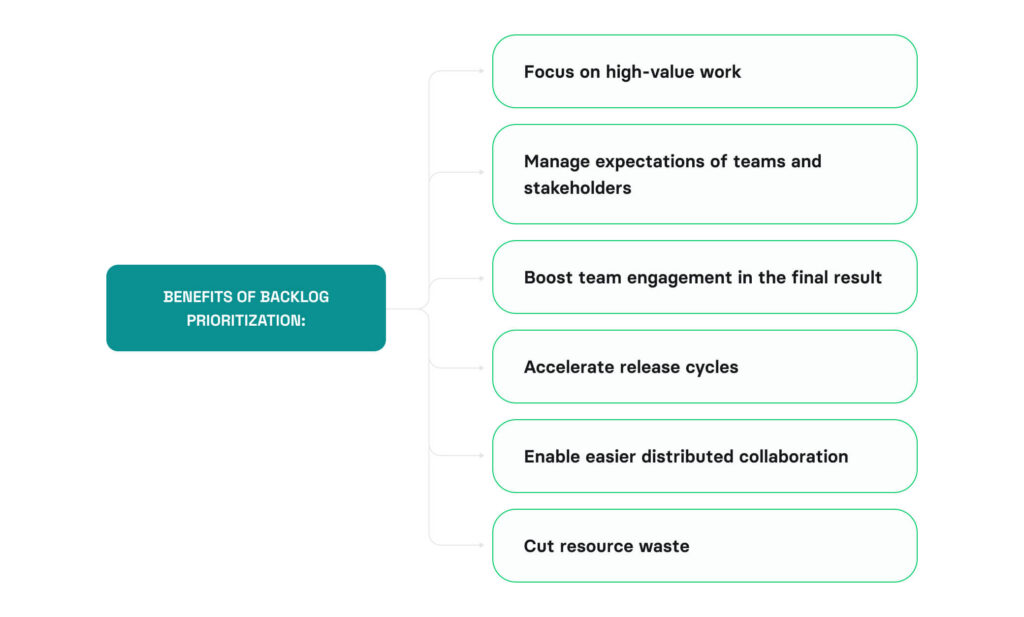
A well-managed product backlog is a foundation of Agile software development, which has a tangible impact on your team’s performance and other metrics. Here’s what you get by prioritizing backlog:
- Increased efficiency since the most valuable tasks are covered first. When teams know the real customer feedback and business objectives, they can work directly towards specific project goals.
- Clearer expectations for teams and stakeholders. Everyone shares the same software development roadmap, which makes the development process more goal-oriented and transparent.
- Keeping the team engaged in the final result. By having backlog prioritization meetings, you let each team member contribute to the next product development stage and make them feel valued.
- Faster validation cycles. Real-time backlog updates allow teams to adapt to feedback and fix misaligned priorities before they become sunk costs.
- Real-time collaboration for distributed teams. Backlog prioritization helps assign tasks within distributed teams for asynchronous grooming and smoother cooperation.
- Reduced resource waste. Prioritization enables teams to avoid tasks that require lots of resources while delivering low value, which increases operational efficiency.
Besides the listed benefits, backlog prioritization also improves customer satisfaction, as it takes into account users’ opinions and feedback. If end users are looking for something specific, and it can considerably increase the value of your product, the analysis will capture it and help you meet real people’s needs.
Who prioritizes backlog, and why you also need BAs
In Scrum and Agile backlog prioritization, a product owner is typically the main person accountable for what to do next. However, when they focus all the power and fail to consider input from other team members, product quality is likely to suffer.
Having a business analyst within your team or using business analysis outsourcing helps manage multiple opinions and the real value of each feature. BAs communicate with stakeholders and the engineering team to evaluate the technical debt and its business impact. Engaging a BA brings objectivity into the decision-making process, and teams stop relying on gut feeling or personal preferences.
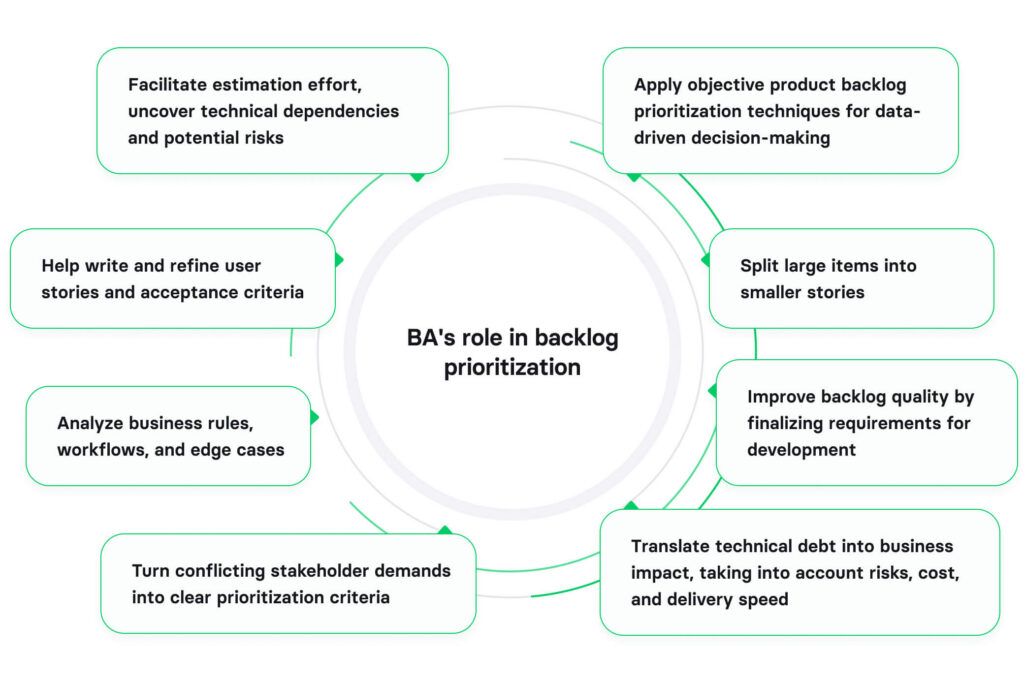
Using business analysis in software development won’t tell you what to develop next. BAs create a decision framework that makes prioritization objective, transparent, and aligned with business goals. Once you know which features bring the maximum output, you can invest more wisely and ensure the product supports your business goals. Engaging BAs can also solve other software development problems, such as managing distributed teams and project management.
Technical debt vs. new features: how to manage both
The choice between accumulating backlog vs. implementing new functionality required by market trends and user preferences is a painful one. You need to keep the balance between fixing bugs and building potential features based on the value of each development decision.
Stakeholders often deprioritize refactoring — not because it isn’t valuable, but because the ROI is harder to see than net-new features. Technical debt lacks proper acceptance criteria that illustrates the outcome of changes. Second, short-term KPIs are often valued more than product sustainability, as many product teams are focused on immediate results.
If you are in a situation where managing the technical debt is as important as implementing innovations, here is what you can do:
- Make a connection between tech debt items and new features where applicable: e.g., without refactoring A, we won’t be able to easily integrate product B.
- Track technical indicators and use them as part of the justification (use tools like Sentry and save input from the support team).
- Use value-based prioritization models (e.g., WSJF, cost of delay, or risk vs. value matrices).
- Consider reserving fixed capacity for each type of item (e.g., 70% for new features and 30% for backlog and debt).
- Make sure you can justify the value of the backlog and its impact on the outcome by gathering feedback from your engineering team.
- Reframe technical debt issues as measurable business risks or trade-offs.
- Break technical improvements into smaller tasks to combine them with developing new features and make incremental changes.
Having business analysts within your team simplifies prioritization between technical debt and new features, as product owners can rely on deeper research to make optimal decisions.
More advice on how to prioritize the product backlog from our BAs
During the years of offering BA services, we have accumulated recommendations on how to prioritize the product backlog. Below are the core insights and backlog prioritization techniques to consider in your project.

Use monitoring data to make prioritization evidence-based
Monitoring is one of the most effective ways to remove subjectivity from backlog prioritization. Engineering teams can directly use metrics such as performance trends, error rates, and incident frequency as inputs for value-based prioritization models.
Monitoring data helps evaluate backlog items across the same key dimensions as features: business impact, user impact, risk, effort, and urgency. This makes technical debt visible, comparable, and easier to justify alongside new functionality, especially when stakeholder alignment is required.

“Setting up monitoring early helps establish performance and stability baselines, making it much easier to justify priorities as the product evolves. But even if this step was missed initially, introducing monitoring later is still highly valuable and quickly exposes hidden risks, delivery slowdowns, and the growing cost of delay.”
– Liliia Hos, Business Analyst at Volpis
Apply backlog prioritization techniques to make things transparent
There are multiple common backlog prioritization techniques, including the Kano model, RICE, WSJF, and value vs. effort backlog prioritization matrix, to support feature prioritization with evidence. They all follow the same logic of gathering feedback from stakeholders, engineering teams, or end users and prioritizing potential features based on it.
You can rely on a single methodology or combine several approaches depending on your capabilities. Regardless of which prioritization technique you adopt, the main factors to consider when working through the backlog are business value, customer and user value, risk and dependencies, level of effort, and urgency of implementation. Estimating these factors can help you determine which functionality is the most critical and convince other stakeholders if necessary.
Know the outcome you want to achieve in the following months
Have a specific, midterm goal tied to your business strategy to better understand which features from the technical debt or innovations align with it. Three to six months is a typical time frame for setting such goals. Knowing midterm goals helps make decisions when everything seems important, and the value of the available options is comparable.
Understand why people would use your product
Remember that people use your product because it helps them solve specific problems, makes life more enjoyable, or brings other benefits. You should know exactly what existing and potential users expect. These are not always specific features. It may turn out that a large share of the user audience needs data security and performance speed. Then, you will know what developments matter first of all and prioritize the backlog accordingly. In-app surveys and interviewing users directly are the typical ways to gather such feedback.
Test AI tools, but keep people in the loop
Tools like Jira offer built-in AI capabilities, such as Rovo and Atlassian Intelligence, that automatically flag outdated tickets, show dependencies, and suggest priorities. You can also use them to build custom workflows, plan and prioritize tasks, break down work into tasks, and more.
Test these features to better evaluate your technical debt and speed up analysis. However, defining the real business value of different features requires a more comprehensive approach than the most popular tools for backlog prioritization can offer and, most importantly, human supervision. Engineering teams need to combine multiple data sources and turn disparate information into prioritized tasks supported with evidence and critical judgment.
Product backlog prioritization example from our completed projects
Volpis is an engineering company with over 10 years of experience in business analysis services. We offer business analysis both as part of the custom software development lifecycle and as a separate service for existing teams.
The Holy Quran app is one of the projects that required business analysis with backlog prioritization. It’s a non-profit mobile app for Android and iOS, which serves as a platform for studying the Quran.
When we started working on this project, our focus was on maintaining and ensuring the core functionality remains stable. Volpis completed backlog prioritization to estimate the urgency and value of bug fixing, performance optimization, existing functionality improvements, and stabilizing the app.
As the app matured, the team observed increasing maintenance complexity, growing bug reports, and UX limitations. To avoid making changes without clear justification, we launched an in-app survey. It revealed a high volume of user complaints and feature requests we could not address without upgrading the underlying technology. The research also showed that many users were unaware of some of the existing features, reinforcing the need for a comprehensive UX rethink.
Based on nearly 400 issues and requests, the team applied a value-impact matrix to prioritize improvements. It resulted in a data-driven backlog that guided a full product redesign and technical refresh for several months of delivery.

Summary on prioritizing backlog
Prioritization techniques in Agile bring more control and order into the software development process. Instead of relying on someone’s personal opinion, you can gather objective information on what users need in terms of performance, functionality, design, and other details that determine the success of your software. The effort, dependencies, and time also matter.
If your project requires a fine balance between working on the technical debt and implementing new functionality, backlog prioritization is even more important. It allows you to estimate the value and impact behind every change and combine software improvements with innovations within sprints.
Need help with business analysis services? Contact us via info@volpis.com to schedule a free consultation and discuss your case.
Questions & Answers
FAQ
How does a product owner prioritize backlog?
A product owner prioritizes a backlog based on multiple factors, such as business value, customer/user value, effort required, risks and dependencies, and urgency. After collecting these insights from an engineering team and stakeholders, the PO ranks features depending on their importance and impact.
Who is responsible for grooming the prioritized product backlog?
A product owner is responsible for grooming the backlog after prioritizing it. However, they usually rely on the input from multiple stakeholders, including an engineering team and business analysts, to review the backlog and prepare it for future sprints.
How do business analysts help product owners with backlog prioritization?
Business analysts provide product owners with additional information about potential and existing backlog items, turning demands into clear prioritization criteria. They clarify feature requirements, update acceptance criteria, reassess business value and dependencies, and gather feedback from stakeholders and customers to support product owner’s decisions.
How often should a product backlog be prioritized?
Backlog prioritization is a continuous process as a product owner constantly reviews and adjusts priorities based on business needs, required efforts, value, and other factors. Major prioritization usually happens before sprint planning and significant events, such as regulatory changes or emerging market innovations.
Is it possible to work on technical debt and new features simultaneously?
Yes, an engineering team can combine working on technical debt and new features simultaneously. You have to run prioritization to understand which features from the overall scope have the highest value, and then allocate a percentage of each sprint to technical debt and new functionalities.
What is the difference between backlog refinement and prioritization?
The main difference between backlog refinement and prioritization is that prioritization determines which items must be refined and in which order. Then, an engineering team refines the items by clarifying requirements and estimating the effort needed to prepare high-priority items for sprint planning. Both processes are iterative and complement each other.