If If you’re looking for Kotlin developers, one of the first decisions you’ll face is how to build your development team. Should you hire developers in-house, work with dedicated developers through staff augmentation, or fully explore outsourcing mobile app development for your project?
Choosing the right model will help you save time, optimize costs, and set your mobile app development project up for success. Pick the wrong one, and you’ll feel it in sprint three.
At Volpis, we’ve worked across different models with clients at different stages – from founders shipping their first MVP to established teams scaling a product with a million users. Some had a bad outsourcing experience before. Some burned time and budget trying to go in-house before pivoting.
The pattern I keep seeing: the model itself is rarely the problem. Choosing a model that doesn’t match where your business actually is – that’s what costs you. This article is built around that insight.
If you want to go deeper on any of these models with real examples from our practice, I cover that in detail in my personal breakdown of outsourcing models.
Here’s what we’ll cover in the article:
- In-house hiring – when full ownership is worth the overhead
- Dedicated developers (outstaffing) – when you need specialized skills without the headcount
- App Outsourcing – when speed and cost predictability matter most
We’ll explain the pros and cons of each approach and help you choose the best fit for your project.
In-House vs. Outstaffing vs. Outsourcing App Development: Three Models Explained
Before picking a vendor, you need to pick a model. Here’s how the three mobile application development models break down in practice:
1) In-house development: full control and knowledge retention
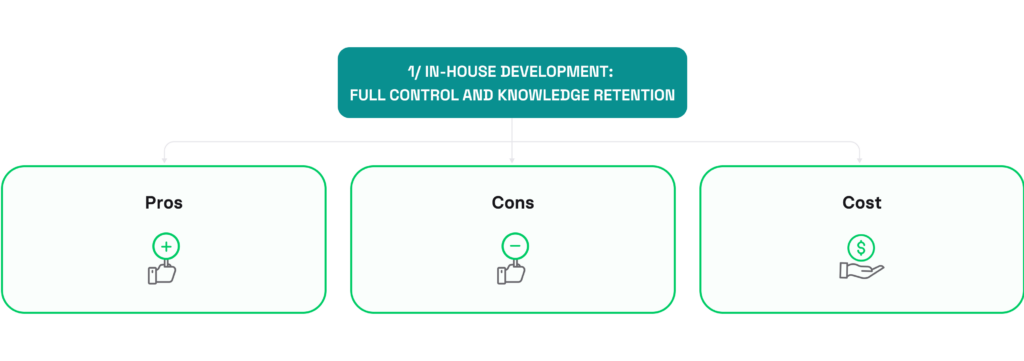
You recruit Kotlin developers directly into your company as full-time employees. They follow your internal processes, grow inside your culture, and stay on your payroll permanently.
In house software development model gives you full control over the development team and software development activities. But it also comes with high recruitment costs, slower hiring timelines, and operational risks.
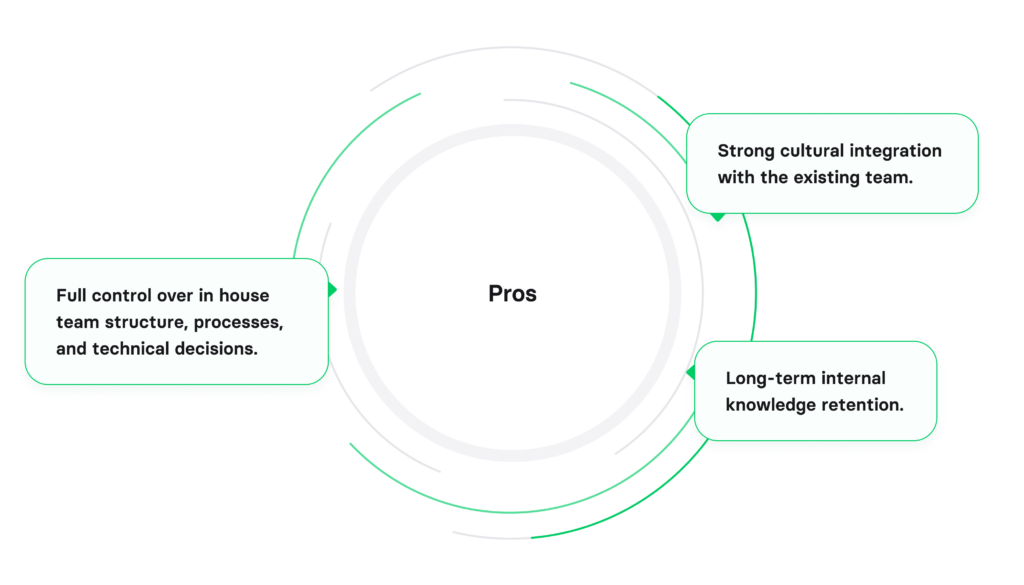
Pros:
- Full control over in house team structure, process, and architecture decisions.
- Deep cultural alignment with the existing team.
- Long-term knowledge stays inside the company.
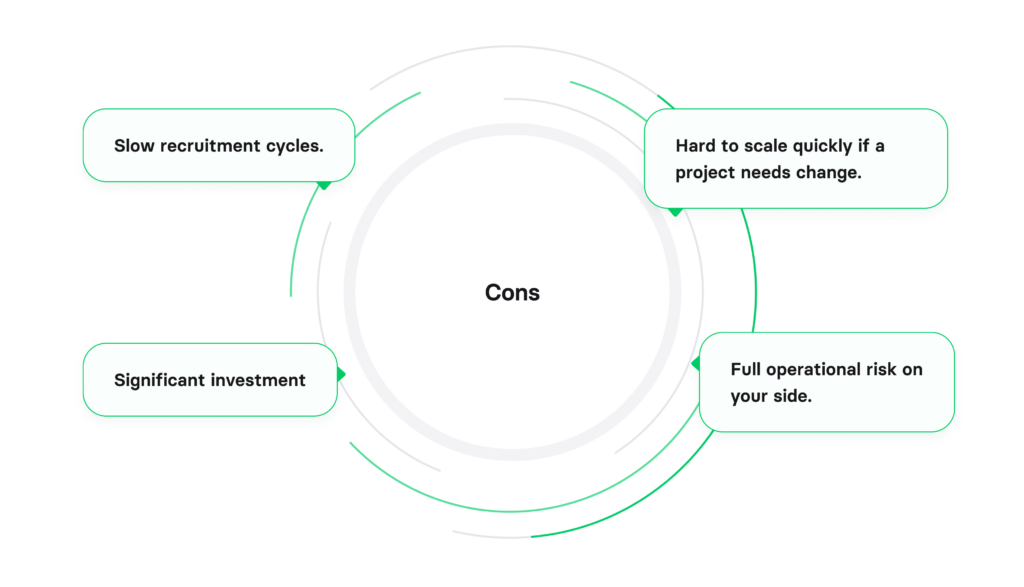
Cons:
- Slow recruitment cycles (can take 3–6 months).
- Significant investment: salaries, benefits, HR, taxes, office space, equipment.
- Hard to scale up or down quickly when project scope changes.
- Full operational risk on your side (churn, retention challenges).
- High salary floor with no flexibility (according to Dice’s 2025 Tech Salary Report, mid-level position ranges between $110,000-$148,000/year).
Typical use cases:
- Enterprises with strong HR and long-term mobile strategy.
- Companies investing heavily into proprietary technology.
- Organizations that require maximum IP security and internal knowledge building.
2) Dedicated developers (outstaffing): flexibility and cost savings

You hire Kotlin developers from a trusted vendor, through staff augmentation. Developers work full-time on your project, follow your development processes, and report to your team daily. While the vendor handles employment, taxes, HR, and legal, equipment, insurance, etc.
A dedicated team model gives you flexibility, fast hiring speed, and significant cost savings – without HR overhead.
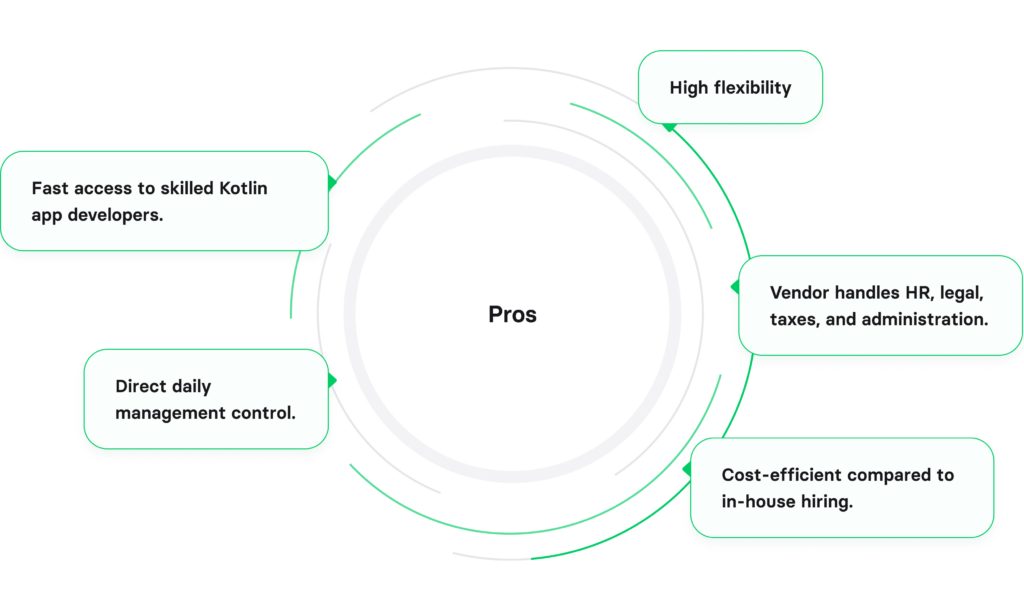
Pros:
- Kotlin developers onboard in weeks, not months.
- You have the full management control: the sprint planning, code reviews, and task assignments.
- Team size adjusts with 30 days’ notice – scale up for a launch, scale down after.
- Vendor handles HR, legal, taxes, and administration.
- 40-60% cost saving compared to equivalent US in-house hires.
Cons:
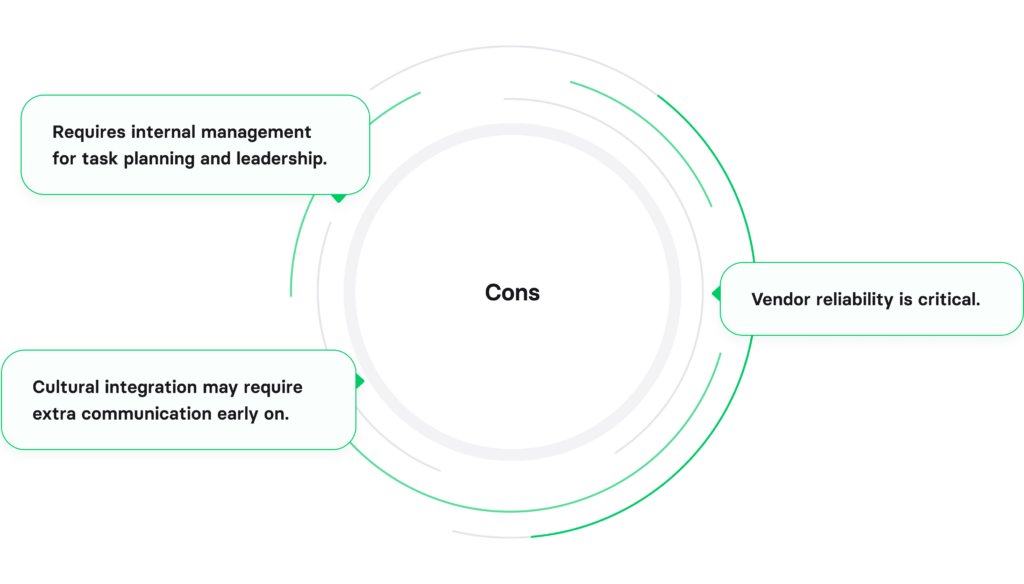
- Requires internal management for task planning and leadership.
- Cultural differences may require extra communication early on.
- Vendor reliability is critical.
Typical use cases:
- Fast-scaling startups needing engineering capacity fast.
- Businesses optimizing development team size based on dynamic market conditions.
3) Full application development outsourcing (offshore app development)
You hand over the entire responsibility for your Kotlin development project to a trusted vendor offering app development services. That includes team composition, project management, delivery, quality assurance, architecture decisions, and deadlines. You define what you need to ship. The vendor figures out how to ship it.
This is the highest-leverage model for companies without internal mobile expertise – and the fastest path to a minimum viable product (MVP).
Pros:
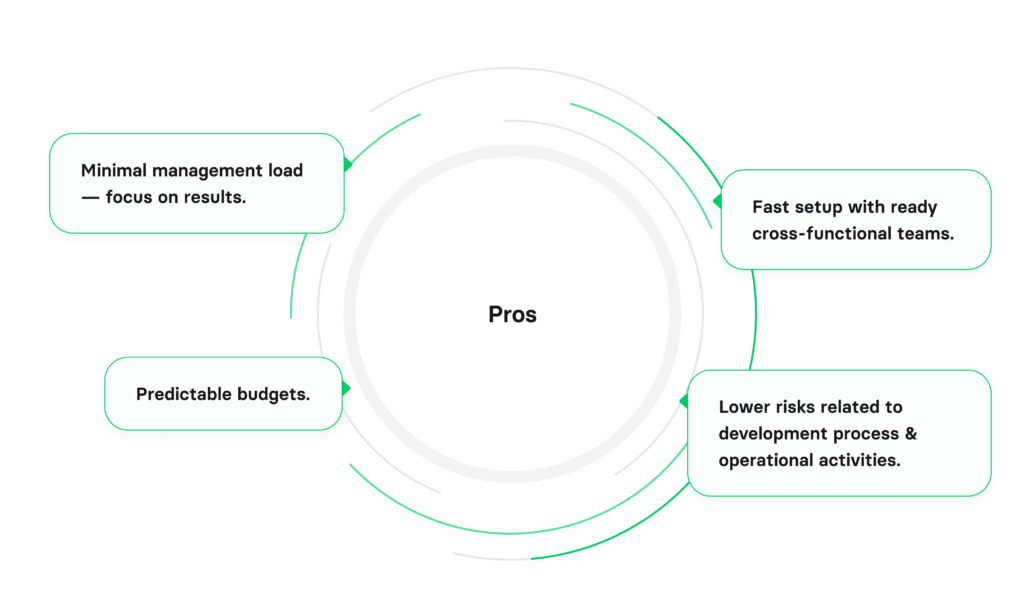
- Minimal day-to-day management load – you review milestones.
- Predictable budgets with fixed price model or milestone contracts.
- Ready cross-functional teams (Dev, QA, PM, Design) mean a significantly faster time to market.
- Lower risks related to development process & operational activities through effective risk mitigation.
Cons:
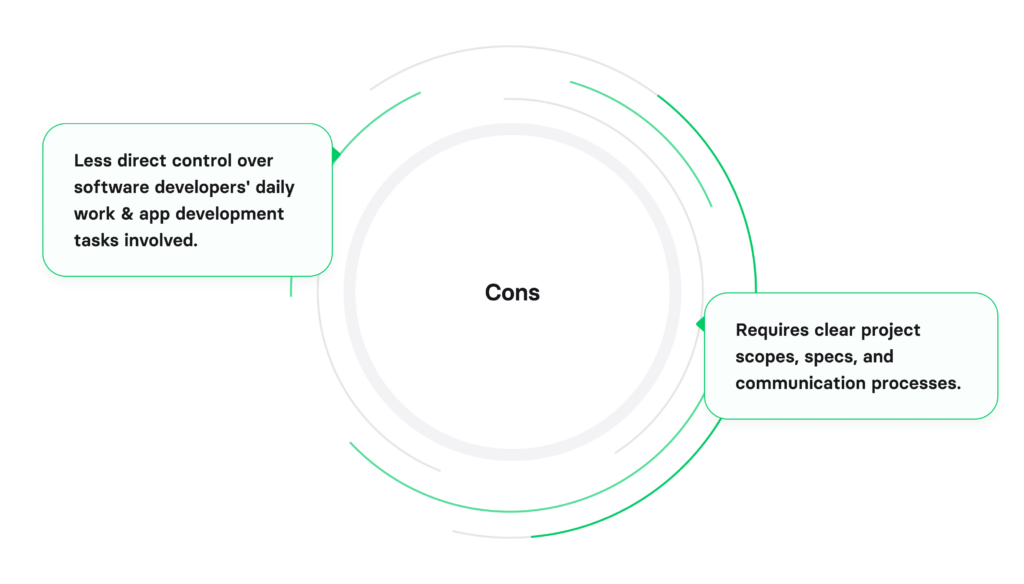
- Less daily visibility into individual developers’ work.
- Requires clear project scopes, business requirements, and technical requirements.
Typical use cases:
- Companies launching MVPs and entering new markets fast.
- Enterprises needing temporary full project teams without internal hiring.
- Businesses that lack internal mobile expertise and want turnkey delivery.
Now that you know what each model is, here’s how to match that to where you actually are.
Which option is best for your Android app development project? Balancing business strategy and development cost
Choosing the right collaboration model is not just about development cost — it’s about what your business needs today and how you plan to grow over the next 6–24 months.
| When in-house hiring makes the most sense | When dedicated Kotlin developers are the best choice | When outsourcing software development is the best fit |
| – Long-term mobile development plans. – Strong HR and tech leadership in place. – High budget and willingness to invest in building internal teams. | – Need to start fast without building from scratch. – Budget optimization matters (save 40–60%). – Flexible team scaling needed. – Managing tasks directly but avoiding HR complexity. | – Small and well-defined projects. – No mobile development team internally. – Prefer predictable budgeting and minimal daily management. |
You decided to go the dedicated developer or outsourcing route, and need a Kotlin team specifically? Our Kotlin development services page walks through how we staff and vet engineers, typical timelines, pricing, and how to get started.
How to evaluate a mobile development outsourcing partner
The wrong vendor doesn’t just slow you down – they cost you months, money, and product credibility. Here’s exactly what to look for before you sign anything.
1. Domain Expertise, Not Just Mobile Experience
Most dev shops can build a mobile app. Far fewer can build one for fleet management, indoor navigation, or real-time logistics – and get the edge cases right the first time.
Ask directly: have they built something in your domain? Not “adjacent” or “similar.” Your domain. If they haven’t, they’ll spend the first two sprints learning what you already know.
The right partner brings domain patterns to the table from day one. That’s the difference between a team that solves your problem and one that discovers your problem.
2. How they run discovery
A vendor who jumps straight to estimates without a discovery phase is a red flag. You don’t need speed here – you need accuracy.
A solid discovery process includes scope definition, requirement validation, architecture planning, and risk identification before a single line of code gets written. It saves you from change orders, missed deadlines, and features that made sense in the brief but not in production.
Ask them: What does your discovery phase look like? How long does it take? What do you deliver at the end of it?
If their answer is vague, their delivery will be too.
3. Team stability and retention
Developer turnover mid-project is one of the most expensive problems you’ll never see on an invoice. Every rotation costs you onboarding time, context rebuilding, and degradation in code consistency.
Ask your prospective partner directly: What’s your average team tenure? Do developers stay on a client project through completion, or rotate based on internal availability?
Red flags to watch for: Vague answers about “resource allocation”. No named team members in the proposal. A structure where you meet senior talent in the pitch and get junior developers in delivery.
The team that scopes your project should be the team that builds it.
4. Scalability – built in, not bolted on
An app that works for 500 users can collapse at 50,000. Scalability isn’t a feature you add later – it’s an architecture decision made in the first sprint.
Ask how they approach it: Do they design for load from day one? How do they handle real-time data sync, background processing, and offline support under volume? Have they scaled a product past its MVP stage – and can they show you what that looked like?
A partner who’s only built MVPs will build you an excellent MVP. If your roadmap goes beyond that, make sure their track record does too.
5. Security practices
Security problems don’t show up at launch. They show up in a breach, a leaked API key, or a GDPR audit you weren’t ready for.
Ask your partner directly: where do security reviews happen – during development or only at the end? A final-stage audit finds problems. In-process thinking prevents them. Ask about certifications too – ISO 27001 for information security, ISO 9001 for quality management. Not every good vendor has them, but the question alone tells you a lot.
6. Post-launch support model
Most vendors are motivated to build. Far fewer are structured to maintain. The moment your product goes live is when the real work starts – bug fixes, performance tuning, user feedback loops, and scaling under real load.
Before you engage, get clarity on:
- Do they offer dedicated maintenance plans?
- What’s their response SLA for critical bugs?
- Will the same team that built it support it – or does it get handed to a junior tier?
A partner who disappears after launch isn’t a product partner. They’re a contractor. Make sure you know which one you’re hiring.
If you want to get details on how to assess an individual developer, check our full guide on evaluating Kotlin developers.
What to know before you outsource app development
Choosing a model isn’t a one-time decision. It shifts as your product matures, your team grows, and your roadmap firms up.
Start with your current stage, not your ideal end state. If you’re pre-product, the fastest path is to outsource mobile app development – you get to validation without permanent headcount. If you have a proven concept and need to scale, dedicated developers give you control without the HR overhead.
The vendor you choose matters as much as the model. Look for measurable case studies, a clear communication structure, and a partner who plans for your independence – not your dependency. If you’re still deciding which model fits your project, talk to the Volpis team – we’ll help you to choose. And if you have already decided to outsource Android app development, explore our full portfolio and leave your request in the form below
FAQs
How do I choose between in house development and outsourcing application software development for my project?
When weighing an in-house development model against choosing to outsource mobile application development, consider your long‑term goals, budget, and need for control. An in-house team gives you direct oversight and cultural integration but comes with higher salaries and slower hiring cycles. Outsourcing can tap into a global talent pool rapidly, offering predictable budgets and minimal HR overhead. If you need to scale quickly or focus on core business activities, outsourcing service providers often deliver faster time-to-market. However, clear project requirements and strong communication processes are essential to mitigate communication challenges. Ultimately, the right choice balances technical expertise, cost efficiency, and strategic priorities.
What communication challenges should I prepare for when working with app development outsourcing service providers?
Collaborating with external teams can introduce communication challenges related to time zones, language nuances, and differing work cultures. Establishing overlapping working hours and using robust project management tools helps synchronize distributed teams. Regular stand‑ups and clear documentation of project requirements ensure everyone stays aligned. Assigning a dedicated project manager can bridge gaps between your own team and offshore developers. Emphasizing transparent development processes builds trust and accountability. With proactive planning, you can turn potential hurdles into streamlined workflows.
Will outsourcing jeopardize my intellectual property compared to building an in-house team?
Reputable outsourcing service providers prioritize IP protection with legal frameworks, NDAs, and secure development environments. While an in house model inherently feels more controlled, experienced vendors implement strict access controls and use reputable software licenses. You can negotiate contractual safeguards to mirror the protections of your own team. Regular code audits and transparent development processes further bolster security. By selecting a partner recognized for technology solutions and compliance, you can safeguard your IP without the overhead of maintaining a full in-house developers roster. This balance lets you focus on innovation rather than administration.
How do I ensure smooth project management when working with remote developers?
Engaging an outsourcing partner that provides a seasoned project manager reduces administrative burden on your side. The project manager coordinates sprint planning, tracks milestones, and facilitates daily check‑ins across time zones. Clear documentation of project requirements and agreed‑upon development processes keeps everyone accountable. Leveraging collaboration platforms and regular demos helps catch issues early. Combining these practices with transparent reporting ensures you stay informed without micromanaging. This structure empowers you to focus on core business activities while your partner handles delivery.
Can app development outsourcing help me focus on core business activities while ensuring high‑quality software development?
Absolutely—by delegating development tasks to expert outsourcing service providers, you free up internal resources to advance your strategic initiatives. Established vendors handle recruitment, HR, and infrastructure so you can concentrate on product vision and market growth. Their technical expertise, from functional programming mastery to mobile proficiency with kotlin app developers and experienced android developers, ensures robust deliverables. Fixed‑price or milestone contracts deliver predictable costs, aligning with your budget planning. With a dedicated partner overseeing the development process, you minimize operational risks and accelerate time‑to‑market. This partnership model supports both innovation and efficiency.
What should I look for in the best Kotlin developers when I outsource Android development?
Seek candidates with proven experience in production Kotlin applications, including Kotlin app porting and backend integrations. A senior Kotlin developer or senior developer should demonstrate a strong understanding of functional programming principles and Android SDK nuances. Verify their track record through portfolio reviews and client testimonials—ideally from recognized technology solutions providers. Ensure they’re comfortable with your chosen development process, whether Agile sprints or hybrid methodologies. Confirm their availability aligns with your time zones and communication preferences. Prioritizing these qualifications helps guarantee a seamless collaboration and outstanding results.