

I studied computer science and artificial intelligence, worked as an engineer, and have been Volpis’ CEO for 10 + years. We have developed over a hundred projects using different software development outsourcing models, and I know what can make or break a project.
During my recent trip to Chicago, Los Angeles, and Detroit, I visited our existing and potential clients, discussing engineering outsourcing a lot. I spoke with those who have only a few people in the office and dozens of remote employees, and companies that keep everyone in one city. No right or wrong approach, to be honest. The best option depends on each company’s context, culture, and capabilities.
While talking to dozens of business owners and C-level executives, I asked about their reasons for and against outsourcing, because, with the proper setup, the software outsourcing business model can be very profitable. All these insights have inspired me to write this post and share my ideas on the pros and cons of different outsourcing strategies and how to make them work.

Let’s briefly talk about software development outsourcing models
Top software development outsourcing models are quite versatile and can meet the needs of almost any tech company. Here’s a quick explanation of what these models are about:
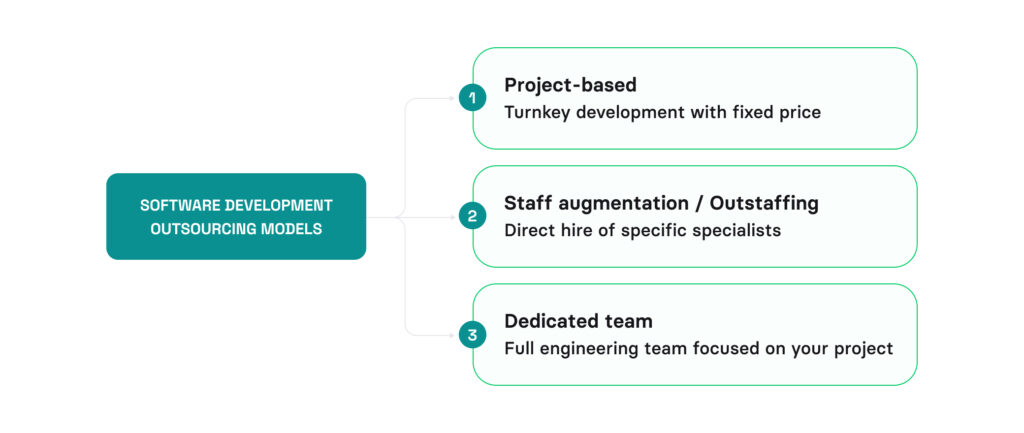
- Project-based outsourcing. You hand over the entire project to a team that provides turnkey development. These are usually fixed-price projects that depend upon clear documentation and requirements before starting.
- Staff augmentation / Outstaffing. You add individual specialists to your team and manage them directly. They work inside your processes and follow your daily guidance, while the contractor only handles HR and legal formalities.
- Dedicated team. You bring in a self-contained team that works only on your product. It integrates into your workflows, but management is shared. You set priorities and direction, while the contractor ensures day-to-day coordination and stable delivery
Why and when companies prefer software outsourcing models
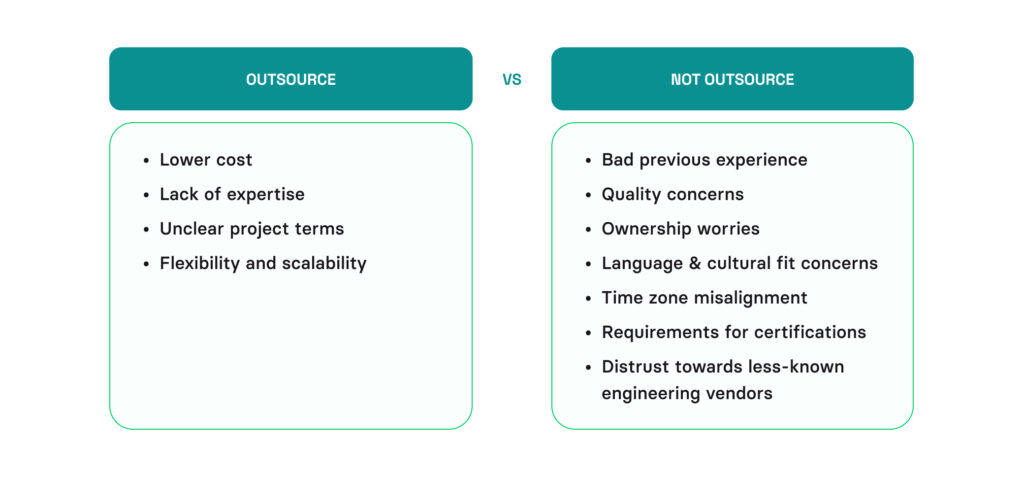
The reasons why startups outsource are clear. They are usually founded by solo entrepreneurs or friends who need people for quick growth. MVP development outsourcing is the most common among startups. It’s a logical step due to the limited budget and the lack of expertise for end-to-end product development.
But why do companies with good revenue and stable customers choose a standard or hybrid model in software outsourcing? There are the main drivers I’ve heard:
Lower cost of software development outsourcing
And it’s not about the hourly rate. It’s about the long-run difference. If you hire someone for three months, the difference may be less tangible. But if we are talking about annual budgets, optimization becomes more important. “Should I hire 2-3 local developers or 5-6 remote engineers with the same level of skills?” The difference will be visible in your annual results.
Lack of expertise
If your company doesn’t have experience in a specific area, building that expertise from scratch takes a lot of time and is not always smooth. The real question is, will you need the same expertise in 1-2-3 years? That’s the reason why Rand McNally collaborated with our team. They didn’t have in-house mobile development expertise and saw no need to grow it internally. Our mobile developers assisted them in developing the mobile components of the fleet-tracking project and implementing the necessary functionality on demand.
Unclear project terms
For a project that lasts 3-6 months or an MVP with a vague future, there is no point in hiring people in-house and promising them something. If things don’t work out, you will need to fire them, and nobody likes it.
Flexibility of changing a remote team’s size
The software outsourcing business model allows companies to scale up and down quickly. In one of our projects, the client had a backlog of 2-3 years and sought external help to speed up development. We scaled the team by adding 8 engineers and completed 80% of the backlog in a year. Then we returned to the original team size and continued working on the project, saving the client lots of time.
Why not? What causes hesitance to outsource
The decision to outsource rarely feels straightforward. Even if the model makes strategic sense, many companies hesitate because of risks, real or perceived, that can derail a project. Here are the concerns I’ve heard the most often when talking to engineering leaders:
Bad previous experience
Finding a reliable outsourcing partner is not always easy. The typical story is hiring a random vendor for an MVP. They worked on something for 6 months only to deliver a product with a bunch of bugs, which is easier to redevelop than to fix. Money and, what’s worse, time is lost.
Quality concerns
Many people think that only engineers physically present in the office can do something properly. They believe you must always keep an eye on employees to make them work. Such business owners are often afraid that a remote team will cut testing, choose easier solutions rather than optimal ones, and write code just for show.
Ownership worries
Companies are concerned about maintaining control over their projects and intellectual property. These usually sound like what if the vendor disappears? Or steals the code? Clients may fear vendor lock-in. What if only the contractor has access to servers, repositories, and databases and abuses it?
Language & cultural fit concerns
The success of the software outsourcing business model heavily depends on soft skills. People always work with people, and the outcome builds upon how well they get along and understand each other.
Time zone misalignment
Some business owners want everyone to work in the same time zone. They worry that a simple question that takes 5 minutes will require hours, slowing down work.
Requirements for certifications
Projects in regulated industries often require vendors to hold specific certifications, such as ISO 27001 and ISO 9001. Not every software development vendor has them, which complicates potential cooperation.
The “Nobody got fired for buying IBM” logic
This reason for avoiding using software development outsourcing models is less apparent, yet I encounter surprisingly often. Imagine you are a project manager in a company with 500+ people and substantial budgets. It only has web developers, and you’re tasked with finding a team for mobile app development. Since a PM is the one who has to hire and work with engineers, and they are responsible for the results that directly affect their career, they go to a very well-known, expensive local company as a safe bet. Is it a rational decision? For them, yes. Could they do it three times cheaper and with better quality? Also yes.
My experience in making different software development outsourcing models work
Hesitation around outsourcing is natural – unfamiliar models always raise questions. But what really matters is how well the process is structured. I’ve seen cases when the lack of coordination or mismanagement severely undermined a remote team’s performance. The actual result was 30–50% worse than it could have been.
That’s why to make outsourcing models work, you should find someone who knows how to do it. Below, I am sharing my personal experience and fundamental practices that apply to any outsourcing model, as well as recommendations tailored to each engagement type.
General advice for all software outsourcing models
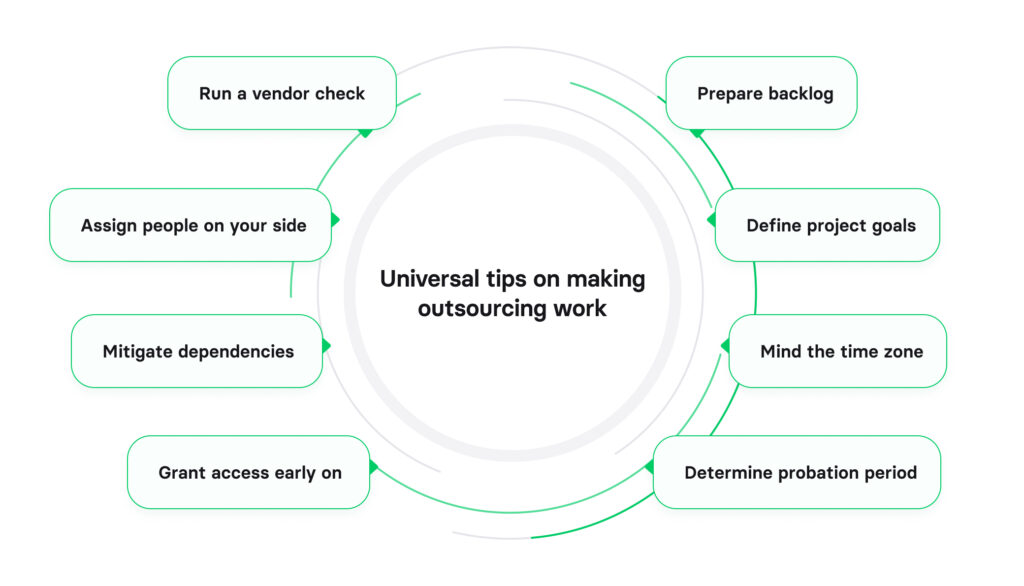
- Run a careful vendor check. Check everything you can, including reviews, certifications, and the authenticity of projects in the portfolio. Ask for the contact information of previous clients and gather feedback. Talk to each vendor and see how they communicate. At this stage, you can already sieve out many candidates and focus only on those with verified credibility.
- Assign responsible people within your company. Who prioritizes tasks? Who approves results? Who is the sole product owner on the client’s side? Unspecified roles are a particularly noticeable issue in larger companies, where 5-10 people are involved in a project and each has ideas, sometimes even contradicting one another. In such cases, communication takes a lot of time and negatively affects productivity. If there are several people responsible, no one is.
- Mitigate dependencies. Identify all possible dependencies and minimize their potential impact. Suppose you hire an engineering vendor to develop a mobile app while you cover design and backend development. It means they depend on you, so you should always be 1-2 sprints ahead to prevent blocking the progress.
- Make sure you can grant the necessary access. It’s a big issue in large companies with complex internal structures. Sometimes, we wait weeks to obtain the necessary access due to security precautions and human factors. This burns the budget.
- Mind the gap between a rough idea in the backlog and the actual task. It often happens that a company has many ideas in its backlog and hires developers only to find that these ideas are raw and require additional refinement, design, and documentation. When it happens, a project manager faces a difficult choice: either accept that developers will do nothing and wait for clarifications, or rely on unpolished requirements, which often causes trouble later. That’s why we recommend using business analysis services to finalize the product concept and get ready for development.
- Define clear project goals. Know why you hire engineers and what tasks you plan to assign them. This problem often happens with the dedicated team model when the backlog is huge, but no one knows where to start. It wastes time, slows down the process, and disrupts cooperation between developers. When there is a clear goal, your “north star”, choosing the right path becomes much easier.
- Mind the time zone. Make sure you have at least 2-3 work hours daily overlapping with your remote team.
- Determine the probation period and KPIs. Decide how long you will test the vendor and specify the results you expect. It’s hard to make decisions without a clear evaluation of what has been achieved/not achieved. Many engineering vendors offer a probation period, allowing clients to see how they work before a long-term commitment.
Outstaffing model recommendations
Staff augmentation (or outstaffing) is one of the software development outsourcing models that requires close management. It means you should carefully plan who coordinates cooperation with remote specialists, and here’s what I would recommend:
- Have a team lead for remote employees. They should run interviews to decide who joins the team, control the quality, and guide everyone. If you have an experienced team lead and just need more hands to complete the project, even hiring mid-level specialists brings decent results.
- Assign or hire a project manager. You need someone to plan tasks, track progress, manage risks, and remove blockers that slow down the work. Don’t make the team lead do this. You will get a bad PM instead of a good lead.
- Provide feedback on each remote hire. We at Volpis gather CSAT scores for every specialist hired through the outstaffing model. It helps us quickly respond to issues and improve service quality. If your vendor doesn’t ask you about feedback, take the initiative and let them know about any concerns. There is no point in hiding the problems. It won’t fix them.
Dedicated team insights (my favorite one)
I personally prefer this one over other software development outsourcing models. It’s a perfect balance of control and autonomy. Let me show how it works with our projects.
Volpis received the following request: “We have a backlog for 2-3 years and need an independent team to speed up the work. We have a budget for +5 developers for a year. The remote engineers must be quite autonomous, as we cannot devote much time to managing them. What can you offer?”
How we started:
- Client’s side: the Product Owner.
- Our side: a BA to gather and formulate the requirements and a PM to organize the work.
Our plan was as follows:
- The PO and BA analyze the backlog, describe and approve the requirements, create the design, and only then the engineering team proceed with development. They always stay 1-2 sprints ahead to prevent delays and bottlenecks.
- The engineering team starts with the clarified and approved requirements and product design.
- Every two weeks, the PM and engineering team present the sprint results to keep everyone on the same page.
Such an approach ensures clients spend minimal time managing the dedicated team and receive high-quality results meeting their expectations.
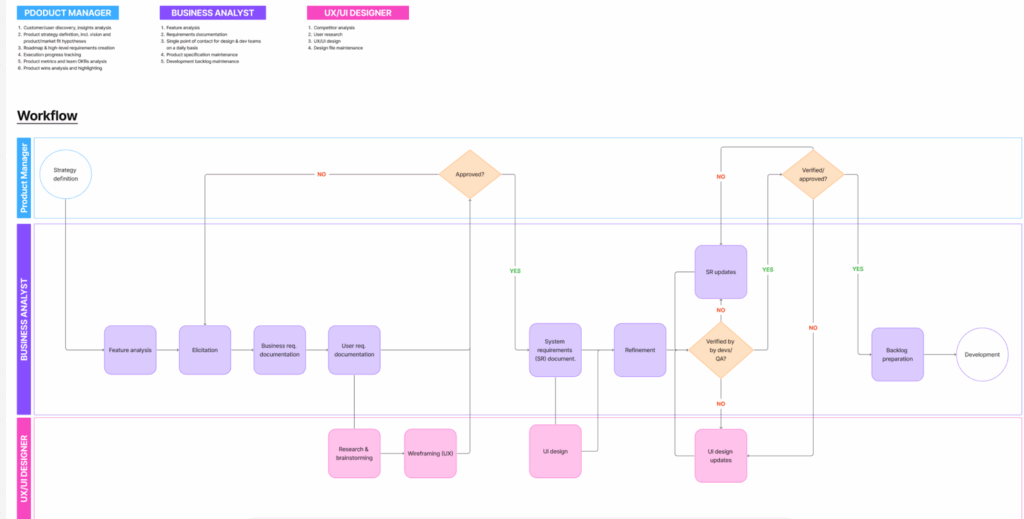
If I were to give one advice on how to use the dedicated team model, I would say you should engage a business analyst at the early stages of task preparation. Business analysis considerably boosts product delivery. One day of planning saves a week of inadequate implementation.
Here is how a BA works in the dedicated team model:
Project-based outsourcing model
This approach works well for short-term, fixed-price projects. Even though this model seems attractive at first sight, it often causes many issues down the road. Here’s what we recommend for minimizing risks in such projects:
- Invest in the discovery phase services. You can’t expect a fixed price for an unfixed scope of work. Discovery helps break the project into smaller blocks, describe the functionality, and create designs. It allows the vendor to estimate the scope and budget. Unfortunately, what you find obvious is not always obvious to others and requires clarification.
- Clarify the definition of done. Agree on what it means that a project or task is completed (acceptance criteria) from the start. You should specify both functional (e.g., passes 20 test cases) and non-functional requirements (e.g., the list takes less than 2 seconds to load). Otherwise, you are very likely to have lots of arguments and severe miscommunication.
- Break projects into milestones. Don’t do one big scope for six months. A small bite at a time. Each stage must have a clear goal and a separate cost estimate. It makes the process more transparent and prevents situations where you risk an entire budget.
- Talk through the change management process right away. Changes are inevitable in every product development project, so it’s better to know how to manage them beforehand.
- Discuss the next steps after the release. Is there any guarantee period for fixes? How fast will the team fix bugs? What if you decide to add a new feature 3 months after the release? These issues are common, and you’d better know how the engineering vendor approaches them in advance.
I hope these insights will help you outsource more effectively. Whichever software development outsourcing model you choose, be sure to find a good vendor and prepare for software development through careful planning and discovery.
After all these years in software engineering, I’ve come to understand a key thing. The success of outsourcing is not about contracts or geography. It’s about people, mutual trust, openness, and the desire to do quality work. When all these factors come together, you have a reliable partner who cares about the result as much as you do.
If you are looking for an engineering vendor, reach out to our team at info@volpis.com or message me directly on LinkedIn. We offer end-to-end engineering support, from discovery to post-release maintenance.
Questions & Answers
FAQ
How do AI coding tools (Copilot, Cursor, Claude) change the economics of outsourcing?
AI compresses the junior–senior gap and flattens geographic arbitrage. Expect 20–35% productivity lift on senior-heavy teams, less on junior-heavy ones. Leading vendors now price in “AI-augmented” output rather than bodies. Ask how your vendor measures AI-assisted throughput, and insist on clean IP and data handling for any model context shared.
What must be in the MSA and SOW to actually protect IP and avoid vendor lock-in?
MSA essentials: present assignment of IP (not a promise to assign), work-for-hire language under US law, source-code escrow for turnkey work, named-developer NDA riders, non-solicit with carve-outs, and a documented off-boarding SLA.
SOW: acceptance criteria, change control, and indemnity caps tied to fees; never sign unlimited liability.
How do you exit a bad outsourcing relationship without losing the product?
Before giving notice: make sure every credential, repo, cloud account, and third-party integration is under your organisation, not the vendor’s. Run a 2-week knowledge-transfer sprint with recorded walkthroughs per module. Retain 1–2 key engineers on short contracts for 30–60 days post-exit. Budget 10–20% of annual spend as switching cost.
Should early-stage founders ever outsource the core product, or only non-core work?
Outsource core only when the founding team lacks the technical chops and needs to ship in under 6 months — and only via a dedicated team with an embedded product owner and a clear plan to hire a full-time CTO before Series A. Outsourcing the core without a technical founder-in-residence is the single most common cause of unmaintainable Series A codebases.