
- eFTI is Regulation (EU) 2020/1056. From July 9, 2027, authorities in every Member State must accept freight information sent through a certified eFTI platform.
- It’s mandatory for authorities and voluntary for businesses. There’s no fine for staying on paper, and under Article 16 that holds at least until the Commission’s 2029 review.
- It covers road, rail, inland waterway, and air transport.
- No platform is certified yet, because the certification rules aren’t final. The data model is in force and stable enough to map against. Plan for amendments.
- Your TMS doesn’t need certification. But a platform can only onboard it with eID at eIDAS level substantial, an authorisation registry, and mapped output.
Put July 9, 2027 in your roadmap. From that day, every enforcement authority in the EU has to accept freight transport information in digital form. An inspector can’t refuse data made available through a certified platform.
That’s usually read as a carrier problem. It isn’t one. eFTI puts no obligation on businesses, and there’s no penalty for staying on paper. The obligation sits with the state. For operators and vendors, the question is whether your systems can produce the data in the format the regulation defines.
We build logistics and transport software, so this is written from that side of the problem. Everything below comes from the regulation and the acts under it. Where something is still open, we say so instead of guessing.
What eFTI regulation is and what it changes
eFTI stands for electronic Freight Transport Information. Regulation (EU) 2020/1056, adopted in July 2020, sets one EU-wide framework for giving regulatory freight information to authorities electronically.
The gap eFTI closes is narrow: authorities were never obliged to accept them. Companies that had digitized everything internally still printed paper in case of an inspection. From July 9, 2027, a submission through a certified platform carries the same legal weight, in every Member State.
According to the European Commission, the regulation covers road, rail, inland waterway, and air transport. Maritime sits outside it, under the European Maritime Single Window environment. If you also operate in the US, our fleet compliance guide for DOT and FMCSA covers that side.
Nothing forces your business to submit digitally, and there is no fine for staying on paper. Under Article 16, the Commission has to assess by February 21, 2029 whether to extend the obligation to operators. Until then, the pressure to move is commercial rather than legal.
What’s the difference between eFTI and eCMR?
Vendors blur these two constantly. They aren’t the same kind of law. The CMR Convention is international law, but what it governs is the private contract between the parties to a shipment. eCMR makes that consignment note valid in electronic form.
eFTI is public, administrative EU law. It doesn’t govern the contract between shipper and carrier. It obliges authorities to accept regulatory data electronically. You can hold a valid eCMR and still meet an inspector who isn’t required to take it.
Eight Member States put a number on it in a 2021 position paper to the Council. Almost 99% of cross-border transport operations in the EU still involve a paper CMR at some stage. The eCMR protocol dates from 2008, and adoption is still low.
How eFTI works, and what moves between which systems
The regulation reads like law, but what it describes is a data pipeline. The diagram below shows what moves where, and which parts need certification.
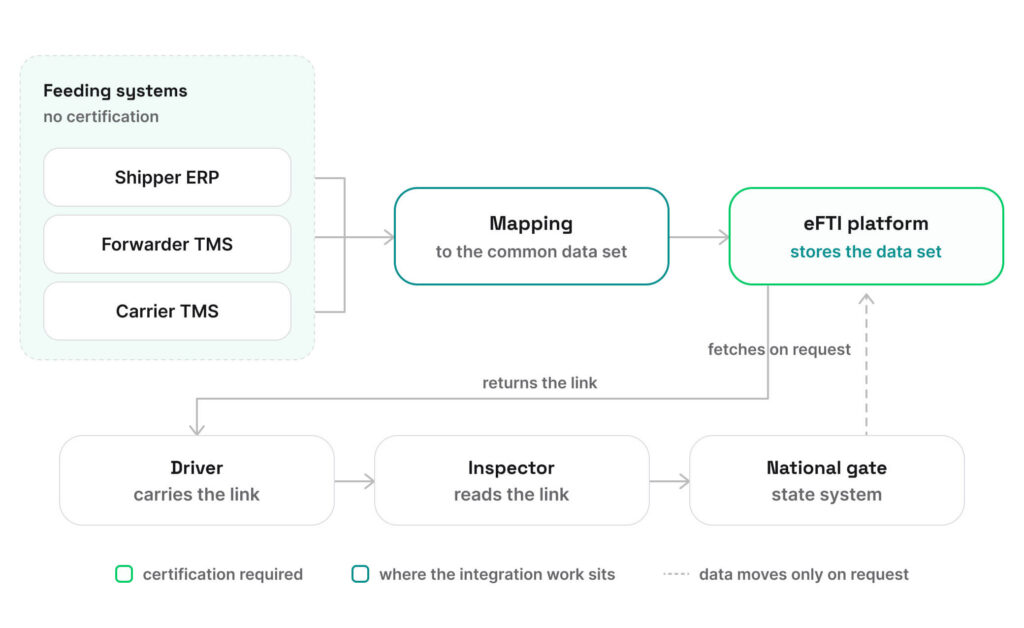
Three points in that picture do most of the explaining.
The platform holds the data, and the driver carries a link. The certified platform holds the eFTI data set. An authority receives only the subset it’s authorized for, and only when it asks. The platform issues a Unique Identifier Link and returns it. The driver carries that link and, on request, shows a human-readable copy on a company device.
The state talks to the platform machine to machine. An inspector never logs into your platform. They query their own national gate. The gate uses the identifier to find the right platform, even one in another country. It then pulls the data over a secure channel. Implementing Regulation (EU) 2025/2243 says this happens solely by machine-to-machine communication.
The common data set is the hard part. Everything turns on the eFTI common data set, fixed in Delegated Regulation (EU) 2024/2024. It isn’t a flat list of fields. It’s a hierarchical model built on the UN/CEFACT reference data model. Your data already exists, just in the wrong shape. An address sits on one line where the model wants five elements. A weight reads “12500 kg” as text where the model wants a number plus a unit code. Some fields aren’t captured anywhere yet.
The eFTI implementation timeline, and what’s still open
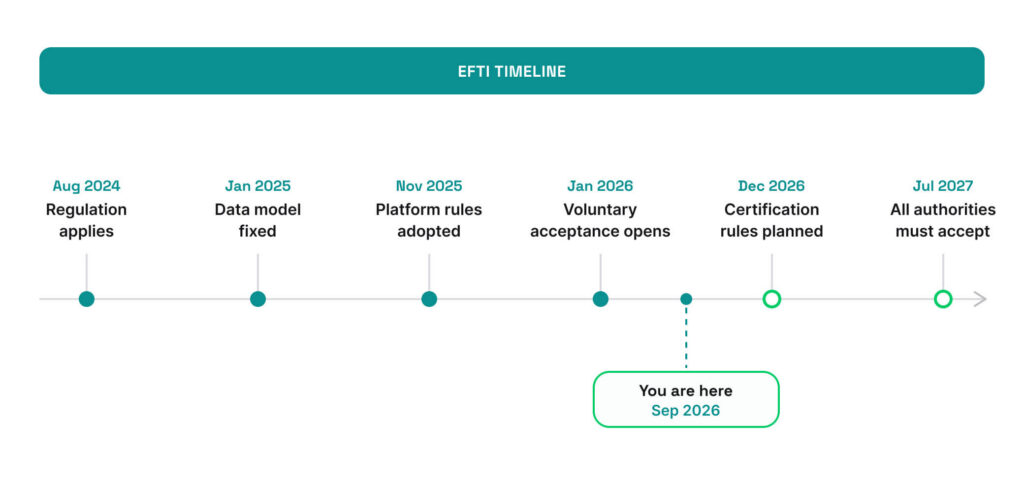
The regulation has applied in general since August 21, 2024, but it lands in stages. July 9, 2027 isn’t written in the regulation itself. Article 5 sets the obligation at 30 months after the first implementing and delegated acts entered into force. That happened on January 9, 2025. The Commission now publishes the date directly, and it’s anchored to acts already in force.
| When | What happens | What it means for you |
|---|---|---|
August 21, 2024 | The regulation enters general application | The framework is live, and the clock starts |
January 9, 2025 | The common data set and access-procedure acts enter into force | The data model you map to is now fixed |
November 2025 | Functional requirements for platforms adopted (Impl. Reg. 2025/2243) | Platform behavior is now defined |
By December 2026By December 2026 | The Commission plans to adopt the remaining specs and the certification rules | The platform can finally become certified |
July 9, 2027 | Every authority must accept eFTI submissions | The acceptance obligation is live in all 27 Member States |
The EU AI Act rolls out the same way, and its high-risk deadlines for fleet AI moved to December 2027.
Two things are still open. Neither blocks the mapping work.
Certification rules aren’t final. Until the Commission adopts them, no platform can be certified and no vendor can honestly claim an eFTI certificate. If one claims otherwise, the fair question is which body issued it, and under what number.
The signature bar is lower than the marketing suggests. eFTI doesn’t require qualified signatures. The consignor, carrier, and consignee each sign separately, with at least an advanced electronic signature or seal under eIDAS. If your TMS signs once per document, that’s a data model change.
The data model is in force and stable enough to map against. The Commission can still amend it, so version your mapping layer from day one.
What you build, and what you buy
The regulation names two roles that must be certified. One is the eFTI platform, the system that stores the data and serves it to the gate. The other is the eFTI service provider, the company that operates a platform under contract. It also names a third kind of system that needs no certification at all. That’s the tributary system: the TMS, ERP, or telematics that feeds data to a platform.
You don’t build or certify a platform. The work is connecting the systems you already run to a certified one. Structured data reaches it without anyone retyping. No box ships that connection, because every company’s data landscape is different.
These are two layers of one stack, and the useful question is who provides each.
| Layer | What it does | Certification | How you get it |
|---|---|---|---|
Certified eFTI platform | Stores the data set and answers the gate | Required | Partner with a provider. Platforms compete on price, so this is close to a commodity |
The connection to it | Maps your systems into the common data set and publishes | Not required | Build it, custom to your stack. The mapping and validation logic is where the cost sits |
Partner for the certified platform, and build the layer that feeds it. That layer is reusable: the mapping and validation logic carries across every system running on the same underlying software. The same structured data is what AI and machine learning in fleet management need to work.
We’ve done the equivalent work before. Our Kotlin Multiplatform work on TransFollow Drive is a digital consignment note app. The same mapping problem sits underneath it. If you haven’t mapped your data model yet, start with business analysis.
Start with an eFTI readiness assessment
Before any build, a short, fixed-scope assessment maps your TMS, ERP, or telematics against the eFTI common data set. It flags the fields you’re missing, including anything your telematics never captured. You get a scoped plan and a cost estimate for being ready before July 9, 2027.
Volpis is a software development company with 10 years of experience building custom telematics, tracking, and logistics systems for operators and software vendors across Europe and the United States. My team has shipped 15+ transport and fleet projects, including navigation platforms for Rand McNally and NFC-based tracking tools in active commercial operation.
Questions & Answers
FAQ
Is eFTI mandatory for my business?
No. eFTI obliges authorities in every EU Member State to accept freight information submitted digitally through a certified platform. It puts no obligation on operators and sets no fine for staying on paper. Under Article 16, the Commission has to assess by February 21, 2029, whether to make it mandatory for operators.
Does any eFTI obligation apply before July 2027?
No. But if you move waste, a separate regulation takes effect sooner. Regulation (EU) 2024/1157 requires electronic submission from May 21, 2026. Annex VII shipments get a transition to December 31, 2026. eFTI’s scope references that regulation, so the two meet in 2027.
What’s the difference between eFTI and eCMR?
eCMR is the electronic consignment note under the CMR Convention, which governs the private contract between the parties. eFTI is public EU law that obliges authorities to accept freight data electronically. You can hold a valid eCMR and still be asked for paper, and eFTI is what removes that.
What is an eFTI data subset?
A subset is a named slice of the common data set, identified by a code such as EU01. It isn’t a convenience bundle. It’s an access boundary: an authority authorized for a subset receives exactly those elements and nothing beyond them. Design your access model around subsets, not around filtering after the fact.
What is the UIL?
The Unique Identifier Link is the reference that a certified platform issues for a data set. The driver carries the link rather than the documents. An authority uses it through the national gate to locate the right platform and request the data.
Does my TMS or ERP need to be certified?
No. Certification applies only to eFTI platforms and eFTI service providers. Your TMS is a tributary system. But under Article 4(5) of Impl. Reg. 2025/2243, a platform can only onboard it once identification, authentication, and authorisation are in place.
Do we need to build our own eFTI platform?
Usually not. For most companies, the task is connecting existing systems to a certified platform. Operating one makes sense for a TMS or forwarder platform vendor serving many customers. It means carrying certification and reassessment as an ongoing cost.