About the client
Meet our client,
Purple
Purple is a UK-based company founded in 2012 with a focus on guest, staff, and multi-tenant WiFi solutions. Purple has since aimed at expansion with indoor wayfinding, location analytics, and visitor engagement.
Today, Purple partners with global retail, hospitality, healthcare, and transportation brands, including McDonald’s, Walmart Canada, and Michael Kors.

Industry
Digital connectivity

Location
based in the UK
13+
years on the market
89
countries served
PROJECT GOAL
Goal of the project
Indoor navigation is its own technical category: GPS doesn’t work reliably indoors – walls block satellite signals, and the meter-level precision needed to navigate between rooms is well beyond what satellite positioning delivers.
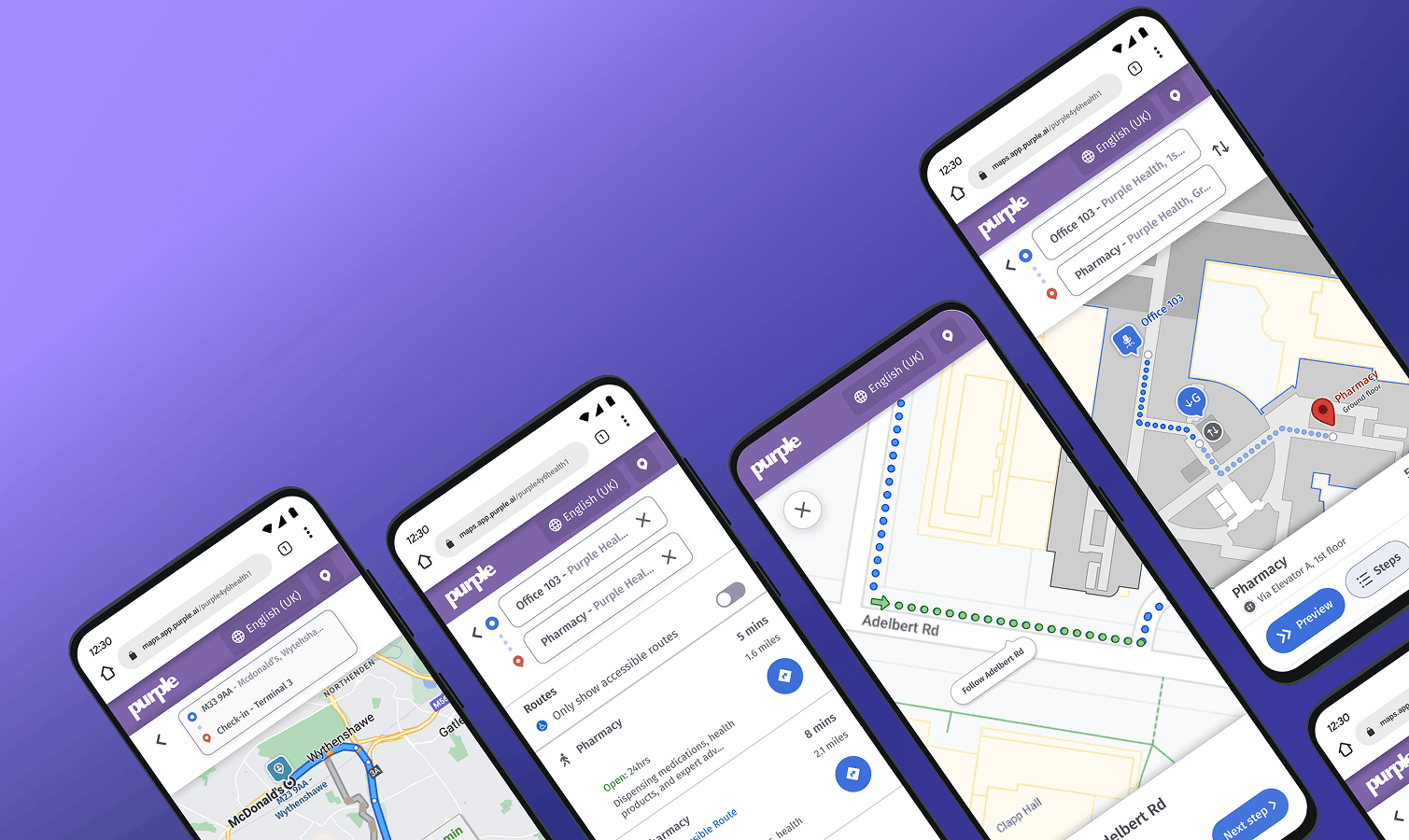
Purple already had a mature web-based wayfinding solution but needed a modern native mobile experience to match it. They partnered with Volpis to build the iOS and Android apps from scratch, with a focus on delivering reliable real-time blue-dot navigation across complex venues.
The initial vision was a white-label SDK that Purple’s clients and partners could embed into their own apps. Over time, that scope evolved into a single, polished consumer-facing app.

CHALLENGES AND SOLUTIONS
Challenges we faced
Compensating for the inherent variability of beacon-based positioning.Indoor positioning relies on Bluetooth beacons whose signals are affected by walls and building materials. Without correction, the blue dot drifts off the true path or drops entirely during floor transitions.
We built a custom navigation layer on top of the IndoorAtlas SDK to correct for signal drift, including snap-to-route logic, snap-to-corner handling, and dynamic location-manager switching across floors. The result: a stable blue dot in the conditions real venues actually present.
Core navigation could not be tested locally. Indoor positioning depends entirely on physical beacon infrastructure installed at the customer’s premises, which meant the central feature of the app, wayfinding, could not be simulated on a developer’s desk.
We set up a remote-testing loop with Purple and their customers, where on-site testers recorded screen sessions and shared logs after each cycle. Our team triangulated each issue against the recordings to determine whether the root cause was beacon setup or app code, then iterated fixes between cycles.
High-resolution floor plans crushed map performance. Floor plan images were initially rendered on the device as full static images rather than as map tiles, which became increasingly demanding as venue size grew.
We moved tile generation from the mobile client to the backend. Map load time improved by more than 10x, and performance remained stable on venues with dozens of floors.
IMPLEMENTATION ROADMAP
Our collaboration journey
Purple Wayfinding moved through several distinct stages – from a focused proof of concept to a multi-year dedicated team partnership. Each phase had a clear delivery scope, and feedback from earlier stages shaped what came next.

Phase 0
Proof of Concept (PoC)
The project began with a six-week proof of concept aimed at validating the technical foundation for a white-label indoor wayfinding SDK on iOS and Android. The team delivered a working map interface with offline support, location search, and route building and preview, all backed by Purple’s shared Rust routing library.

Phase 1
MVP: Turn-by-Turn Navigation
With the foundation validated, the next phase introduced full turn-by-turn navigation. We enabled accurate blue-dot positioning indoors, implemented real-time location tracking, and adapted the search interface so users could build routes starting from “Your location.” This was the first version of the app where end users could navigate from where they were standing to where they wanted to go.

Phase 2
Accessibility and Discovery
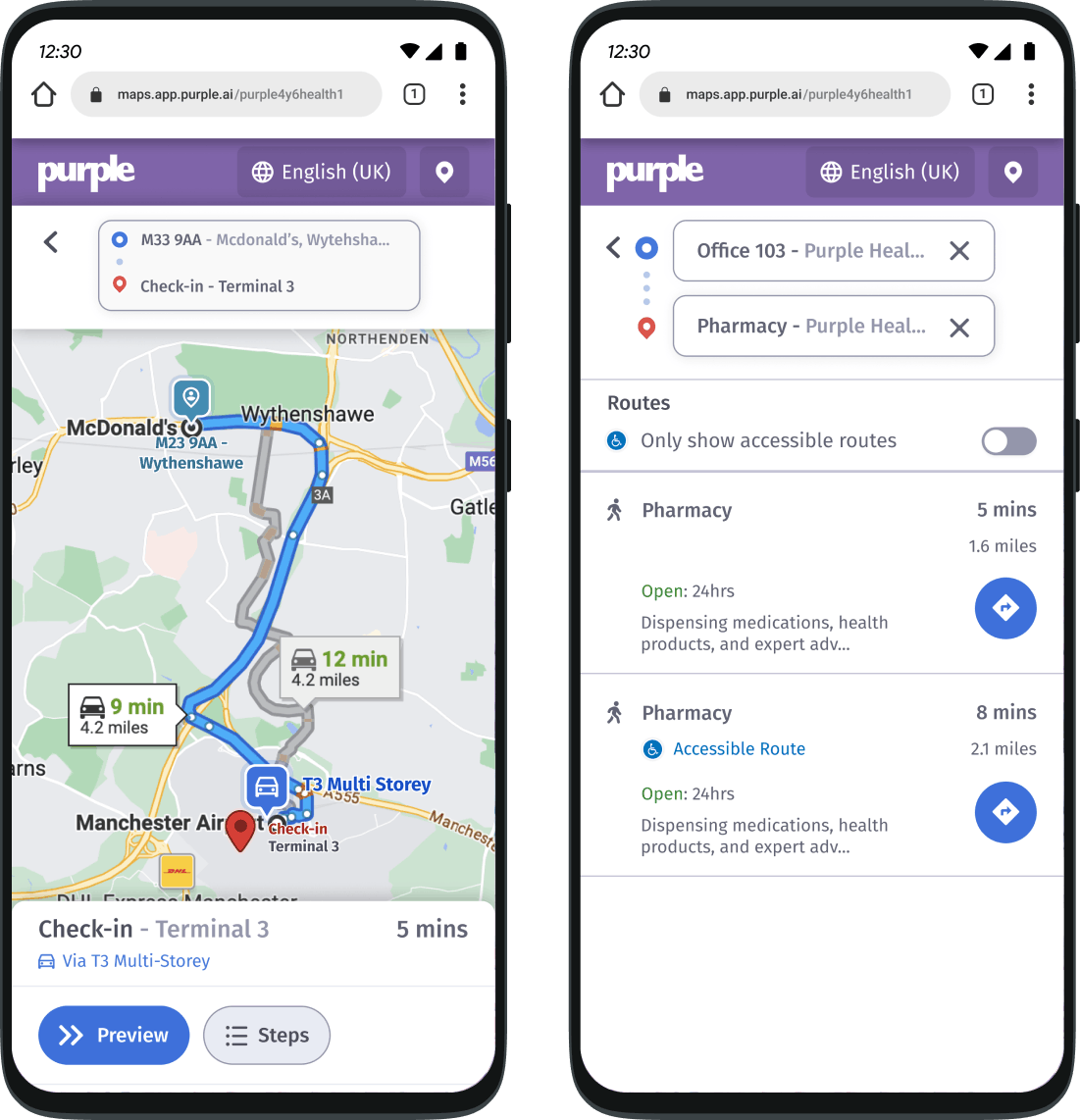
The third phase focused on inclusivity and on broadening how users could interact with their surroundings. The team implemented Accessible Routes for users with mobility constraints, added a Search Nearby feature for discovering points of interest from the user’s current location, and extended the navigation algorithm to support an additional indoor positioning approach.

Phase 3
Dedicated Team Partnership
After the MVP stabilized, the engagement shifted into a dedicated team model that ran for roughly a year. Purple took direct ownership of prioritization, while iOS, Android, and project management on our side operated as an extension of their internal product team.
WHAT WE DID
Services we provided
Purple Wayfinding was a focused mobile engagement: we owned iOS, Android, QA (through the early phases), and project management, while Purple’s internal teams handled product, design, and backend. The two sides operated as a single coordinated team across an 18-month collaboration.
SERVICES WE PROVIDED
Development
The development effort focused on delivering reliable indoor navigation under conditions that beacon-based positioning systems struggle to satisfy. The team took responsibility for both iOS and Android end-to-end, making architecture and engineering decisions in close coordination across platforms to keep behavior consistent for users.
What we did:

iOS App
We built a native iOS app focused on accurate blue-dot navigation across indoor and outdoor environments. Special attention went to the conditions indoor wayfinding actually faces, dropped signal in stairwells, multi-floor transitions, dead zones, and long-session battery use.

Android App
Our team built a native Android app with the same focus on reliable, accurate navigation as the iOS counterpart. Particular care went into map performance across large, multi-floor venues and into a clean, reusable architecture that could scale as the product evolved.
Technologies we used
We carefully selected the stack to deliver precise navigation in indoor environments full of obstacles.
-
 Swift
Swift
-
Swift UI
-
MVVM + Clean Architecture


-
Kotlin
-
 Jetpack Compose
-
MVVM + Clean Architecture
-
MVI


-
Google Maps

-
Realm

-
Swinject
-
Lottie
-
Sentry
-
SwiftGen
-
ZIPFoundation


SERVICES WE PROVIDED
Quality Assurance
QA was embedded in the project through the early phases – PoC, MVP, and feature expansion. The function evolved from sprint-by-sprint validation into structured regression suites and automated backend monitoring. When the engagement shifted to a dedicated team model, QA responsibility transitioned in-house at Purple as part of broader integration with their product team.
What we did:

Test planning & documentation
QA defined testing scope, priorities, and acceptance criteria for each sprint, ensuring full coverage of the core functionality, edge cases, and platform-specific behaviors. Detailed test cases established a shared quality baseline across iterations.

Functional and regression testing
Separate regression suites were maintained for iOS and Android so each platform could be exercised independently after each release candidate. Making regression time measurable and predictable directly improved how reliably the team could commit to release dates.

Automated validation
Beacon-dependent navigation was tested on-site at customer venues, with screen recordings and logs feeding back into the development loop. Automated test runs validated backend responses after every change and reported results into Slack, freeing manual time for deeper exploratory testing.
“I introduced automated test reporting into Slack, reducing repetitive manual reporting and improving visibility into QA runs for the entire team. The workflow later became a standard approach across multiple projects within the company.”

ABOUT THE PRODUCT
Purple Wayfinding turns large, confusing buildings into spaces people can navigate indoor with confidence 🏥 ✈️ 🗺️
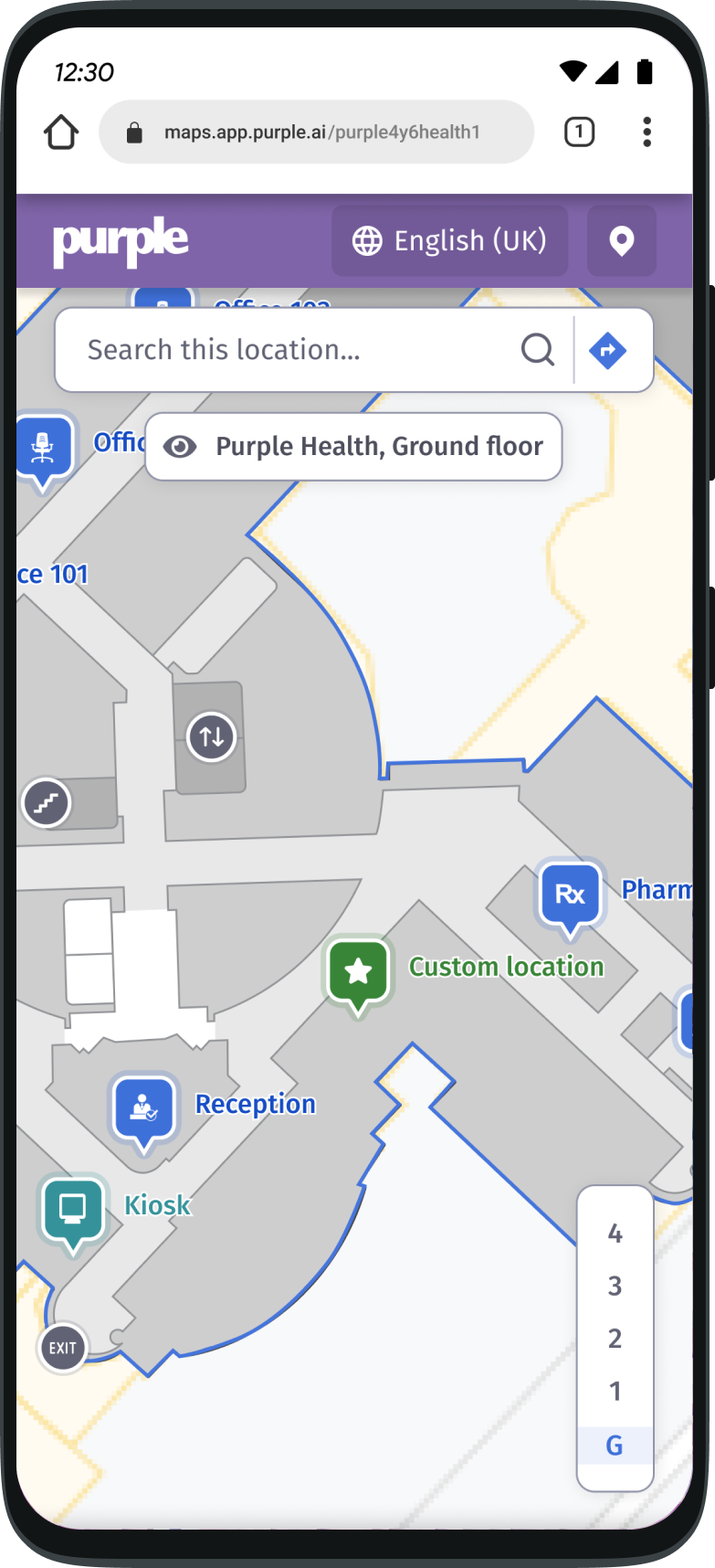
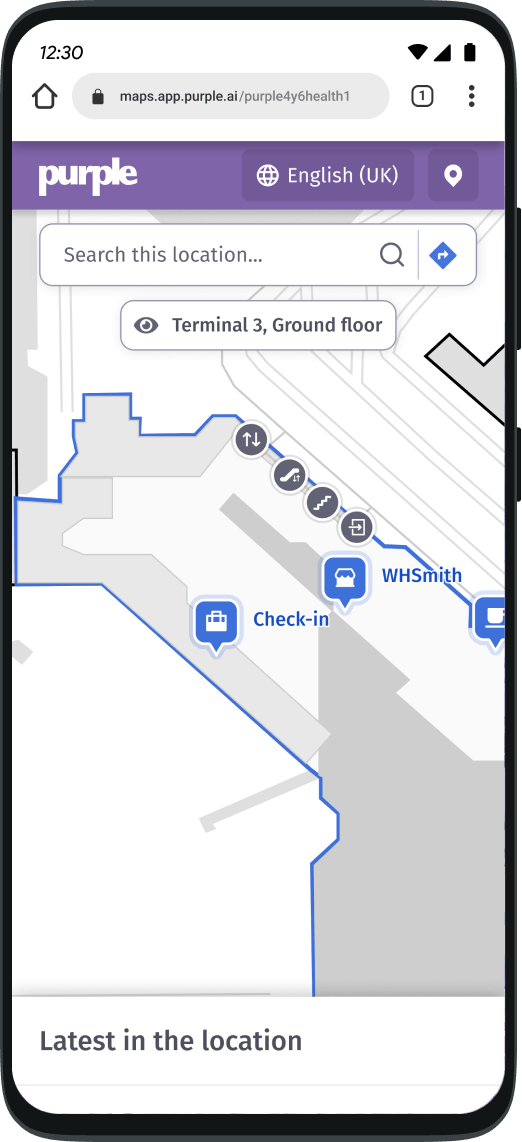
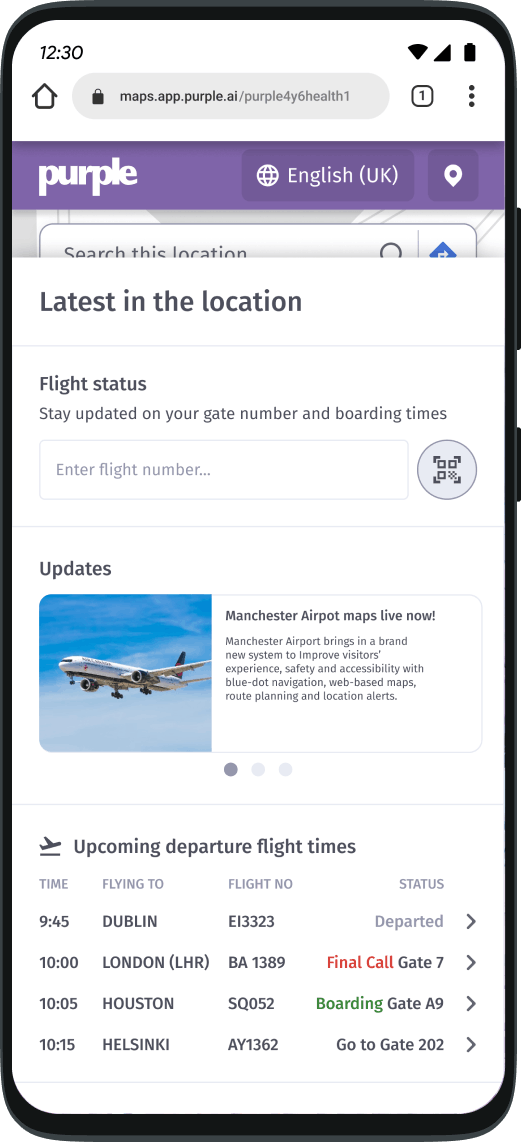
Designed for places where getting lost has real consequences: hospitals, airports, and large campuses. The app combines indoor positioning with custom-built map tiles for each venue. A blue dot follows users in real time, indoors and outdoors, automatically rerouting if they stray off path.


With Purple Wayfinding, users can:
- See their location indoors.
- Get turn-by-turn directions to any destination.
- See estimated time to arrival.
- Choose accessible routes optimized for wheelchairs.
- Discover nearby points of interest.

CORE FEATURES
Product Overview
Below are the core features our mobile team helped deliver for Purple Wayfinding.
01
Blue Dot navigation (indoors and outdoors)
Blue Dot navigation displays the user’s real-time position as a blue dot on a digital map. Indoors, the position is calculated using a hybrid of Bluetooth beacons, WiFi signals, and the device’s own geomagnetic sensors, which together deliver reliable positioning across multi-floor venues.
The blue dot continues to work offline and in building dead zones, so users stay oriented even when connectivity drops as they move through a venue.
02
Turn-by-turn directions with automatic rerouting
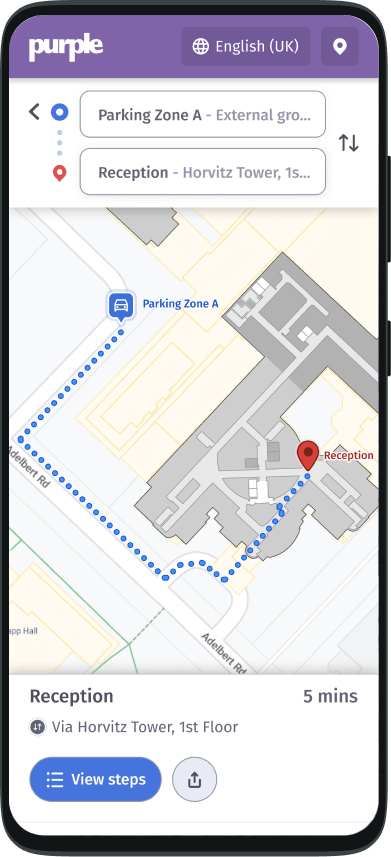
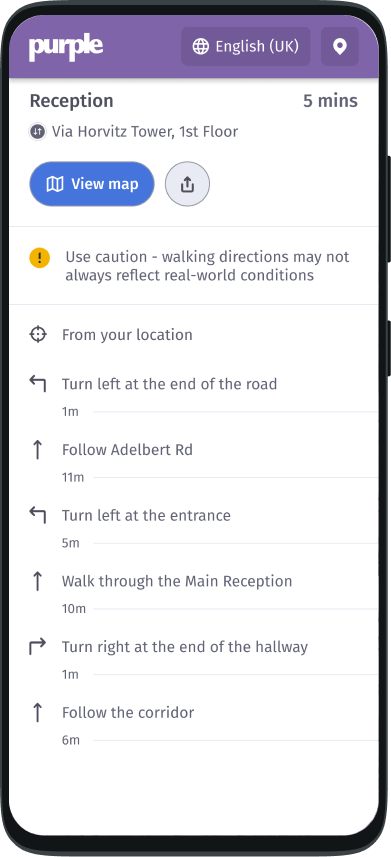
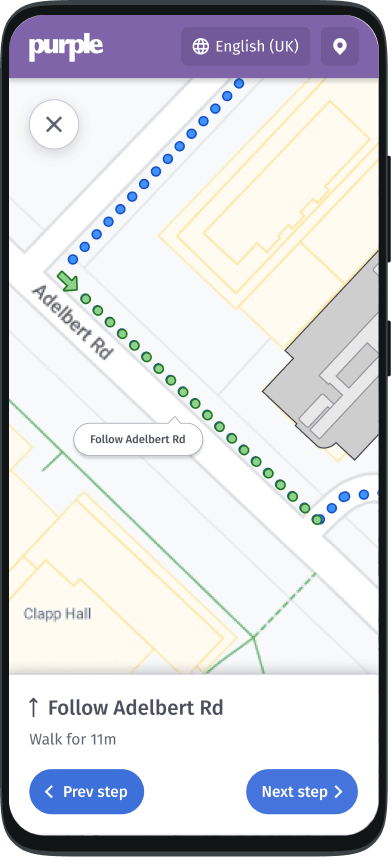
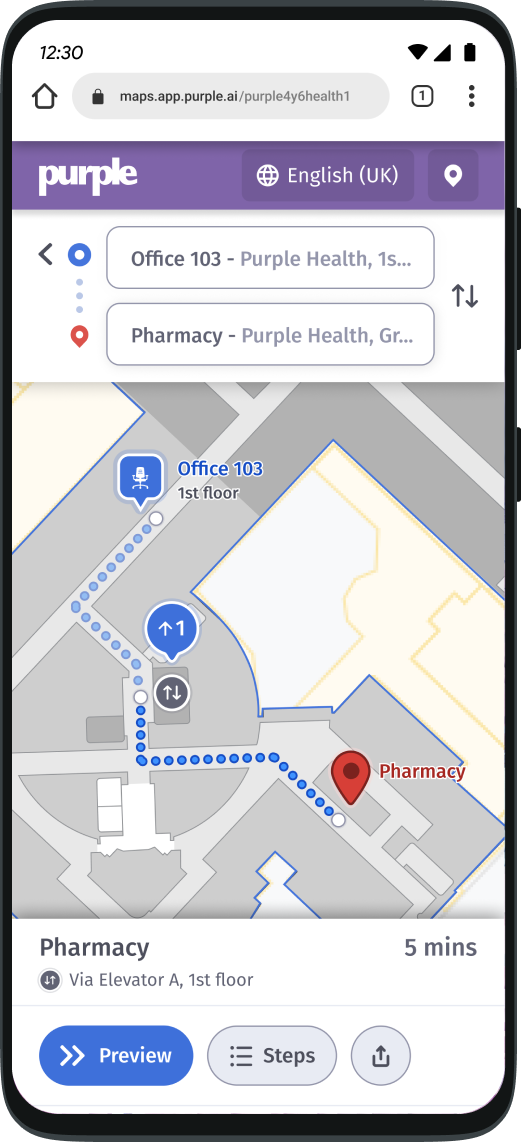
Once a destination is chosen, the app provides step-by-step real-time guidance, walking users along the route, prompting them at each turn, and updating remaining time and distance as they progress. If the user strays off path, the app reroutes automatically.
03
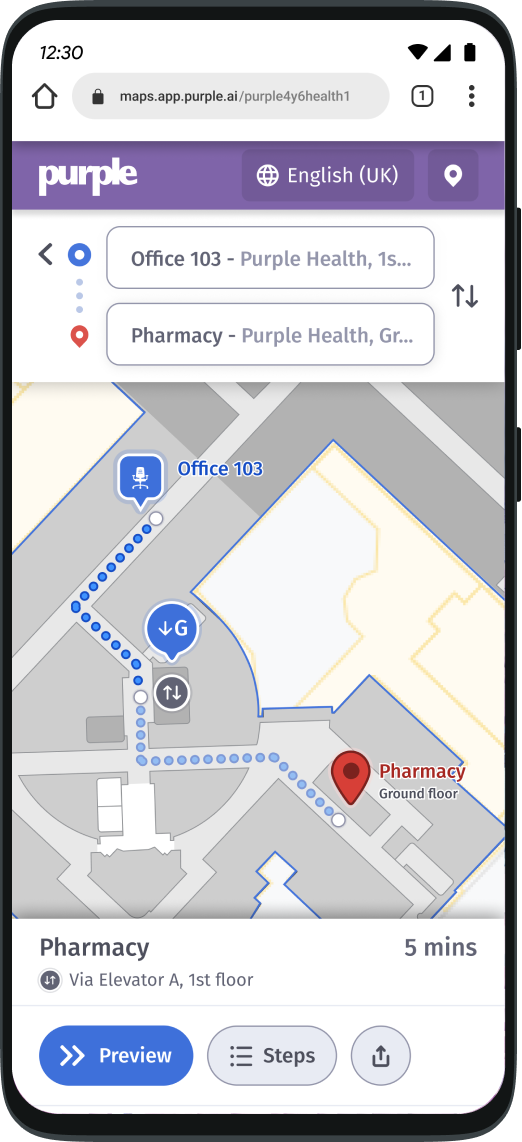
Route preview
Before starting, users can preview the full route from start to destination, including floor changes, elevators, and the corridor sequence along the way.
04
Estimated time
to arrival
ETA predicts when a user will reach their destination, accounting for total walking distance, including floor transitions and indoor corridor segments.
05
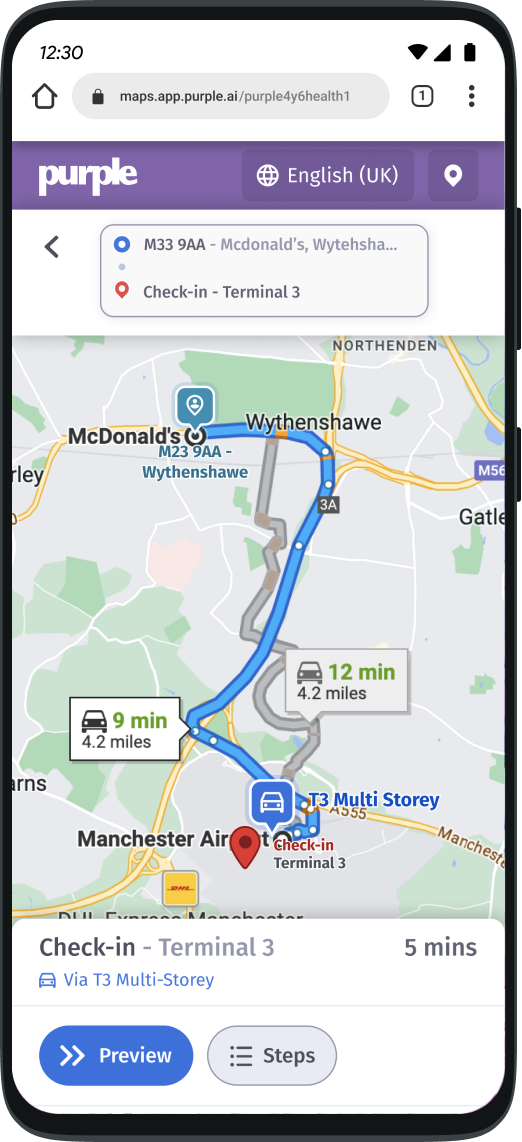
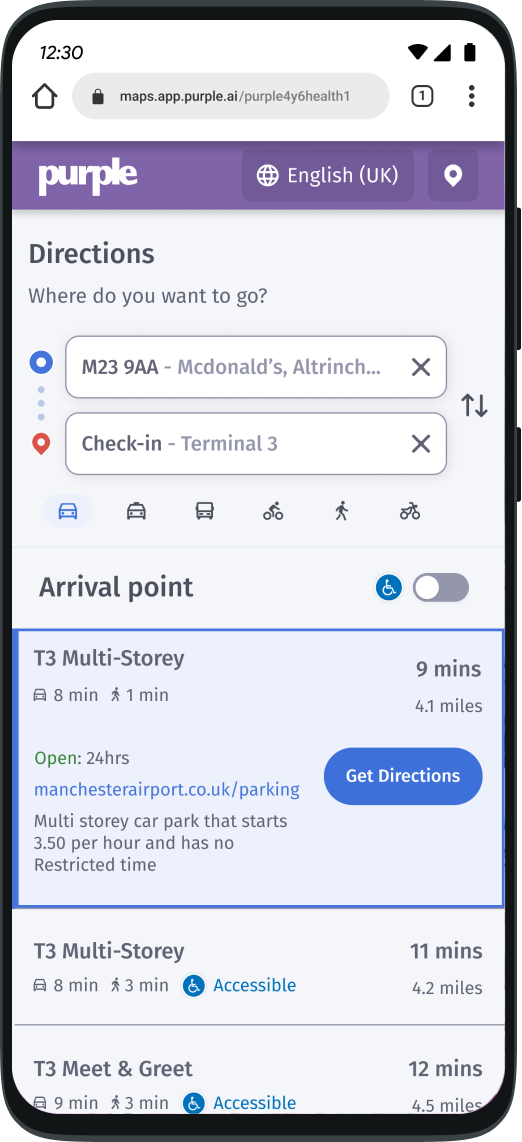
Off-site to on-site navigation
The app supports planning a trip to the venue before arriving. Arrival points can include extra context like opening hours, cost, descriptions, and website links, and the journey time accounts for the walk from the chosen entrance all the way to the final destination inside the building.
06
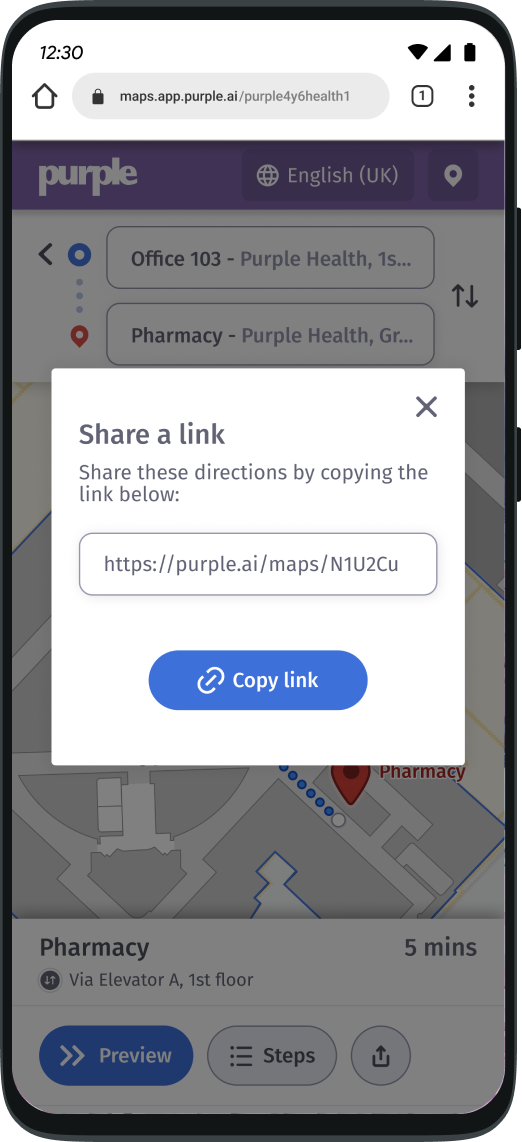
Route sharing
Users can share detailed directions to a specific point of interest with someone else.
07
Unlimited POIs
The app supports unlimited POIs per venue, with attributes and route weighting that can be configured through Purple’s central administration tool.

Client’s testimonial

Volpis delivered a solution that worked and could blue dot navigate around an indoor environment. Deliveries were on time and any delays were caused on our end for lack of services we needed to build, the project manager, UX designer and exec staff are all very responsive.
Contact us to build the right product with the right team

Top rated company since 2015

Top mobile app development 2018

Top B2B company 2019
Showcase
Similar projects
Rand One
FLEET MANAGEMENT
Purple ConneX
CONNECTIVITY
Trusty
FOOD & HOSPITALITY