

- Non-compliance with fleet regulations is costly; for example, a hazardous material violation that results in death or other critical outcomes can cost a fleet $238,809, according to 49 CFR § 107.329.
- Not all fines are that big, but a simple Electronic Logging Device (ELD) tampering can cost a company $15,846.
- Most of the rules and regulations applying to fleets in the USA are set by DOT and FMCSA, the primary legislative bodies in the logistics industry.
- The critical areas where compliance is necessary are hours of service (HOS), Compliance, Safety, Accountability (CSA) scores, and Driver-Vehicle Inspection Reports (DVIRs).
- Other aspects of trucking compliance include logging preventive maintenance checks, driver’s pre-employment background, ongoing drug and alcohol testing, driver qualification (DQ) files, cargo securement, weight and size limits, and insurance and licensing requirements.
- A fleet management system with automated ELD compliance functionality and features for recording, storing, formatting, and auditing fleet-related information can help companies ensure compliance.
A single hours-of-service violation can cost up to $19,246, according to 49 CFR Appendix B to Part 386. But hours-of-service is just one area where fleet managers need to stay sharp – plenty of other regulations and standards carry the same or even bigger risk of fines if left unchecked.
Navigating these rules is challenging but manageable, especially with software tools and practices in place that catch violations before they happen.
In this guide, I draw on 10+ years of experience delivering fleet management software to break down the fleet regulations you need to track in 2026. Here, I also provide practical insights on the tools and practices that keep your fleet compliant.
What is fleet compliance? Laws you need to know in the USA
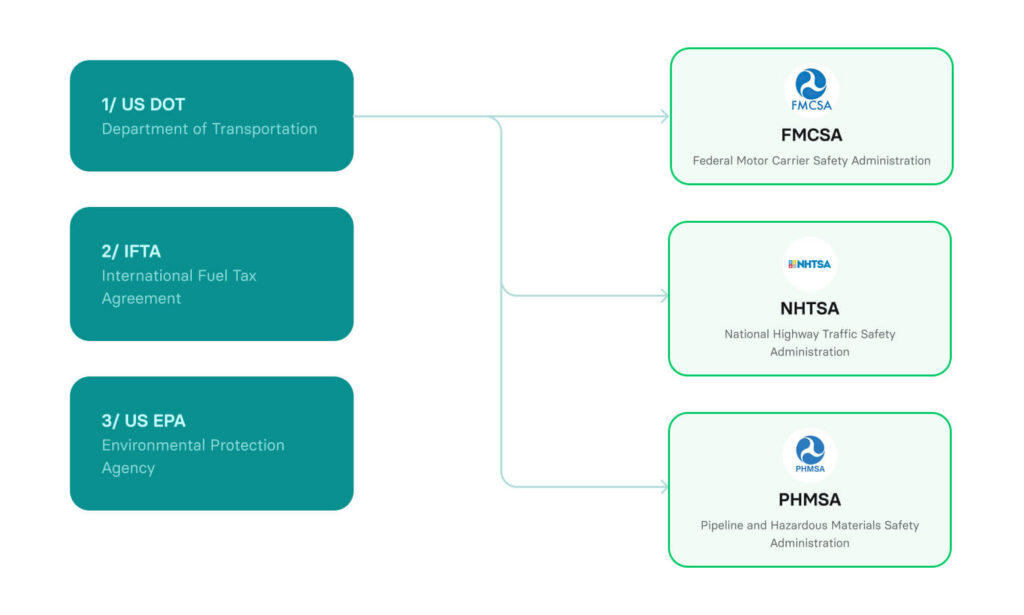
Fleet compliance refers to the policies and practices that govern commercial fleet operations. The primary goal of most such practices is ensuring safety and continuous reporting for transparency in fleet operations. In the USA, such regulations are mostly set by the DOT and FMCSA. Let’s explore these and other notable federal agencies in more detail.
What is Department of Transportation (DOT)?
The United States Department of Transportation is the executive agency that oversees all federal transportation policy. As its top priorities, DOT sets public safety, economic growth through efficient transportation, and mobility. An important thing is that agencies like FMCSA, NHTSA, and PHMSA operate within the framework developed by DOT. For a better understanding of DOT compliance, check out current DOT regulations.
What is the Federal Motor Carrier Safety Administration (FMCSA)?
The FMCSA works as DOT’s enforcement agency for commercial trucking. It aims at reducing crashes, injuries, and fatalities that involve large trucks and buses. For most fleet operators, FMCSA rules are the ones they deal with daily – hours of service, ELDs, driver qualifications, and drug testing all fall under FMCSA authority. Their Guidance Portal is the authoritative source for regulatory details. The agency also provides employers with an FMCSA Drug and Alcohol Clearinghouse, a federal database that tracks CDL drivers’ drug and alcohol violations that must be checked before hiring decisions.
What is National Highway Traffic Safety Administration (NHTSA)?
NHTSA handles vehicle safety standards – crashworthiness, safety equipment, and design requirements. Fleet operators buying or specifying new vehicles need to ensure those vehicles meet current NHTSA standards. Recalls issued by NHTSA must be addressed promptly to stay compliant. You can check out more information about this administration on the official NHTSA portal.
What is Pipeline and Hazardous Materials Safety Administration (PHMSA)?
PHMSA governs the transportation of hazardous materials, such as chemicals, gases, explosives, or other regulated substances. This regulatory body defines labeling, packaging, and handling requirements – on top of standard FMCSA rules. Hazmat violations carry some of the highest penalties in fleet compliance: up to $102,348 per violation, rising to $238,809 if the violation results in death, serious illness, severe injury, or substantial property destruction, according to 49 CFR § 107.329. For more information on this, you can check out the official PHMSA portal.
What is International Fuel Tax Agreement (IFTA)?
IFTA distributes fuel tax revenue among 48 US states and 10 Canadian provinces. Any fleet operating across state lines must file quarterly IFTA reports. These require detailed records: trip dates, starting and ending points, route stops, odometer readings, total miles per jurisdiction, and fuel purchases. Missing records trigger audits and back-tax assessments.
What is Environmental Protection Agency (EPA)?
The EPA enforces emissions standards and environmental regulations. For example, manufacturers must demonstrate compliance with the Clean Air Act (CAA) and applicable EPA regulations to sell an engine or a vehicle in the U.S.. Once compliance is verified and any required testing is completed, the EPA issues a Certificate of Conformity, allowing the product to be manufactured and sold in the U.S.
Also, the EPA SmartWay Program gives fleets a pathway to meet sustainability requirements while reducing fuel costs. For fleets with diesel vehicles, emissions compliance increasingly matters for operating permits in urban areas.
Fleet compliance checklist for 2026: 10 key areas to cover
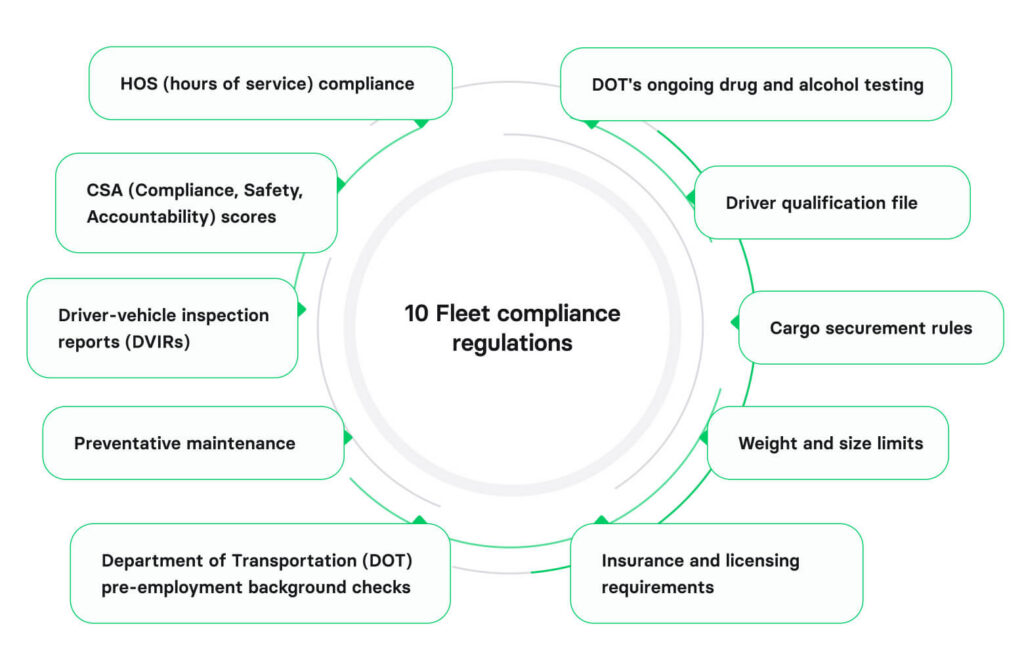
Every company operating commercial vehicles for interstate passenger or cargo transport must register with the FMCSA, obtain a USDOT Number, and track the following rules, requirements, and standards.
1. HOS (hours of service) compliance
Hours of Service rules, set under 49 CFR Part 395, limit how long commercial drivers can drive or work without a break. They exist to prevent accidents caused by driver fatigue. The key limits for property-carrying drivers in 2026:
- 11-hour driving limit – drivers may drive a maximum of 11 hours after 10 consecutive hours off duty.
- 14-hour window – the driving must happen within a 14-hour window from the start of the workday (on-duty time counts toward this window even if the driver isn’t driving).
- 30-minute break – required after 8 hours of consecutive driving.
- 70-hour/8-day limit – drivers may not drive after accumulating 70 hours of on-duty time in any 8-day period.
- 34-hour restart – drivers who hit the 70-hour limit can restart the count by taking 34 or more consecutive hours off.
All commercial drivers must use Electronic Logging Devices (ELDs) to record HOS data automatically. Paper logs are only permitted for short-haul exemptions. To stay compliant with Hours of Service rules, fleets must:
- Keep Record of Duty Status (RODS) logs for six months
- Review logs promptly for missing or incorrect entries
- Monitor for rule violations in near-real time.
See the FMCSA’s full HOS rules for all driver categories.
2. CSA (Compliance, Safety, Accountability) scores
CSA is the FMCSA’s safety compliance and enforcement program, grounded in the safety fitness standard under 49 CFR Part 385. It assigns each carrier a BASIC (Behavior Analysis and Safety Improvement Category) score. Such a CSA score considers seven behavioral categories, and those scores stay on record indefinitely. When a score crosses a threshold, FMCSA can trigger investigations, interventions, or operating license reviews for the carrier.
The seven BASIC categories are:
- Crash indicator – frequency and severity of accidents.
- Controlled substances/alcohol – driving under the influence incidents.
- Driver fitness – operating without a valid CDL or medical certificate.
- HOS compliance – failures to keep duty records or violations of driving limits.
- Hazardous materials compliance – improper handling or transport of hazmat cargo.
- Unsafe driving – speeding, seatbelt violations, reckless driving.
- Vehicle maintenance – neglected brake, cargo, lighting, or system repairs.
Fleet managers who monitor CSA scores continuously can address issues before they reach investigation thresholds.
3. Driver-vehicle inspection reports (DVIRs)
PFederal regulations under 49 CFR §392.7 require an inspection before every trip. §396.11 requires a Driver Vehicle Inspection Report (DVIR) at the end of the workday – but only when a defect is discovered or reported. Since a 2014 rule change, property-carrying carriers no longer have to file a “no-defect” DVIR, while passenger-carrying carriers still must file one daily regardless of defects.
The DVIR process encompasses:
- Pre-trip vehicle inspection, including a review of the previous DVIR.
- Post-trip inspection after each workday for every vehicle used.
- Reporting any safety-related defects found during inspections.
- Confirming repairs before returning the vehicle to service.
- Following applicable DVIR exemptions for eligible operations.
The inspection covers steering, tires, brakes, lights, mirrors, fire extinguishers, safety equipment, coupling devices, and the windshield. According to FMCSA compliance rules, in case your employees find any defect affecting safety, they must document, report, and correct it before using the vehicle again.
DVIR violations cost up to $1,584 per vehicle per day, capped at $15,846 for a single violation, according to 49 CFR Appendix B to Part 386. Most fleet managers have shifted to electronic DVIRs (eDVIRs) through mobile apps, which eliminate paperwork during roadside checks and make audit trails immediately accessible.
The FleetSu driver app, built by Volpis, includes features for logging various trip events, from driving time to speeding and harsh driving events. This data provides valuable insights that help prepare DVIR reports. Instead of spending hours managing paper records, drivers and fleet specialists can simply log the events required for DVIRs, and the system automatically uses this information to generate accurate reports.
For more insights, check out my guide to fleet driver behavior monitoring for 2026.
4. Preventative maintenance
DOT compliance requires documented preventive maintenance schedules under 49 CFR §396.3. A standard maintenance checklist includes:
- Oil and filter changes.
- Brake checks.
- Tire servicing and alignment.
- Cooling and electrical system upkeep.
- Battery maintenance.
- Transmission care.
- Rust inspection.
The critical compliance point is documenting vehicle operations, with dates and mileage, in a way that survives a DOT audit.
5. Department of Transportation (DOT) pre-employment background checks
Before a commercial driver operates a vehicle for your fleet, DOT mandates pre-employment screening under 49 CFR §391.23:
- Driving records.
- Employment history verification.
- FMCSA drug and alcohol clearinghouse check.
- DOT pre-employment drug test.
- DOT physical examination.
Skipping any of these is a recordable violation, regardless of whether the driver subsequently performs without incident.
6. Ongoing drug and alcohol testing
Fleets must maintain an assigned contact for testing administration (DER, 49 CFR §382.107) and ensure all employees performing safety-sensitive functions are subject to the program. Prohibited substances include marijuana, cocaine, amphetamines, opiates, and phencyclidine.
Alcohol testing rules ban consumption within four hours of duty. Random testing selections must follow DOT’s criteria, and post-accident testing is mandatory. A drug testing program violation carries fines starting from $7,155 per violation, according to 49 CFR Appendix B to Part 386.
7. Driver qualification (DQ) files
Every CMV driver requires a complete DQ file that documents their qualifications for the duration of employment plus three years, under 49 CFR §391.51. This includes:
- Job application.
- Driving history report.
- CDL and road test certification.
- Record of traffic violations.
- Annual driving evaluations.
- Medical clearance paperwork.
- Drug and alcohol screening outcomes.
- Vehicle inspection reports.
Driver qualification file requirements define that they must be maintained for the driver’s tenure plus three years.
For insights on improving driver qualifications, check out my article on improving driver behavior with fleet management software.
8. Cargo securement rules
Under FMCSA’s 49 CFR Part 393, every load must be secured to prevent shifting, falling, or spilling during transit. Securement requirements vary by cargo type – flatbed freight, logs, machinery, and vehicles each have specific tie-down and anchor point rules. A cargo securement violation can ground your vehicle at the roadside and carries fines comparable to other FMCSA violations.
The table below illustrates rules applicable to different types of cargo.
| Category | Rule type | Requirement |
|---|---|---|
All cargo (default) | General | 1 tie-down under 5 ft and 500 lbs, 2 tie-downs for 5–10 ft, plus 1 additional per 10 ft beyond that; devices must meet minimum working load limit |
Logs | Special | Banded/unitized loads or 4 or fewer processed logs may use general rules; larger loose loads need dedicated blocking and tie-down patterns |
Dressed lumber | Special | Minimum 2 tie-downs per bundle, with load gates or equivalent blocking if not otherwise contained |
Metal coils | Special | Coils weighing 5,000 lbs+ require dedicated blocking and both longitudinal and lateral tie-downs |
Paper rolls | Special | Applies to rolls weighing 5,000 lbs+ individually or combined; rolls under that threshold may follow general rules |
Concrete pipe | Special | Dedicated cradling, blocking, and tie-down rules to prevent rolling |
Intermodal containers | Special | Specific locking/securement device requirements at chassis attachment points |
Automobiles, light trucks, vans | Special | Wheel or frame tie-down requirements sized to vehicle weight |
Heavy vehicles, equipment, machinery | Special | Attachment to designated tie-down points; accessory equipment secured separately |
Flattened/crushed vehicles | Special | Specific banding and containment rules distinct from intact vehicle transport |
Roll-on/roll-off containers | Special | Locking device and hook/chain securement specifications |
Large boulders | Special | Dedicated blocking and tie-down configuration due to irregular shape |
9. Weight and size limits
Federal regulations under 23 CFR §658.17 and §658.15 set baseline weight and width limits for commercial vehicles on the interstate system; height has no federal cap and is set by each state. Vehicles over 10,000 lbs GVWR already fall under core federal rules, well below the 26,001 lbs CDL threshold. Nondivisible loads exceeding the limits below can move legally with a state-issued overweight/oversize permit and pre-approved route under §658.17(h), but exceeding limits without one triggers roadside detention and potential load transfer.
| Category | Federal limit |
|---|---|
Gross vehicle weight | 80,000 lbs |
Single axle weight | 20,000 lbs |
Tandem axle weight | 34,000 lbs |
Width | 8.5 ft (102 in) |
Height | No federal limit; state-set (~13.5–14.5 ft) |
Oversize/overweight loads | State permit + route approval required |
In most states, if a truck is flagged as overweight or overwidth, it is held at the inspection point until the issue is fixed. Usually, this means moving some cargo to another vehicle or removing it. The truck can continue only after it meets legal limits.
Different states and routes have different cargo, size, and weight requirements. The Rand One driver app developed by Volpis addresses this challenge by generating compliant routes across the U.S., Canada, and Mexico for various tractor-trailer combinations, including hazmat and oversized loads. It considers restrictions, such as commercial vehicle weight limits or bridge heights, to deliver safe and compliant route suggestions.
10. Insurance and licensing requirements
FMCSA sets minimum liability insurance requirements for interstate for-hire carriers under 49 CFR Part 387. For general freight (for-hire, non-hazmat) carriers operating vehicles over 10,001 lbs, the minimum is $750,000. For hazmat carriers, the minimum ranges from $1,000,000 to $5,000,000 depending on the specific material and quantity involved. The higher end is reserved for bulk shipments, explosives, poison gas, and radioactive materials.
Private carriers hauling non-hazardous freight are generally not subject to this FMCSA minimum-insurance filing requirement. Carriers must file proof of insurance (Form MCS-90 or BMC-91) with FMCSA. If a carrier’s insurance lapses, FMCSA flags it as non-compliant almost right away, gives just a few days to fix it, and revokes the authority – usually within a month – if it isn’t.
What does non-compliance actually cost?
The abstract risk of “fines and penalties” becomes much more concrete when you see the actual numbers. Here’s what you can pay for specific violations if you fail during the FMCSA audit in 2026:
| Violation type | Maximum fine (per violation) |
|---|---|
Hours of service (HOS) violation | $19,246 |
ELD tampering or falsification | $15,846 |
DVIR violation | $1,584 per vehicle per day, capped at $15,846 |
Drug testing program violation | $7,155-$39,615 |
Hazardous materials violation | $102,348 (up to $238,809 if the violation results in death, serious illness, severe injury, or substantial property destruction) |
Operating without required insurance | $21,114 |
Repeated or egregious violations | Possible registration suspension (e.g., 12-36 months for brokers/carriers violating household-goods delivery rules) |
Reactive compliance vs. proactive compliance: why the difference matters
Most fleet managers start with reactive compliance – fixing issues after a violation or citation. They’re used to addressing problems only once they’re flagged. Still, such an approach means missing some issues or addressing them when the damage is already done. Proactive compliance – catching and fixing issues before they trigger a citation – is typically a more reliable option. It provides an operational model that keeps fleets off enforcement radar permanently.
| Category | Reactive compliance | Proactive compliance |
|---|---|---|
Response trigger | Respond to roadside citations and audit findings | Monitor compliance status in real time; fix before inspections |
Violation tracking | Track violations after they occur | Alert when a driver is approaching HOS limits |
Recordkeeping | Paper-based or manual records, assembled for audits | Centralized digital records accessible on demand |
CSA score management | CSA score rises before anyone notices | CSA score monitored continuously; trends identified early |
Cost structure | Fines + legal + downtime | Software subscription + staff time |
The shift from reactive to proactive is often a software problem. When compliance data lives in spreadsheets or paper files, proactive monitoring isn’t physically possible at scale. When it lives in a centralized system with automated alerts, it becomes the default.
How do you stay compliant day to day? Fleet compliance best practices

To stay compliant operationally, you’ll need to apply systems and habits that make compliance the path of least resistance for every driver and fleet manager.
Implement fleet management software
The most effective step for fleet compliance is to keep all compliance data in software that automatically tracks it. The right system tracks ELD data, flags HOS approaching limits, schedules maintenance, digitizes DVIRs, and generates compliance reports for audits. Without it, compliance becomes a manual coordination problem that scales poorly with fleet size. We cover software options in detail below.
Build a written fleet safety policy
A safety policy sets the expectations your drivers are held to – mandatory seatbelt use, speed limit adherence, zero tolerance for impaired driving, and the consequences for violations. The policy must be written, acknowledged by drivers in writing, and updated when regulations change. Just don’t treat it like pointless paperwork – it’s actually your first line of defense when an incident triggers a DOT audit.
Train drivers continuously
Continuously train your drivers through coaching sessions, in-cab feedback from telematics, and periodic refreshers on HOS rules. Fleets that only train at onboarding consistently see compliance scores degrade over 12 to 18 months as institutional knowledge erodes.
While working on the FleetSo fleet management app, we’ve included the functionality for monitoring driver behavior and statistics. Managers can review metrics such as speeding incidents, harsh braking, and hours nearing regulatory limits to give drivers guidance that helps improve their behavior. In turn, this can lead to a significant reduction in violation rates within the first 90 days after adoption.
Document everything and keep it accessible
A DOT audit can request records going back three years. If your documentation system requires manual searching through physical files or email threads, you’re already at a disadvantage. Daily driver vehicle inspection reports (DVIRs) ensure compliance while routine inspections offer valuable insights into vehicle conditions. These reports can be completed via a mobile app, allowing fleets to eliminate messy paperwork during roadside checks.
Centralized document management should include DQ files, maintenance records, DVIR logs, and drug test results – all searchable and exportable within minutes. Even if your workflows are compliant, you need a solid reporting and auditing approach to prove it.
Stay ahead of renewals and deadlines
License renewals, medical certifications, vehicle registrations, and insurance filings all have fixed deadlines. A single lapsed CDL medical certificate grounds that driver immediately. Automated renewal tracking – with alerts 30, 60, and 90 days before expiry – eliminates the scenario where a deadline slips because it fell in a busy week.
Use vehicle inspection findings to drive maintenance
Pre-trip and post-trip inspections generate a stream of vehicle condition data. In reactive operations, defects get flagged and scheduled eventually. In proactive operations, inspection data feeds directly into maintenance scheduling. For example, a defect reported on a DVIR automatically creates a maintenance work order. This connects inspections with repairs and creates a clear record showing that your maintenance program is actually being followed.
What is a fleet compliance management system?
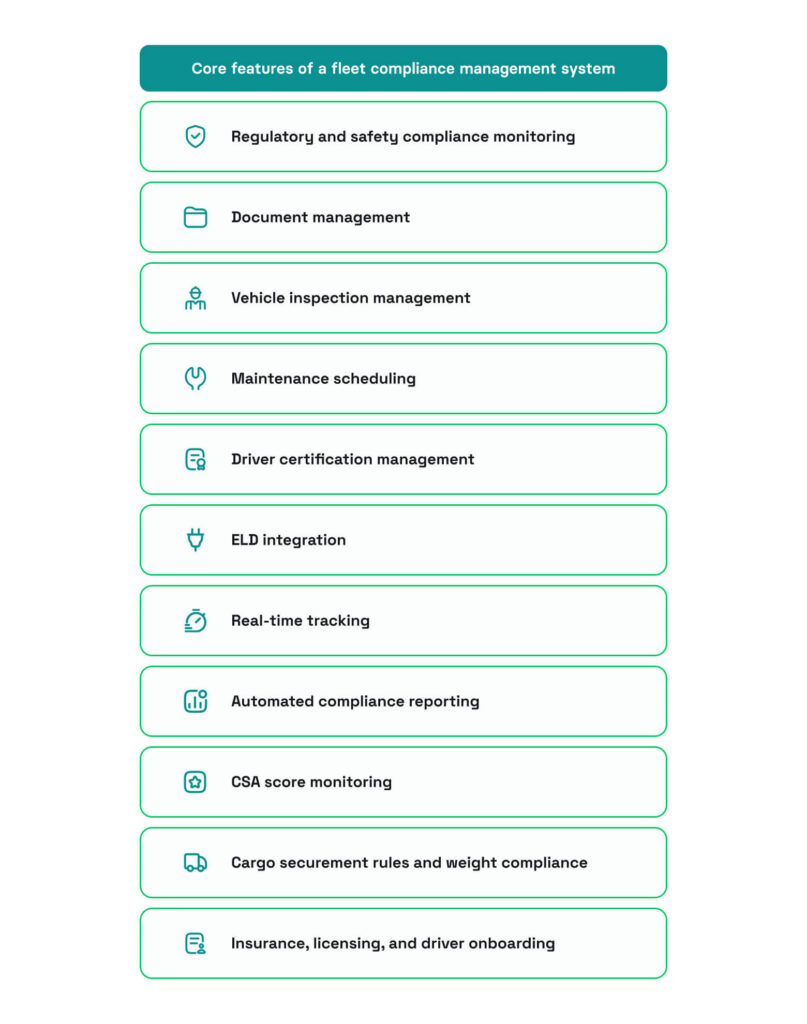
A fleet compliance management system is software that centralizes the monitoring, documentation, and alerting to keep a fleet within regulatory boundaries. It’s distinct from basic GPS tracking or dispatching tools because compliance systems are specifically built around regulatory requirements.
Core features a compliance management system should cover:
- Regulatory and safety compliance monitoring – continuous tracking across HOS, DVIRs, DQ files, and drug testing schedules.
- Document management – centralized storage of compliance records with access controls and audit-ready export.
- Vehicle inspection management – digital DVIR completion and defect tracking.
- Maintenance scheduling – automated scheduling tied to mileage, time, and inspection findings.
- Driver certification management – CDL expiry tracking, medical certificate monitoring, qualification file management.
- ELD integration – HOS data pulled directly from electronic logging devices.
- Real-time tracking – vehicle location tracking for route verification and violation context.
- Automated compliance reporting – reports formatted for DOT audits and internal review.
- CSA score monitoring – ongoing tracking of BASIC scores with violation trend analysis.
- Cargo securement rules and weight compliance – securement verification and permit tracking for oversize or overweight loads, tied to axle-weight and route restrictions.
- Monitoring for compliance with emission standards – continuous monitoring of vehicle emissions to comply with environmental regulations and reduce environmental impact.
- Insurance, licensing, and driver onboarding – proof-of-insurance filing status (MCS-90/BMC-91), carrier authority monitoring, and pre-employment screening, including Clearinghouse queries, DOT physicals, and driving history checks.
What are the benefits of fleet compliance software?
Integration of fleet management systems provides comprehensive visibility into your entire fleet. This facilitatesThe business case for fleet compliance software isn’t just about avoiding fines. The operational benefits compound over time:
- Reduced administrative overhead – automated reporting and digital records cut the manual compliance workload that otherwise consumes fleet managers’ time.
- Lower violation risk – centralized monitoring and automated alerts catch issues before they become violations.
- Faster audit response – all required documentation is accessible in one place, reducing audit response time from days to hours.
- Better insurance outcomes – fleets with documented compliance records and low CSA scores typically negotiate better insurance premiums.
- Improved driver safety – behavior monitoring and HOS tracking reduce fatigue-related incidents.
- Scalability – a compliant fleet of 20 vehicles can scale to 200 without adding proportional compliance headcount if the right system is in place.
How AI is changing fleet compliance management
Machine learning and AI can create a solid foundation for a proactive compliance management approach. Instead of showing you that a driver violated HOS, the system warns you 90 minutes before the violation would occur. Instead of logging a DVIR defect, the system flags that this vehicle has had three similar defects in 60 days and predicts the next failure.
Practical AI applications in fleet compliance today include:
- Predictive HOS alerts based on driver patterns.
- Anomaly detection in DVIR data that surfaces systemic vehicle issues.
- Real-time CSA score forecasting.
- Natural language report generation for audit submissions.
- Automated document classification and expiry alerts for DQ files, CDLs, and medical certificates.
- Automated insurance and authority status monitoring, with alerts before lapses affect carrier authority.
- Predictive maintenance scoring that flags vehicles likely to fail inspection before a defect is reported.
- Computer vision verification of pre-trip inspections via in-cab cameras.
For a deeper look at how these technologies work in practice, check out my AI and ML in fleet management guide that covers implementation specifics.
How do you choose the right fleet compliance management system?
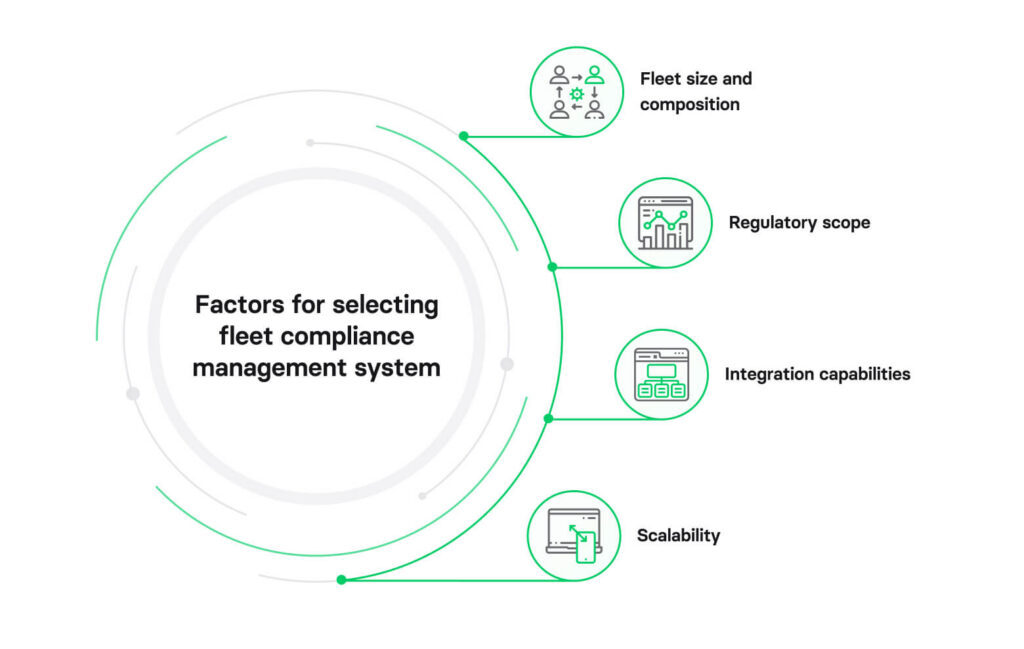
To select the right system for your compliance workflows, focus on your fleet’s specific profile.
Fleet size and composition
A 10-truck regional carrier and a 500-vehicle national fleet have very different compliance management needs. Small fleets often do well with off-the-shelf SaaS platforms that cover the basics. Larger or more specialized fleets that handle mixed cargo, hazardous materials, and cross-border operations often need custom systems that can manage situations generic software can’t.
Regulatory scope
Compliance regulations vary across industries and regions. The software you choose needs to match the specific regulatory framework governing your operations.
Integration with existing systems
Compliance data is most valuable when it connects to your ELD provider, GPS telematics, maintenance systems, and dispatch platform. A compliance system that operates in isolation creates data silos that defeat the purpose. Evaluate integration depth carefully. Your system’s API availability matters as much as native features.
Scalability
Your compliance requirements will evolve as your fleet grows, as regulations change, and as you expand into new states or cargo types. A system that fits today but requires replacement in two years is a false economy. Custom-built systems are often the better long-term investment for fleets that expect significant growth or operational change.
For a better understanding of what currently matters in the fleet software domain, check out my overview of the biggest fleet management trends for 2026.
When to consider custom fleet compliance software?
The market for fleet compliance and management software offers a great range of options. But remember that off-the-shelf platforms work well for standard compliance scenarios. There are also situations where a custom system is the right choice:
- Your fleet spans multiple cargo types or jurisdictions with conflicting compliance requirements.
- You need compliance data integrated deeply with proprietary dispatch, ERP, or warehouse systems.
- Off-the-shelf reporting doesn’t match your DOT audit documentation requirements.
- You’re building a compliance product as part of a fleet software offering for your customers.
- You’ve outgrown multiple SaaS platforms and need a system built for your specific scale and complexity.
Custom fleet software development typically makes sense for fleets above 100 vehicles or for businesses with non-standard, specialized, or highly flexible operations, as well as those working under strong regulatory pressure. A custom approach also fits organizations where compliance software is part of a broader technology product. The upfront investment is higher, but the long-term fit eliminates the ongoing workarounds that come with forcing a generic platform into a specialized operation.
For more insights, check my complete guide to fleet management software development.
Final Thoughts
From my experience, the clients who get the most from a custom compliance system are the ones who’ve already tried two or three off-the-shelf platforms and hit their limits. By that point, fleet companies know exactly what they need. They are ready to implement a custom solution with clearly defined functionality and workflow requirements.
One problem remains: finding a team that understands the domain and can build a solution that meets your requirements. At Volpis, we are ready to help. Whether you need to build a solid foundation based on your requirements or handle the entire software development lifecycle, starting with the discovery phase, our team can support you.
Contact us to build fleet software that helps you comply with core standards and regulations proactively.
Questions & Answers
FAQ
What penalties can fleet managers face for non-compliance?
FMCSA penalties range from $1,584 per vehicle per day for DVIR requirements violations (up to $19,246 per HOS violation, $15,846 for ELD tampering or falsification, and $7,155 for drug testing violations. Hazardous materials violations can reach $102,348 per violation, increasing to $238,809 if they result in death, serious illness, severe injury, or major property damage. These limits are defined in 49 CFR Appendix B to Part 386 and 49 CFR § 107.329. Repeated or severe violations may lead to the suspension of operating authority.
What are fleet management standards?
Fleet management standards are established guidelines for vehicle maintenance, driver training, fuel management, and safety procedures. FMCSA sets the minimum legal standards. Many fleets adopt internal standards that exceed regulatory minimums. For example, some fleets run preventive maintenance more frequently than required. While this can introduce some operational hardships, such a practice helps companies reduce breakdown risks and stay on the safe side.
What is fleet safety in general?
Fleet safety encompasses the policies, procedures, and training programs designed to reduce accidents, injuries, and vehicle damage. It includes driver behavior monitoring, HOS management to prevent fatigue, vehicle maintenance programs, and safety regulation compliance. A strong safety record directly supports trucking compliance – low accident rates positively affect CSA Crash Indicator scores.
What is fleet reporting?
Fleet reporting involves generating and analyzing operational data: vehicle usage, maintenance records, fuel consumption, driver behavior metrics, and compliance status. For compliance purposes, the most important reports cover HOS logs, DVIR records, drug testing results, and DQ file status. These reports need to be audit-ready at all times, not assembled only when an audit is scheduled. The best fleet management software can help companies automate this process.
What does “on-duty” mean in DOT regulations?
Under DOT regulations, “on-duty” time includes all time a driver spends performing work-related tasks: driving, loading or unloading cargo, pre-trip and post-trip inspections, waiting to be dispatched, and completing paperwork. On-duty time counts toward the 14-hour daily window and 70-hour/8-day limit, even when the driver isn’t behind the wheel.
What to include in a fleet compliance checklist?
A solid fleet compliance checklist covers hours of service (HOS) logs backed by ELD data, CSA/BASIC score monitoring, and daily driver-vehicle inspection reports (DVIRs). It should also consider documented preventive maintenance schedules, pre-employment background screening, ongoing drug and alcohol testing, driver qualification (DQ) files, cargo securement rules, weight and size limit compliance, and proof of insurance and licensing (Form MCS-90/BMC-91).