

There are 11 primary logistics apps types: fleet management, inventory, last-mile delivery, warehouse ops, parcel tracking, TMS, supply chain visibility, route planning, load planning, customs compliance, and reverse logistics. Jump to the comparison table for a side-by-side view, or the decision framework if you’re ready to narrow it down.
In recent years, the logistics software market is growing fast. According to Precedence Research, it’s going to double from $16.3 billion in 2025, to $34.68 billion in 2030.
That growth creates a real problem. More app types appear, and companies often invest into the wrong type of app, wasting time and money. And it’s not that the software they got is bad, it’s because it doesn’t fit their actual problem.
To prevent you from choosing the wrong way, I created this guide. It covers the 11 most common types of logistics apps, with features, real-world examples, costs, and a comparison table to help you match the right app type to your operation.
At Volpis, we’ve built custom logistics platforms for industry leaders, including Rand McNally. Here’s what we’ve learned at real practice, and how to apply it to your decision.

Types of logistics apps in 2026
In my experience and most common needs, logistics apps fall into 11 primary categories. Some of them overlap. For instance, a fleet management app might include route planning, and a WMS often handles inventory. But each category solves a specific core problem.
1) Fleet management apps
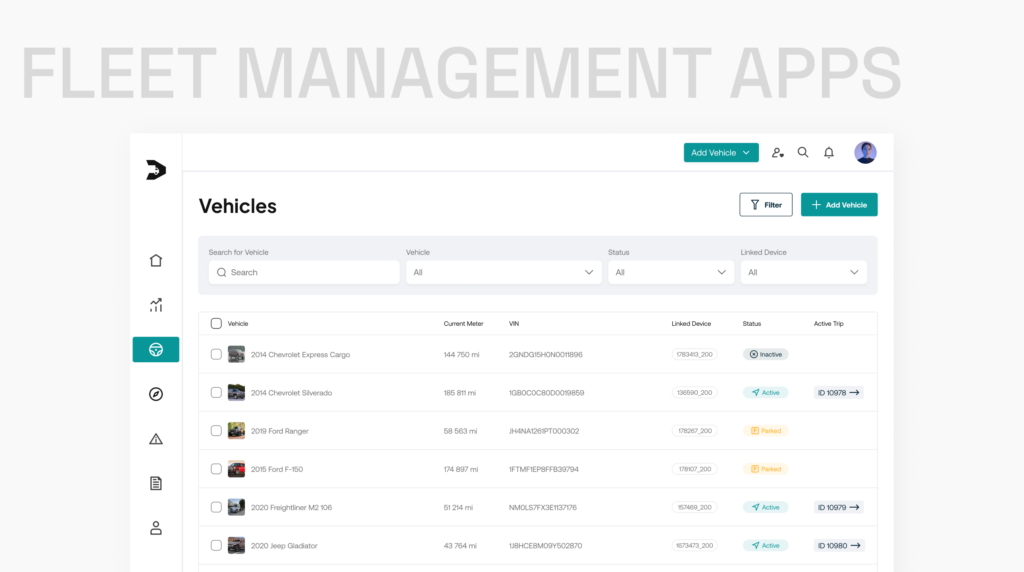
Fleet management apps use GPS to track vehicles in real time, optimize routes, and monitor driver behavior. These apps are the backbone of any company that operates a vehicle fleet, from last-mile delivery vans to long-haul trucks.
Fortune Business Insights states that only in 2025, the fleet management software market reached $32.3 billion. Such scale reflects how critical these apps are to modern logistics.
But what makes fleet management apps so valuable isn’t just GPS, it’s integration depth. The platforms connect to fuel cards, maintenance systems, and ELD devices in one dashboard.
We built a custom fleet management platform for Rand McNally – a mobile app for truck drivers that handles navigation, trip logging, and compliance in a single interface. That project showed us how important it is to design for real driving conditions: large tap targets, offline-first data sync, and integration with existing telematics hardware.
| Dimension | Details |
|---|---|
Core problem solved | Visibility into vehicle location, driver performance, and fleet costs |
Who it’s for | Trucking companies, delivery fleets, field service businesses with 10+ vehicles |
Key features |
|
Integrates with | ELD devices, fuel cards, maintenance systems, ERP, dispatch software, telematics hardware |
Popular apps (examples) | Samsara, Fleetio, Verizon Connect, Motive (formerly KeepTruckin) |
AI features emerging | Predictive maintenance (flags part failures before they happen), AI route optimization that learns from historical traffic patterns |
Cost range | Ranges from $20,000 to $100,000, with timeframes typically varying from 2 to 7 months. |
If you’re evaluating fleet apps, start with GPS accuracy and ELD compliance – both are non-negotiable. For a deeper look, see our article on how mobile apps help in fleet management. Or explore our fleet management development services directly.
2) Inventory management apps
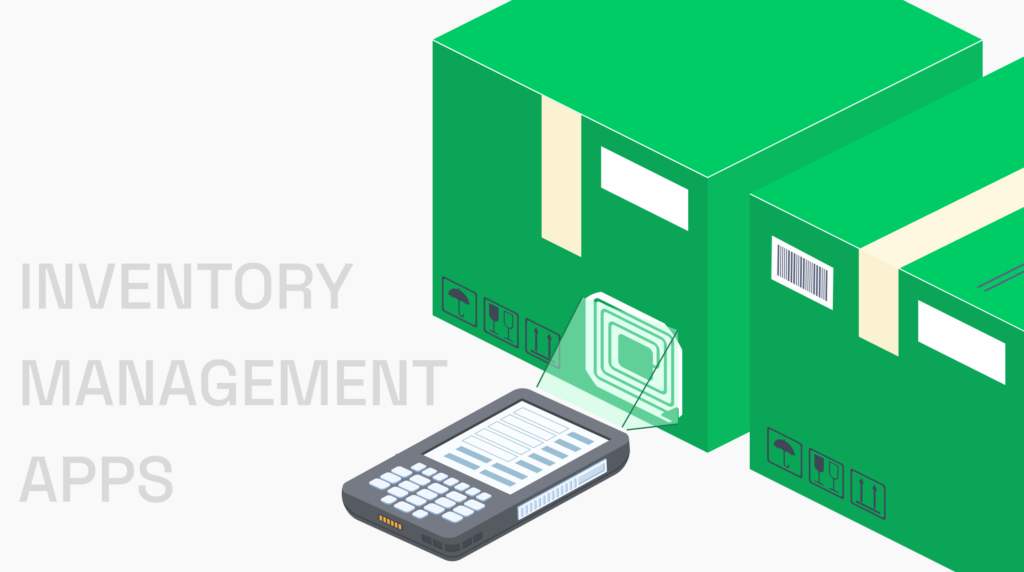
Inventory management apps help to track stock levels across warehouses, trigger reorder alerts, and sync inventory data with ERP systems. They prevent two most critical problems: stockouts and overstocking.
Barcode scanning and RFID technology are table stakes at this point. Modern apps follow the trend and add AI-powered features. For example, demand forecasting that predicts stock needs weeks in advance. According to McKinsey, this approach reduces excess inventory by 20-30%.
| Dimension | Details |
|---|---|
Core problem solved | Stock visibility, reorder timing, and multi-warehouse coordination |
Who it’s for | Retailers, distributors, and manufacturers managing 500+ SKUs across multiple locations |
Key features |
|
Integrates with | ERP systems (SAP, NetSuite), WMS, e-commerce platforms, POS systems, and accounting software |
Popular apps (examples) | Zoho Inventory, Fishbowl, Cin7, NetSuite |
AI features emerging | Demand forecasting that predicts reorder timing, automated anomaly detection for shrinkage and miscount patterns |
Cost range | $30,000 – $150,000 for custom development (with 4-10 months timeframes) |
One pattern I’ve seen in our own projects: companies often start with basic barcode scanning and add RFID later. The transition isn’t always smooth – RFID tag placement, reader range, and interference from metal shelving all need testing in the actual warehouse environment. Plan for that phase explicitly. For more on this, see our inventory automation guide.
3) Last-mile delivery apps
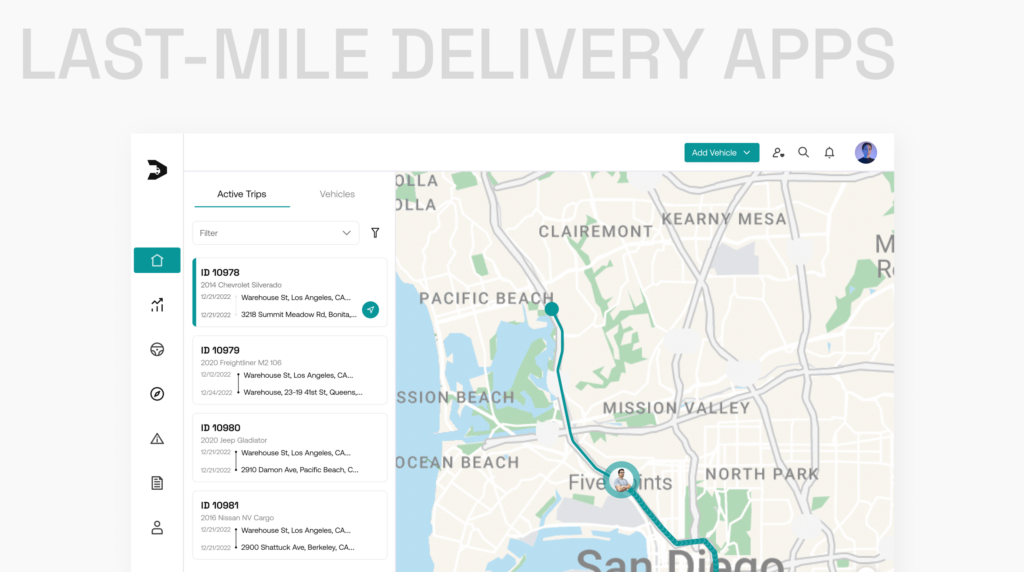
Last-mile delivery apps manage the full journey from distribution hub to the customer’s door. Function-wise, this type of app combines optimized route planning, electronic proof of delivery (ePOD), and customer notifications into one workflow, enabling efficient and transparent delivery.
The requirements vary by sector. For food delivery, real-time ETA accuracy is the defining feature, customers’ satisfaction significantly increases with minute-level updates they can receive. For e-commerce, the priority shifts to ePOD and delivery rescheduling which help to cut failed delivery.
This matters because last-mile delivery is expensive. According to Statista’s research on shipping costs, in 2023, last-mile delivery accounted for 53% of total shipping costs. Five years earlier, it was 41%, showing the steady growth.
| Dimension | Details |
|---|---|
Core problem solved | Delivery speed and cost, real-time tracking updates, customer communication, and proof of delivery |
Who it’s for | E-commerce companies, food delivery services, courier networks, grocery chains |
Key features |
|
Integrates with | E-commerce platforms (Shopify, WooCommerce), payment gateways, CRM, order management systems |
Popular apps (examples) | Onfleet, Bringg, Route4Me, Dispatch |
AI features emerging | AI dispatching that matches drivers to deliveries based on location, capacity, and predicted traffic |
Cost range | Ranges from $25,000 to $120,000, with timeframes from 3 to 8 months |
4) Warehouse operations apps
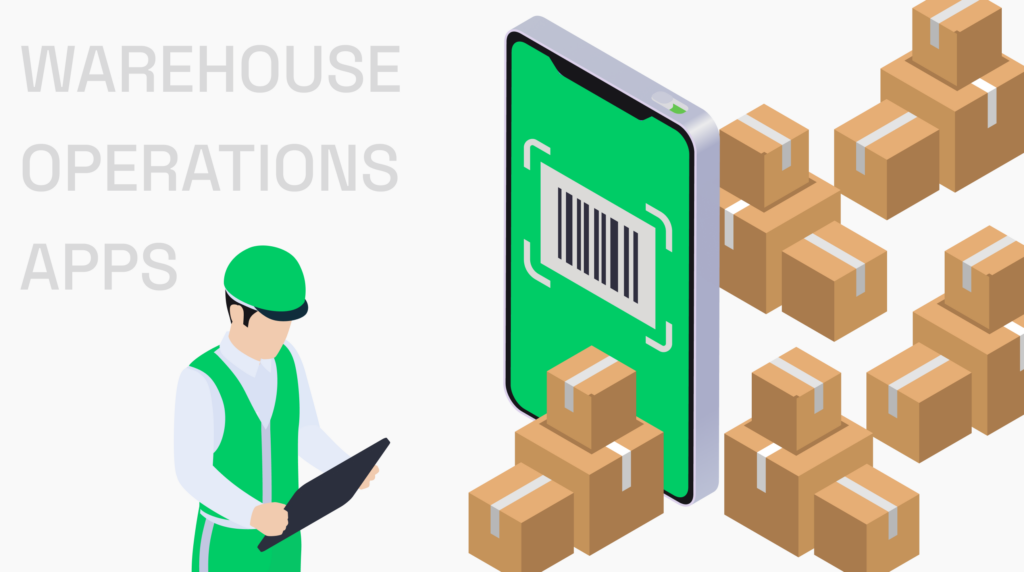
The WMS reached $4.6 billion in 2025 and is expanding at 17% CAGR, according to MarketsandMarkets. Such growth, put the dedicated apps for the sector at interest.
Warehouse operations apps streamline receiving, picking, packing, and shipping. By replacing paper processes with barcode flows, they improve accuracy and efficiency in warehouse processes. Modern warehouse apps go beyond basic inventory counting. Companies in logistics use geofencing to combine zone-based triggers with warehouse apps for automated receiving and dock scheduling.
| Dimension | Details |
|---|---|
Core problem solved | Warehouse throughput, picking accuracy, and space utilization |
Who it’s for | Fulfillment centers, 3PLs, distribution hubs processing 100+ orders/day |
Key features |
|
Integrates with | ERP, inventory management systems, shipping carriers, barcode/RFID hardware, labor management tools |
Popular apps (examples) | Warehouse Mobile Solution, SnapFulfil, Logiwa, Manhattan Associates, Korber |
Cost range | From $20,000 to $90,000, with timeframes from 2 to 6 months |
5) Parcel recipient apps
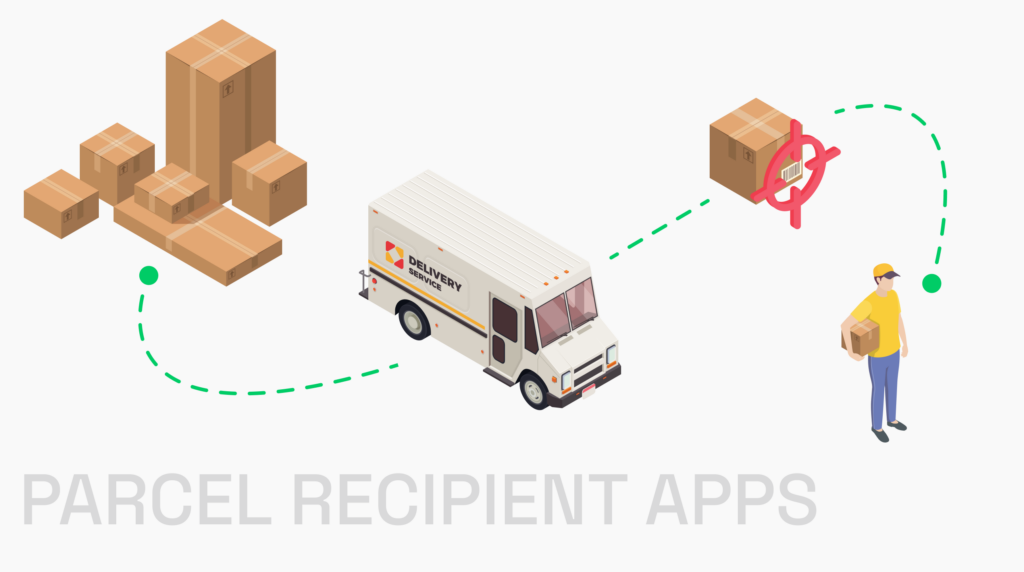
Parcel recipient apps target the end-users who receive packages. These apps allow recipients to track parcels, confirm receipt, and access other delivery-related services, enhancing the overall customer experience.
Major carriers (UPS, FedEx, DHL) already offer their own recipient apps and have huge popularity. According to Parcel and Postal Technology International, UPS My Choice alone has over 52 million members.
But if you run your own delivery fleet or operate as a regional carrier, you need a more customized, branded tracking experience. For this reason, people start developing custom parcel apps. A custom app keeps all engagement data, like delivery preferences, common complaints, peak delivery windows, on your side. That data feeds back into route optimization and customer retention in ways third-party carrier apps never allow.
| Dimension | Details |
|---|---|
Core problem solved | Customer visibility and satisfaction, failed delivery reduction, and support call volume streamlining |
Who it’s for | Regional carriers, postal services, e-commerce companies with own delivery fleet |
Key features |
|
Integrates with | Carrier APIs, e-commerce platforms, SMS/push notification services, maps APIs, CRM |
Popular apps (examples) | Meest, UPS My Choice, FedEx Delivery Manager, Parcel |
Cost range | $20,000 – $90,000 for custom development (2-6 months) |
6) Transportation management system (TMS) apps
Transportation management system (TMS) apps help businesses plan, execute, and optimize the movement of goods. They connect shippers, carriers, and warehouses into one workflow and ensure the timely delivery of freight and compliance with regulations.
Unlike fleet management apps (which focus only on your own vehicles), TMS apps help to manage external carriers, handle freight audits, and balance loads across transport modes. The differentiating feature is the carrier selection algorithms. It replaces the manual bidding process with automated recommendations, all while factoring in on-time rates, fuel surcharges, and lane-specific pricing for better decisions.
| Dimension | Details |
|---|---|
Core problem solved | Freight planning and tracking, carrier selection, and transportation cost control |
Who it’s for | Shippers, freight brokers, and 3PLs managing multiple external carriers |
Key features |
|
Integrates with | Carrier networks, ERP, WMS, customs systems, EDI platforms, freight exchanges |
Popular apps (examples) | Oracle Transportation Management, SAP TM, MercuryGate, Kuebix |
AI features emerging | Automated carrier scoring based on historical performance, dynamic rate negotiation, predictive delay alerts |
Cost range | From $50,000 to $200,000, with timeframes varying from 6 to 12 months |
7) Supply chain visibility apps
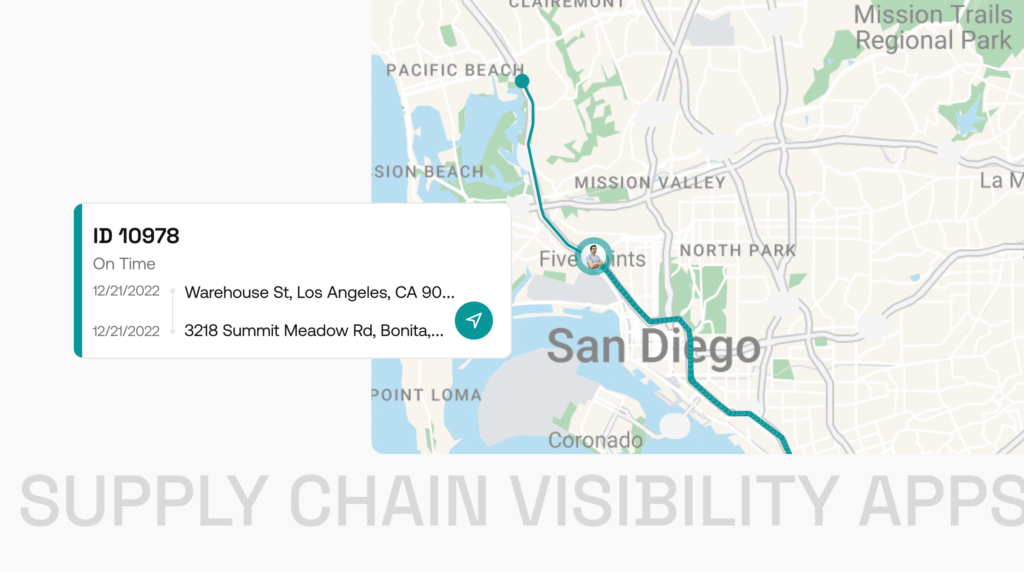
Supply chain visibility apps provide end-to-end real-time tracking and monitoring of goods throughout the supply chain (from supplier to customer). They pull data from carriers, warehouses, and IoT sensors into a single dashboard. So the logistics teams have one place to monitor everything in motion.
The unique value of supply chain apps is disruption prevention. Businesses gain insights into inventory levels, shipment status, and potential disruptions – giving them time to act on the issue before it hits. And such a strategy has real results – FourKites states that C&S Wholesale Grocers reduced logistics calls by 65% in four months.
| Dimension | Details |
|---|---|
Core problem solved | Shipment visibility, disruption prediction, inventory management, and cross-partner coordination |
Who it’s for | Enterprises with multi-tier supply chains, CPG companies, global manufacturers |
Key features |
|
Integrates with | Carrier systems, IoT/sensor platforms, ERP, TMS, warehouse systems, supplier portals |
Popular apps (examples) | FourKites, Project44, Descartes MacroPoint, Overhaul |
Cost range | From $40,000 to $150,000, with timeframes from 4 to 10 months |
8) Route planning apps
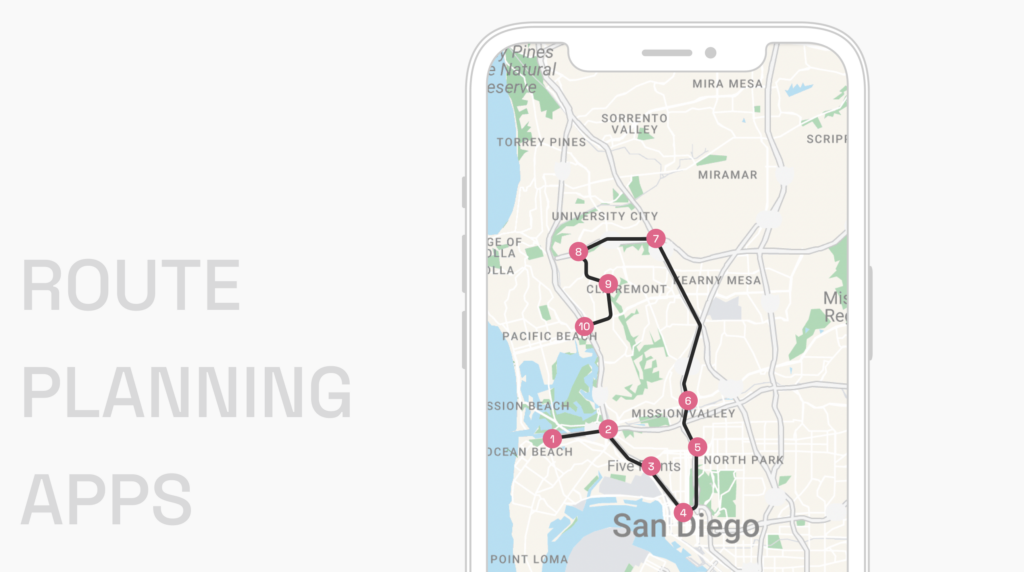
Route planning apps are essential for any company with 10+ deliveries per day. They help to find the fastest path across multiple stops, factoring in traffic, time windows, vehicle capacity, and driver schedules.
The features that set these apps aside from regular map tools are dynamic rerouting. When some changes happen (e.g., road closures or traffic spikes), the app recalculates and adapts routes in real time.
In our experience, the hardest part of developing route planning apps is constraints. Things like time windows, vehicle weight limits, driver break rules, and customer availability need to be included in the calculation. Even one missed constraint can break the route planning.
| Dimension | Details |
|---|---|
Core problem solved | Route speed, fuel costs, and delivery time windows, environmental optimization |
Who it’s for | Delivery companies, field service teams, and sales reps running 10+ stops per day |
Key features |
|
Integrates with | Maps APIs (Google, HERE), fleet management systems, CRM, dispatch platforms, traffic data feeds |
Popular apps (examples) | Route4Me, OptimoRoute, Badger Maps, Routific |
Cost range | From $20,000 to $100,000, with timeframes varying from 2 to 6 months |
9) Load planning apps
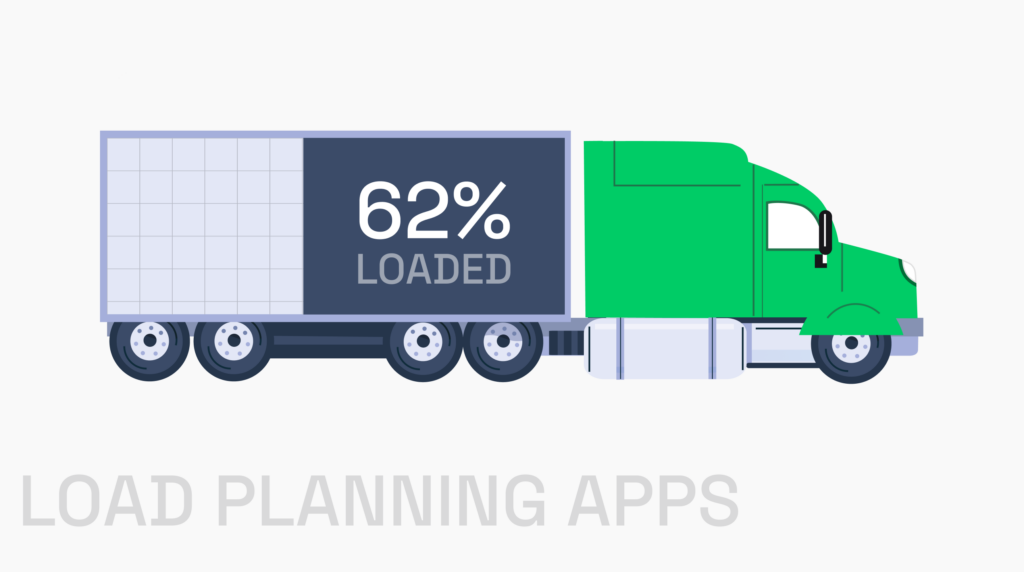
Though being a niche category, load planning apps hugely impact the transportation cost. As stated by Flock Freight, 43% of truckloads moved partially empty in 2023. That unused space resulted in costs wasted.
Load planning apps help logistics companies in optimizing the loading of goods into vehicles. They can take into account weight distribution, maximize space utilization, and ensure cargo safety during transportation.
A standout emerging feature is 3D visualization. With it, planners can see exactly how items fit, even before loading begins.
| Dimension | Details |
|---|---|
Core problem solved | Cargo space utilization, weight distribution, and loading sequence |
Who it’s for | Freight carriers, trucking companies, and container shippers loading mixed cargo |
Key features |
|
Integrates with | TMS, WMS, ERP, vehicle telematics, weight sensors, container tracking systems |
Popular apps (examples) | EasyCargo, Cube-IQ, LoadPlanner, CargoWiz |
Cost range | From $25,000 to $120,000, with timeframes from 3 to 8 months |
For a deeper look at the technical side and development process, see our guide to load planning software development.
10) Customs compliance apps
Customs compliance apps streamline the customs clearance process for international shipments. They automate documentation, classification, and filing required for moving goods across borders and minimizing compliance risk.
International shipping involves a lot of steps. Such as HS code classification, tariff calculations, and trade agreement compliance (USMCA, EU customs, ITAR). If you do it manually, you spend a lot of time. Compliance apps, however, automate paperwork and integrate directly with customs authorities. As a result, little to no delays at borders.
| Dimension | Details |
|---|---|
Core problem solved | Customs delays, documentation errors, and trade compliance risk |
Customs delays, documentation errors, and trade compliance riskWho it’s for | Freight forwarders, importers/exporters, customs brokers handling cross-border shipments |
Key features |
|
Integrates with | Customs authorities (160+ countries), ERP, TMS, EDI networks, trade compliance databases |
Popular apps (examples) | Descartes, Amber Road (E2open), Integration Point, C4T |
Cost range | From $40,000 to $150,000, with timeframes varying from 4 to 10 months |
11) Reverse logistics and returns management apps

Returns management has become a logistics priority in its own right. According to the NRF Annual Returns Report, around 20% of online sales were returned in 2025. Without systems that automate this process, returns become an operational black hole.
Reverse logistics apps handle everything that moves backward in the supply chain. It deals with returns, exchanges, repairs, and recycling. These apps automate return authorization, route items to the right destination (refurbish, restock, or dispose), and track the cost of every return.
| Dimension | Details |
|---|---|
Core problem solved | Return processing speed, refund accuracy, and recovered inventory value |
Who it’s for | E-commerce retailers, consumer electronics companies, fashion brands with high return rates |
Key features |
|
Integrates with | E-commerce platforms (Shopify, Magento), WMS, ERP, shipping carriers, payment processors, CRM |
Popular apps (examples) | Loop Returns, Happy Returns, Returnly (Affirm), ReverseLogix |
Cost range | $25,000 – $110,000 for custom development (3-7 months) |
Logistics app types comparison
If you’re at the start of developing your app and are not sure what category and functionality you need, look at the table below. I put down a side-by-side comparison of all 11 types so you can compare the requirements.
| App type | Best for | Standout feature |
|---|---|---|
Fleet management app | Companies operating 10+ vehicle fleets | Real-time GPS + driver behavior monitoring |
Inventory management app | Multi-warehouse retail/distribution with 500+ SKUs | RFID/barcode scanning + demand forecasting |
Last-mile delivery app | E-commerce, food delivery, couriers | Smart routing + ePOD |
Warehouse operations app | Fulfillment centers, 3PLs | Digital pick lists + space planning |
Parcel recipient app | Regional carriers, own-fleet delivery | Branded tracking + delivery rescheduling |
Transportation management system (TMS) apps | Shippers managing external carriers | Multi-carrier freight planning |
Supply chain visibility app | Multi-partner supply chains | Predictive disruption alerts |
Route planning app | Companies with 10+ daily deliveries/pickups | Dynamic rerouting + time windows |
Load planning app | Freight/trucking companies | 3D cargo visualization |
Customs compliance app | International shippers | Automated HS classification + filing |
Reverse logistics app | E-commerce with high return rates | Automated RMA + disposition routing |
How to choose the right logistics app type
Most companies know they need software. Far fewer are clear on which type. Here’s a three-step framework we use when working through this with clients.
Step 1: Find your most expensive bottleneck
Every operation has one problem that costs more than the others. Rate your main pain points on a 1–5 scale, then pick the top two. That’s where software shows the fastest ROI.
| Your situation | Start with | Add next |
|---|---|---|
Own fleet, no visibility into vehicles or drivers | Fleet management | Route planning |
E-commerce, customers complain about delivery | Last-mile delivery | Warehouse operations |
Multi-carrier shipping, no cost control | TMS | Supply chain visibility |
Warehouse errors or slow fulfillment | Warehouse operations | Inventory management |
Stock problems across multiple locations | Inventory management | Warehouse ops |
Cross-border shipping, customs delays | Customs compliance | TMS |
Trucks leave half-empty | Load planning | Route planning |
High return rates eating into margins | Reverse logistics | Inventory management |
Step 2: Check what features you already have
If you’re working off existing systems, you have to consider it. It can eliminate options before you start evaluating.
Here are four things to check:
- ERP/WMS compatibility. SAP and Oracle have native connectors for some app types. Others need custom middleware that can double the budget.
- Field hardware. ELD devices, barcode scanners, and RFID readers constrain which apps work without replacing equipment.
- Compliance requirements. ELD mandates, FMCSA hours-of-service, cold chain regulations, or ITAR export controls each narrow the field.
- Connectivity reality. Drivers in rural areas, warehouse workers in concrete buildings, and teams at ports lose connection regularly. If that’s your operation, offline mode is a hard requirement.
Step 3: Start with one, plan for two
From what I’ve seen in the field, most mid-size logistics companies end up using 2-3 app types. You don’t need to get all of them at once. I’d recommend picking the one that solves your most expensive problem, test it for 3-6 months, then add the next.
Common mistakes when choosing logistics software
After 9 years working on logistics products, I’ve seen the same patterns repeat. Each one costs months or a significant budget to fix. Here are things to look out for before kicking off:
- Not considering your bottleneck. Apps with loads of features won’t fix the situation if they don’t address your pain point. A TMS with 200 features means nothing if your real problem is warehouse picking errors. Match the tool to your process fallback, not the feature list.
- Ignoring integration costs. The app license is 30% of the real cost. Connecting it to your ERP, telematics hardware, and payment systems is the other 70%. Ask vendors for integration timelines before you start.
- Skipping the offline question. If your drivers or staff work in areas with low connectivity, while the app needs constant internet, you’ll face issues on the first day.
- Over-buying app types at once. Companies that launch fleet management, route planning, and inventory management simultaneously usually end up with three half-configured systems. Start with one.
- Confusing TMS and fleet management. TMS manages external carriers and freight. Fleet management tracks vehicles you own. They solve different problems. I’ve seen this mix-up in lots of initial project scoping calls.
- Underestimating training time. Drivers, warehouse staff, and dispatchers need weeks to learn new software. Build training into the rollout timeline and budget.
Custom development vs. off-the-shelf: which makes sense?

Once you define which app type you need, the next question is whether to build it or buy it.
Both paths work – but for different situations.
When off-the-shelf works
Ready-made platforms like Samsara, Onfleet, or Zoho Inventory cover most standard workflows. That’s your stop, if your business operations follow common patterns, like basic fleet tracking, standard warehouse picking, simple route planning. Buying a SaaS tool will get you running in days, not months. You pay a monthly subscription ($50-$500/user/month depending on the category and app), skip the development, and get vendor-managed updates.
There are disadvantages too. You have to adapt your process to the software, not the other way around. Customization is limited to what the vendor exposes through settings and APIs.
When custom development makes sense
Custom apps are your choice when your workflow is specific and doesn’t follow a template. Common triggers I see:
- Unusual integrations: your ERP, telematics hardware, or government systems don’t have pre-built connectors.
- Regulatory requirements: industry-specific compliance (pharma cold chain, hazmat tracking, ITAR) that SaaS tools don’t cover.
- Competitive advantage: your routing algorithm, pricing model, or dispatch logic is what sets you apart from competitors.
- Scale constraints: SaaS per-user pricing becomes expensive past 200-500 users. Custom apps have a fixed cost regardless of team size.
- Data control: you need full ownership of shipment, customer, or driver data without third-party access.
The hybrid approach
Most logistics companies I’ve worked with don’t go entirely in either direction. The most common practice: use SaaS for commodity functions (GPS tracking, basic inventory counts) and build custom modules for the workflows that set your business apart.
A fleet company might use Samsara for vehicle tracking but build a custom dispatch system that matches their specific driver assignment rules.
To decide which model fits your situation, the table below puts the key trade-offs side by side. Focus on the rows that matter most to your operation — for most teams, that’s time to launch, long-term cost at scale, and data ownership.
| Factor | Off-the-shelf | Custom development |
|---|---|---|
Time to launch | Days to weeks | 2-12 months |
Upfront cost | Low (subscription) | $20K-$200K+ (depending on app type and functionality) |
Long-term cost (500 users) | $300K-$3M/year | $30K-$80K/year maintenance |
Customization | Limited to vendor settings | Full control |
Integrations | Pre-built connectors only
| Any system with an API |
Data ownership | Shared with vendor | 100% yours |
Maintenance | Vendor-managed | Your team or dev partner |
Summary
Eleven app types is a lot to hold in your head, so here’s the condensed version of what actually matters when making this decision.
The category defines the ceiling. Every logistics app type solves a specific core problem, and that problem determines what success looks like. A great last-mile delivery app can’t fix warehouse picking errors, and a polished TMS won’t help if your real issue is driver visibility. Identifying the right category first is the decision that everything else depends on.
Most companies need 2–3 types, but rarely all at once. The most common pattern we see: one app that solves the most expensive bottleneck, tested for 3–6 months, followed by a second that integrates with it. Companies that roll out simultaneously usually end up with none working well.
Integration cost is the hidden budget line. Across all 11 categories, the app license is typically 30% of the real cost. The other 70% is connecting it to existing ERP, hardware, and carrier systems. That number doesn’t appear in vendor pricing pages, but it appears in your project timeline.
Off-the-shelf vs. custom isn’t a quality question; it’s a fit question. SaaS tools cover standard workflows well and get you live in days. Custom development earns its cost when your workflows are non-standard, your compliance requirements are niche, or per-user SaaS pricing stops scaling. Most companies land somewhere in the middle.
If you leave this guide with one actionable step: identify your single most expensive operational problem, find the category that addresses it directly, and start there.
Questions & Answers
FAQ
What are the main types of logistics apps?
There are 11 primary types: fleet management, inventory management, last-mile delivery, warehouse operations, parcel recipient, transportation management system (TMS), supply chain visibility, route planning, load planning, customs compliance, and reverse logistics. Each solves a specific operational problem, and most logistics companies use 2–3 in combination.
Which EDI app is best for logistics companies?
It depends on your trading partners and data formats. SPS Commerce and TrueCommerce work well for mid-market logistics. For enterprise, Descartes and Sterling (IBM) handle high-volume EDI with customs integration. The deciding factor is whether the app supports your partners’ specific EDI standards (ANSI X12, EDIFACT, etc.).
Do logistics apps work offline?
Some do, some don’t – and it matters more than most teams realize. Drivers in rural areas, warehouse workers in concrete buildings, and field teams at ports often lose connectivity. Good logistics apps cache critical data locally and sync when a connection returns. Ask about offline mode before you commit to any platform.
How long does it take to implement logistics software?
SaaS platforms (Samsara, Onfleet, Zoho Inventory) can go live in 1-4 weeks, depending on how much data migration and training you need. Custom logistics apps take 2-12 months, with fleet management and route planning on the shorter end and TMS or supply chain visibility platforms on the longer end. The biggest time sink is usually integrations, not the app itself.
Can one app replace multiple logistics systems?
Rarely. Each logistics app type solves a different core problem, and “all-in-one” platforms usually do several things at 70% quality rather than one thing at 100%. Most companies run 2-3 specialized apps that talk to each other via APIs. The exception is enterprise suites like SAP or Oracle, which cover multiple categories but require significantly larger budgets and implementation timelines.
What’s the difference between TMS and WMS?
TMS (transportation management system) handles the movement of goods between locations – carrier selection, freight planning, shipment tracking, and cost control. WMS (warehouse management system) handles what happens inside a single location – receiving, storing, picking, packing, and shipping. Most logistics companies need both, but they solve fundamentally different problems.
How do I integrate a logistics app with my existing ERP?
Most modern logistics apps connect to ERPs (SAP, Oracle, NetSuite) through REST APIs or pre-built connectors. The typical integration covers order data, inventory levels, and shipment status syncing. Budget 2-6 weeks for a standard ERP integration and 2-4 months if you need custom middleware or real-time bidirectional sync. Test with real data volumes before going live.
Can I build a logistics app with AI?
Yes – you can build a landing page or internal dashboard with AI. AI tools can generate a working interface with maps, tables, and basic workflows in a few days. For a quick prototype to test an idea, that’s a reasonable starting point.
However, you can’t build a production logistics system with AI only yet. The gap isn’t in generating code. It’s in understanding context. Your specific hardware setup, compliance requirements, integration priorities, and how your team actually works day to day. AI can’t sit in a room with your dispatchers and figure out why their current routing breaks every Thursday afternoon.