

- There are three main ways to hire developers for your Swift project: in-house, outstaffing, and full outsourcing – each with its own trade-offs in cost, control, and speed.
- In-house gives you full ownership, but it’s the slowest and most expensive to set up.
- Outstaffing sits in the middle – you move faster, keep control of delivery, and it usually comes in 40–60% cheaper than hiring in the US.
- Outsourcing is the quickest way to get to a finished product, but it only works well if the scope is clear and you trust the vendor.
- Which software development engagement model makes sense comes down to timing, internal bandwidth, and how often your roadmap is likely to change – not just hourly rates.
Used by 5.4% of developers worldwide, according to the Stack Overflow Developer Survey, Swift is the backbone of modern iOS apps. But great Swift developers don’t just write code. They shape how your product performs, scales, and survives in production.
Whether you’re building an MVP or scaling an existing product, how you structure your development team will directly impact your velocity, budget, and long-term roadmap. This isn’t a theoretical debate – it’s a strategic decision.
Each path has trade-offs, and choosing wrong costs time, momentum, and money. In this article, we’ll walk you through the three most popular software development engagement models when hiring Swift developers: in-house development, outstaffing, and outsourcing.
What to choose for a Swift project: In-house vs outstaffing vs outsourcing
Let’s explore the three most common hiring models and take a look at their pros and cons.
1) In-house team: full control, maximum commitment

Hiring Swift developers in-house means bringing them on as full-time employees embedded in your company. With in-house software development, you own the processes, the team culture, and the long-term technical knowledge – for better or worse.
Pros:
- Full control: You define the workflows, set engineering standards, and maintain accountability for delivery.
- Alignment: Developers get deep context on your product and culture.
- IP & knowledge retention: No vendor dependencies, no transition risk. Capability stays inside the organization.

Cons:
- High overhead: Salaries ($123,994/year on average in the US, according to ZipRecruiter), benefits, HR, office space – it adds up.
- Slow ramp-up: In competitive iOS talent markets, time-to-hire routinely exceeds three months, which delays Swift project starts before a line of code is written.
- Overdependency on individual developers: If key developers leave, so does critical knowledge.

When it fits:
- You’re an enterprise with internal HR capacity and a long-term mobile strategy.
- You’re building proprietary iOS technology that must stay in-house.

2) Outstaffing (dedicated Swift developers): flexibility without losing control

Need to scale fast but still want control over delivery? Dedicated developers give you full-time Swift experts who work within your team, but they’re employed by a vendor like Volpis.
Pros:
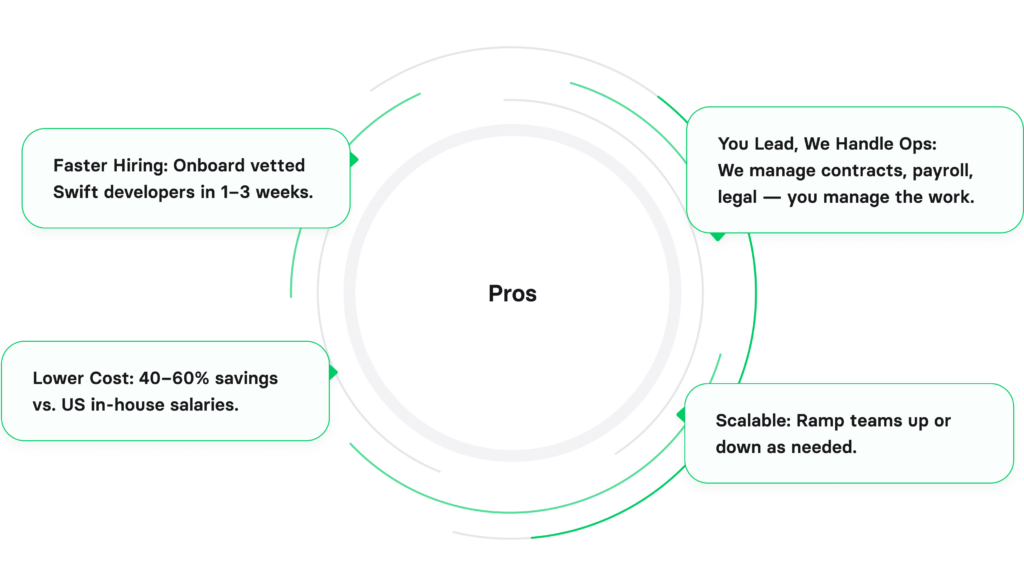
- Big cost savings: Usually 40–60% vs US in-house salaries, without losing seniority or quality.
- Less administrative work: Contracts, payroll, compliance are handled by the vendor. Your team just runs the Swift project.
- Flexible setup: Scale up when needed, scale down when not. No hiring cycles. No layoffs.
Cons:
- You still manage: Sprint planning, technical prioritization, and day-to-day leadership stay on your side. This model doesn’t reduce your management load – it redirects it.
- Initial onboarding: Cultural alignment and workflows need time. Skip these stages, and you can get disorganized processes and internal friction that can hurt project outcomes.
- Vendor quality varies: A poor vendor choice introduces hidden costs in rework, turnover, and lost time.

When it fits:
- You need iOS expertise fast without long-term hiring overhead.
- You want flexibility for changing scopes or timelines.
- You have a strong PM or tech lead in place to manage daily work.

3) Full outsourcing: speed, simplicity, and turnkey delivery

When you outsource iOS development, the vendor takes care of the full Swift build – team setup, development, QA, and delivery. You don’t get pulled into day-to-day execution. You stay focused on what ships and what value it creates.
Companies are using this approach more and more. According to Grand View Research, the global IT outsourcing market is projected to hit $1.2 trillion by 2030, growing at 8.6% annually from 2025.
Pros:
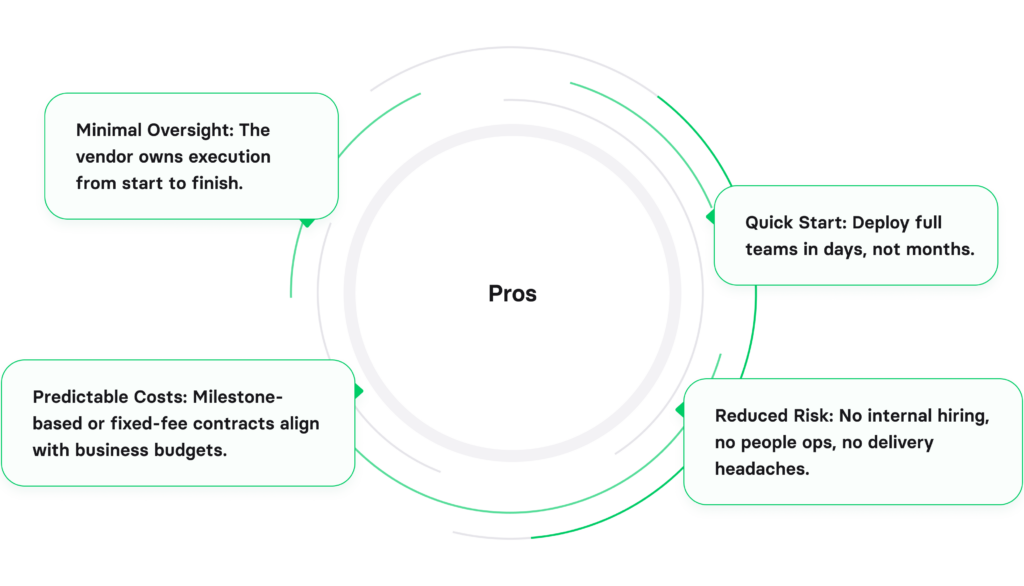
- Minimal oversight: The outsourcing partner owns the entire delivery process, from start to finish.
- Predictable costs: Milestone-based or fixed-fee models make budgeting easier and help keep scope creep under control when the contract is set up properly.
- Quick start: A complete delivery team can be operational within days, not the months required to assemble one internally.
- Reduced risk: No hiring, no retention management, no knowledge concentration in individual employees.
Cons:
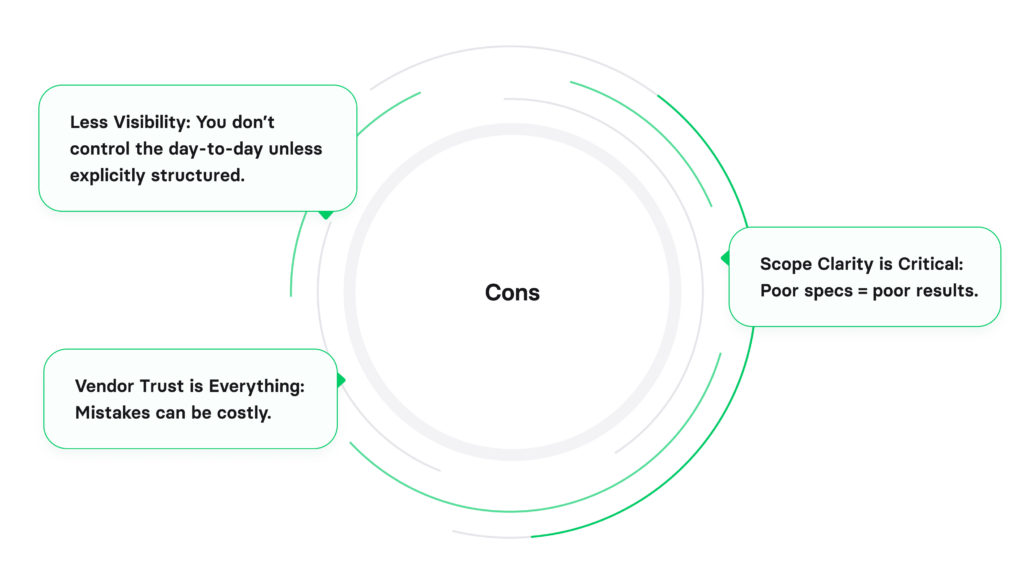
- Less visibility: You don’t control the day-to-day unless explicit reporting workflows are built into the contract.
- Scope clarity is critical: You need an exceptionally well-defined brief because vague requirements cause misalignment that compounds.
- Vendor trust is everything: Delivery quality, timeline integrity, and IP handling all rest on the partner you choose.
When it fits:
- You’re launching an MVP or pilot project fast.
- You don’t have in-house mobile expertise.
- You want full product delivery with minimal internal lift.

In-house vs outstaffing vs outsourcing: A comparison
Every hiring model has its strengths and drawbacks when it comes to cost, control, speed, and risk. The table below compares all three side by side to help you choose among the key software development engagement models for your Swift project.
| Factor | In-house team | Outstaffing | Outsourcing |
|---|---|---|---|
Control over delivery | Full | High – you lead, vendor executes | Low – vendor owns end-to-end |
Time to start | 3+ months | 1–3 weeks | Days |
Cost | Baseline (~$124k/yr avg in US) | 40–60% savings compared to the baseline | Fixed/milestone-based |
Management load | High | High – redirected, not reduced | Low |
Scalability | Low – bound by hiring cycles | High | High |
IP and knowledge retention | Full | Moderate – depends on documentation | Lower – vendor-held |
Talent access | Limited to local/competitive market | Vetted, on-demand | Bundled with vendor team |
Overhead (HR, payroll, compliance) | Fully internal | Handled by vendor | Handled by vendor |
Risk profile | Retention and concentration risk | Vendor quality risk | Scope and vendor dependency risk |
Choosing the right hiring model: a strategic filter
Don’t decide based on hourly rates. Start with your strategy. How fast do you need to move? How much control do you want? Do you have the bandwidth to manage people?
| In-house | Outstaffing | Outsourcing |
|---|---|---|
Building IP-heavy, long-term mobile solutions | Need fast onboarding + direct control | Want turnkey delivery without internal complexity |
Strong internal tech leadership & HR | Budget-conscious with scaling flexibility | Limited in-house development expertise |
Willing to invest in retention, onboarding, and culture | Managing execution internally | Need predictable budgets and a clear delivery timeline |
Regulated industry with strict data residency requirements | Filling a senior skill gap without a permanent hire | No internal PM or tech lead to manage a team |
Whether you opt for an in-house team or external support, we offer solutions that can align with your goals, including product development services and staff augmentation.
To wrap up, here are a few key questions worth asking when deciding how to build your Swift team. Each narrows the choice based on your capacities and needs.
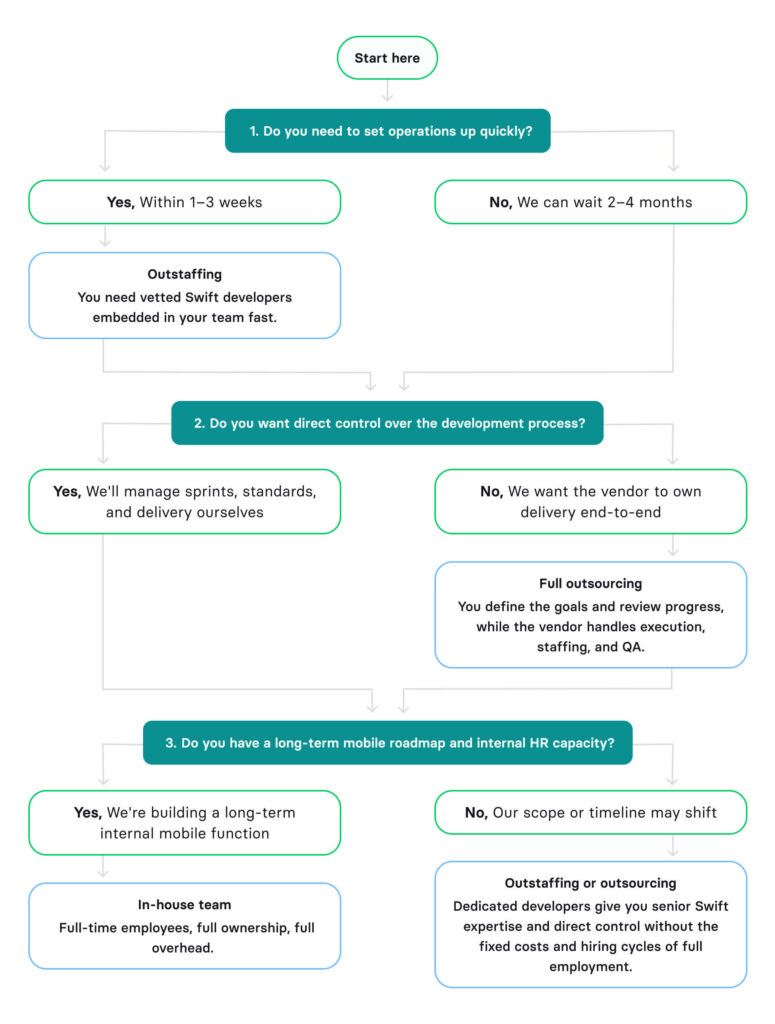
Not sure yet?
Use this as a quick filter:
- No internal tech lead + need to ship fast → Full outsourcing
- Have a tech lead + need to scale fast → Outstaffing
- Long-term iOS product + proprietary tech → In-house team
Final Thoughts
There’s no single “best” hiring model for iOS development – it depends on what your company actually needs right now.
A common mistake is looking mostly at hourly rates or short-term savings. In reality, they rarely decide whether the collaboration works out. Deadlines, internal bandwidth, security requirements, and how often the scope may change usually matter much more.
We at Volpis have strong experience with both outstaffing and full outsourcing models for mobile development with Swift.
Hire experienced and reliable Swift developers today
We would be happy to answer all your questions and help make your project a total win!
FAQ
How to scale an iOS development team mid-project?
Outstaffing and outsourcing models are the fastest. Reputable vendors can ramp up Swift resources in days – much faster than traditional hiring cycles. Pick vendors with real bench capacity and flexible contracts. That’s what prevents bottlenecks. Make sure they also have solid onboarding and knowledge transfer in place. Otherwise, scaling just spreads gaps instead of fixing them.
Can I switch from outstaffing to in-house later without disrupting the project?
Yes – if it’s planned well. Start documenting decisions early. Bring internal leads in from the beginning, not at the end. A phased handover of a Swift development project keeps things stable and prevents knowledge loss. A common path is simple: outstaff first to validate, then hire in-house once the roadmap is clearer.
How do communication rhythms differ between these models?
In-house usually means daily standups and constant sync. Outstaffing is similar, just remote. Outsourcing tends to be more async, with updates tied to milestones. The real difference isn’t location. It’s structure. Set the rhythm early – demos, check-ins, reviews. Define who owns what. And how decisions get made.
How do you choose the right dedicated Swift developer?
Look beyond the resume and evaluate:
– Shipped apps – real production experience, not just side projects.
– Ownership mindset – do they flag risks and move without constant direction?
– Communication – clear async updates, useful PR comments, no hand-holding required.
– iOS ecosystem fluency – do they keep up with Swift updates and Apple guidelines?
– Quality standards – do they write tests and care about what happens post-launch?
– Collaboration fit – timezone overlap, remote work discipline, cross-functional ease.
– Vendor vetting process – if hiring through an agency, ask how they screen the candidates.
You also want to know what to look for when hiring individual developers? Check out our article on the top 9 traits a Swift developer should have.