
The Volpis team has spent over a decade building fleet software, telematics, navigation, and driver-monitoring systems. I wrote this for the fleet that plans to land in the surviving 60% once the hype clears. I’m writing this because “AI agent” has become the most overused, least defined term in the industry: it covers what separates a real agent from rebranded automation, the four use cases where agents already earn their keep, and the build-vs.-buy question most content on this topic avoids. Short version of that last part: buy the commodity, and build the layer that makes your fleet different.
AI agents in fleet management reroute vehicles mid-delivery, flag a failing brake before the driver notices, and reassign loads when a driver nears their hours-of-service limit. That’s a different class of tool than the dashboards and reports most fleets already run.
It’s also a category drowning in hype. Gartner predicts over 40% of agentic AI projects will be canceled by the end of 2027, blaming rising costs, unclear business value, and weak risk controls. Of the thousands of vendors claiming “agentic AI,” Gartner estimates only around 130 build anything that deserves the label. The industry has a name for the rest: agent washing. That ambiguity is exactly why I wrote this article.
-
- AI agents don’t just alert; they act. They schedule maintenance, reroute vehicles, and prevent compliance violations without waiting for someone to read a report first.
-
- The test for a real agent is simple: if you can write the behavior as an if-then rule, it’s automation. If the system chooses between actions based on context and a goal, it’s an agent.
-
- Four use cases have the strongest evidence today: predictive maintenance (brakes, tires, engines), real-time route optimization (dispatch and rerouting), compliance automation (HOS and ELD violations), and driver coaching (in-cab safety behavior).
-
- Buy driver coaching off the shelf – the training data behind it is something no custom build can match. Build the cross-system decision-and-action layer, because that’s the part no platform ships.
-
- Agent authority should be earned, not granted. Every action starts in recommendation mode and graduates to autonomy one at a time, based on track record.
What are AI agents, and what types exist?
An AI agent is a software system that perceives its environment through data and connected tools, works toward a defined goal, decides what steps to take, and executes permitted actions without requiring human approval at every step. Unlike a traditional analytics tool that only generates reports, an agent can carry out multi-step workflows, adapt to new information, and escalate high-risk or exceptional decisions to a human.
Think of it as a junior operations assistant that works continuously and can monitor telemetry from hundreds of vehicles at once, but operates within clear rules, permissions, and escalation thresholds.
Vendors will also pitch you a strict taxonomy of agent types, as if it’s settled science. In practice, the industry hasn’t fully agreed on where one type ends and the next begins (see the FAQ below for one common framework). What’s still useful is seeing how the three main reasoning styles actually behave on a real signal, plus the one coordination question that sits apart from all three: how multiple agents work together.
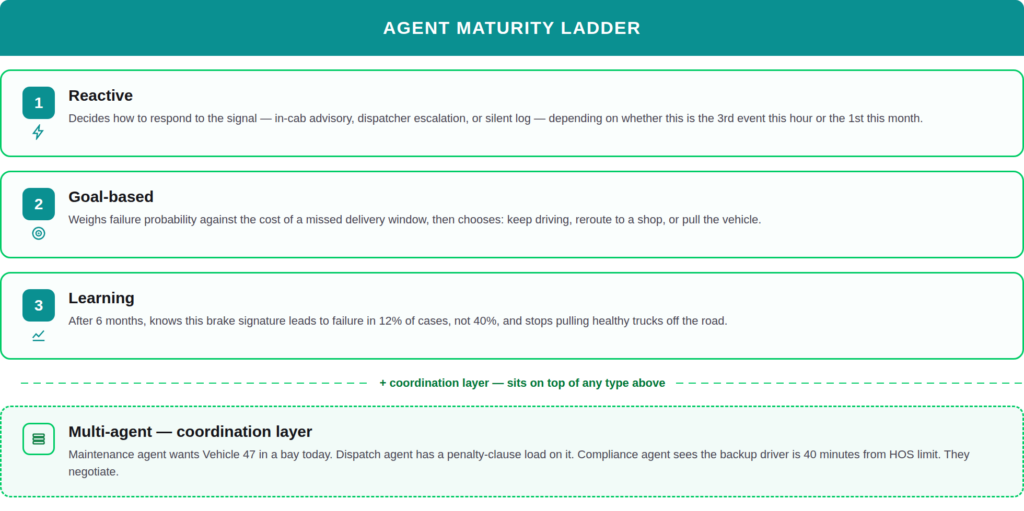
For example: imagine Tuesday, 2:14 PM. The brake pressure sensor on Vehicle 47 starts trending low. Here’s how three common reasoning styles would handle that signal, from simplest to most capable.
A reactive agent decides how to respond to the signal: an in-cab advisory, an escalation to the dispatcher, or a silent log entry depending on whether this is the third event this hour or the first this month. It sits right on the border with plain automation. The only real difference: automation only ever has one response to a given trigger, while a reactive agent still picks among several.
A goal-based agent reasons about the situation against an objective, such as maximizing uptime within safety limits. It weighs the failure probability against the cost of a missed delivery window, then chooses: keep driving, reroute to a shop, or pull the vehicle.
A learning agent gets better at that judgment over time. After six months it knows this brake signature on this vehicle model leads to failure in 12% of cases, not 40%, so it stops pulling healthy trucks off the road.
Coordinating multiple agents is a separate question from any of the three styles above; it’s an architectural decision, not another reasoning style. A multi-agent system (MAS) involves several agents, for example maintenance, dispatch, and compliance, negotiating with each other. The maintenance agent wants Vehicle 47 in a bay today. The dispatch agent has a penalty-clause load on it. The compliance agent sees the backup driver is 40 minutes from their HOS limit. Resolving that conflict well is where fleet-scale AI gets powerful and where most of the engineering difficulty lives.
A narrowly scoped reactive workflow can be a practical first deployment because its triggers, actions, and escalation rules are easier to define and test. Multi-agent systems generally require more mature integrations, governance, and coordination across operational data sources.
None of these should be confused with what most fleet software already does, which brings us to the distinction this whole article turns on.
AI agents vs. traditional automation: where the line actually runs
Most fleet systems are already automated. A geofence rule that texts a dispatcher when a truck leaves the yard is automation. A maintenance module that opens a work order every 20,000 miles is automation. Neither is an agent, and the difference matters when a vendor pitches you “AI agents” that are neither.
If you can write the behavior as a single if X then Y rule, it’s automation. If the response to the same input changes with context and a goal, it’s an agent
A rule-based system fires its trigger if pressure < threshold, sends an alert, and stops. It sends the same alert whether the truck is parked at the depot or hauling a penalty-clause delivery through mountain grades. To be fair to automation: it handles its defined scenario perfectly, forever, for almost nothing. It just breaks on context and on conflicts between rules.
An AI agent starts from a goal and reasons about this situation. Vehicle 47 is mid-route, 340 miles out, carrying a 6 PM delivery window. The agent weighs the failure-probability estimate against the cost of a missed window, books a service bay along the existing route, moves tomorrow’s load to Vehicle 52, notifies the driver and the customer, and logs its reasoning. Same trigger, different decision because the agent chooses actions. It doesn’t run a script.
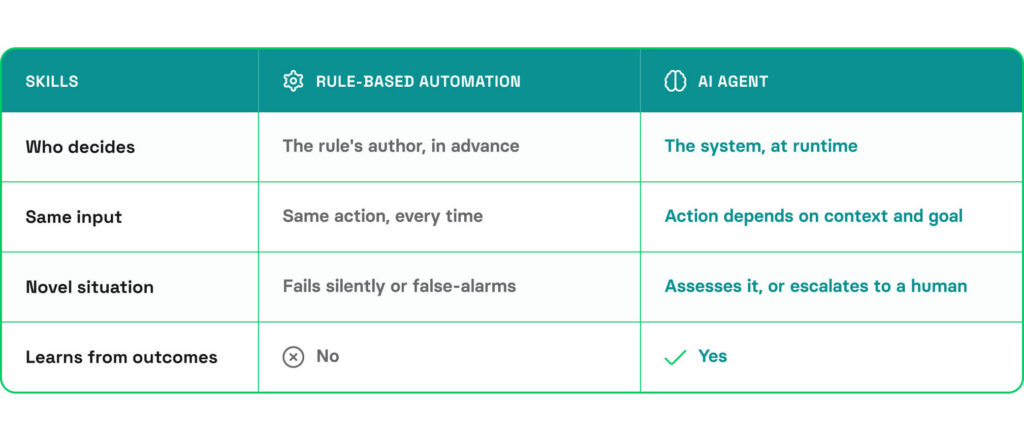
Ask your vendor to walk through this table with their product. If every “agent” behavior they demo is a predefined trigger with a fixed response, you’re looking at automation with a new label.
Why agentic projects fail
Gartner predicts that over 40% of agentic AI projects will be canceled by the end of 2027, and the causes it names have nothing to do with model capability: rising costs, unclear business value, and weak risk controls. Agentic projects fail on management, not on AI. In fleet terms, the three killers look like this:
- Unclear business value. Deploying an agent because agents are the trend, instead of attaching it to a line item that bleeds: breakdown costs, fuel, detention, and CSA exposure. Every use case below starts from the line item, not the technology.
- Weak risk controls. Granting a system authority over vehicles and loads before defining what it may do alone, what needs approval, and how a human overrides it. The autonomy ladder covered in the use cases below is the antidote.
- Rising costs. Usually integration costs. The model that decides “book a repair” is maybe 20% of the work. The layer that can execute that booking across your real vendor landscape is the other 80%.
Practical use cases of AI agents in fleet management
Four use cases have the strongest evidence behind them today. Three rewards a custom build; one you should buy. Each follows the same shape: the situation, how it’s handled today, what a rule does with it, what an agent does with it, and where the human stays in the loop.
1. Predictive maintenance
Also relevant if you’re comparing fleet inspection AI agent options: predictive maintenance is where the fleet-inspection use case lives, flagging component wear before an inspection would otherwise catch it.
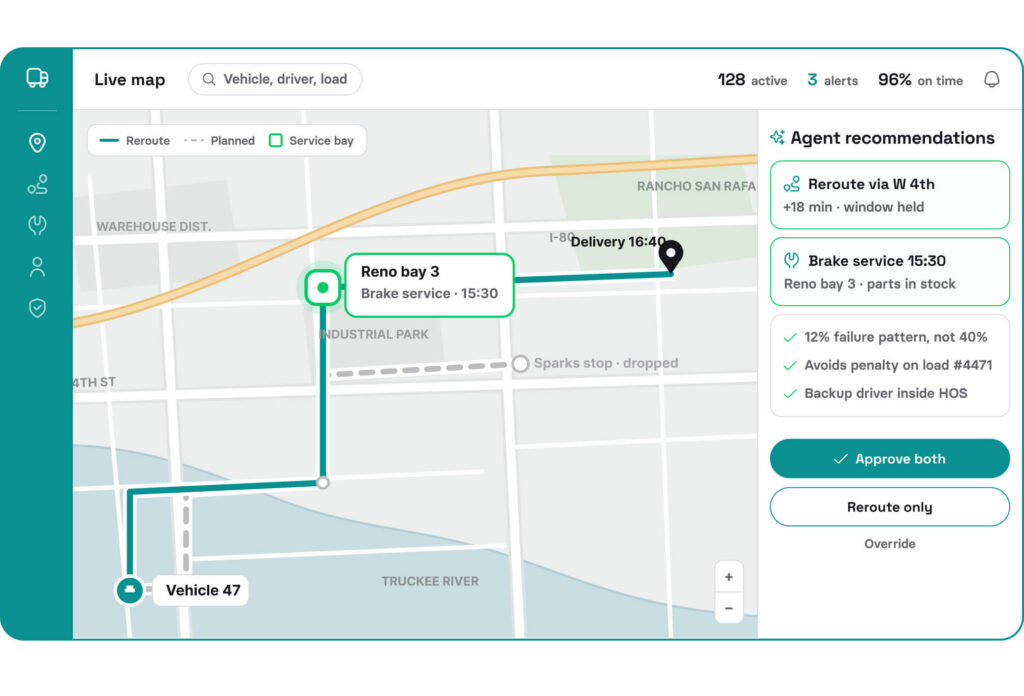
Moving back to the previous example with the vehicle 47. So, 2:14 PM. The brake pressure sensor on Vehicle 47 starts trending low. The truck is 340 miles out, carrying a delivery with a 6 PM window and a late-fee clause in the contract.
How it’s handled today: nobody knows yet. The trend sits in a telematics portal the dispatcher checks when things are quiet, which is never on a Tuesday. In the best case, the driver feels something soft in the pedal Thursday and calls it in. Worst case, the truck goes down on the interstate: towing, emergency repair at 4-5x shop rates, a missed window, and a customer call nobody wants to make.
With rule-based automation, the threshold rule fires at 2:14 PM and emails an alert. Better, the dispatcher knows the same day. But the alert reads identically whether the truck is parked at the depot or hauling a penalty load through the mountains. She still opens three systems: check the route, call the shop, find a slot, figure out who takes tomorrow’s load, and notify the driver. Twenty minutes of swivel-chair work, if she isn’t already handling two other fires. The rule closed the detection gap. The action gap is untouched.
With an AI agent: the agent reads the same signal and reads the context with it. The severity model says the truck safely covers 400+ miles before failure risk climbs sharply. The delivery window is worth protecting. So the agent schedules the repair for tomorrow’s return leg and moves tomorrow’s outbound load to Vehicle 52. How the booking happens depends on the shop: the agent creates the work order directly for its own shop, books through a service-network integration for a partner, or places the call itself through a voice agent if the shop only takes bookings by phone. If the shop can’t confirm, the agent doesn’t guess; it escalates to the dispatcher with fault data, route, and two alternative shops already assembled.
Where the human stays in the loop: as a ladder, the agent climbs one action at a time, not a fixed division of labor. Day one, every action is a recommendation the dispatcher approves; that approval history is training data. After a track record builds, low-risk reversible actions graduate to running solo inside a review queue with a veto window. Pulling a loaded truck off an active route never grates; that stays a human call, permanently.
Predictive maintenance has the deepest evidence base of the four use cases. According to Deloitte’s Analytics Institute, it reduces breakdowns by roughly 70%, lifts productivity by 25%, and cuts maintenance costs by 25%. Fuel gains tend to follow as a byproduct, since agents catch engine degradation early.
Our guide to predictive fleet maintenance covers the technical architecture and data requirements.
2. Real-time route optimization
This is also the natural home for an AI agent for an automated fleet dispatch system, since dispatch reassignment is the core action a routing agent takes.
Static route planning is a solved problem. Real-time route agents are not, and the gap between the two is measured in the miles your plan wastes after 9 AM, once reality diverges from the morning’s assumptions.
11:20 AM. An accident closes the highway ahead of Vehicle 23. Three other trucks share downstream time windows that depend on Vehicle 23’s original schedule.
How it’s handled today: the driver hits traffic and calls dispatch. The dispatcher reroutes Vehicle 23 by eye and hopes the downstream windows hold. They usually don’t; the delay cascades, and the afternoon becomes triage by phone.
With rule-based automation, navigation reroutes Vehicle 23 around the closure locally optimal, fleet-blind. It saves Vehicle 23 twelve minutes and silently destroys two downstream windows because no rule connects one truck’s detour to another truck’s schedule.
With an AI agent, the agent recalculates across the fleet, not just the affected vehicle. It reroutes Vehicle 23, swaps two stops between Vehicles 31 and 40 to protect the tightest window, and updates customer ETAs. The objective isn’t “shortest path for one truck”; it’s “fewest broken commitments across the fleet,” and those two goals regularly disagree.
UPS’s ORION is the most documented deployment of this use case in existence. The system evaluates over 200,000 alternative ways to run a single route, and since its dynamic optimization upgrade, it recalculates throughout the day as traffic and pickups shift with no manual intervention. Results: roughly 100 million miles and 10 million gallons of fuel saved per year, worth $300-400 million annually.
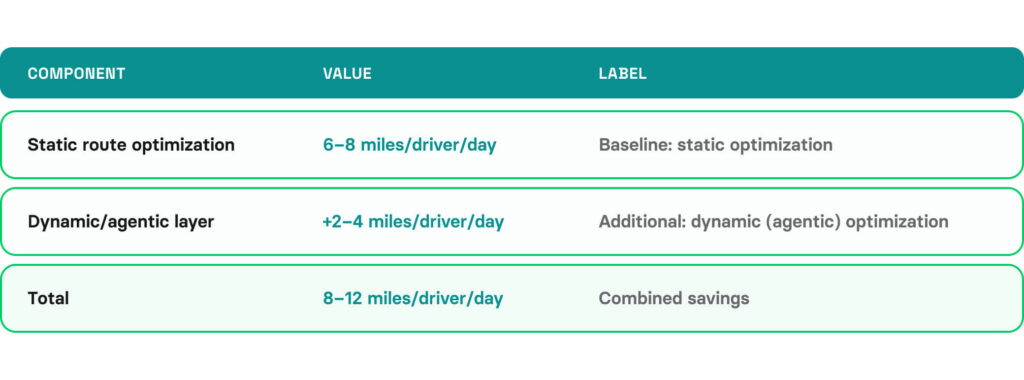
Two honest footnotes make the story more useful, not less. ORION cost about $250 million to build, and its lab-perfect algorithms initially failed in the field. UPS spent three years on field testing and driver adoption before full rollout, and its own retrospectives credit alignment between people, process, and data over the algorithm itself. Second, the increments are sober: static optimization saved 6-8 miles per driver per day, and the dynamic agentic layer added 2-4 more. Agentic routing compounds an already-good system; it doesn’t replace the need for one.
Where the human stays in the loop: route swaps inside agreed service levels graduate to autonomy quickly; they’re reversible, and the agent’s math beats a busy dispatcher’s eyeball. Two things stay human: commitments to customers beyond a defined threshold and any reroute that changes a driver’s end-of-shift location. Schedule fairness is a retention issue no optimizer should own.
3. Compliance automation
Compliance is where ai agent fleet monitoring best practices matter most in practice, since the value comes from continuous monitoring rather than periodic review.
The first two use cases sell on savings. This one sells on risk, because compliance is where an agent’s advantage over a human is categorical, not statistical. Humans forget entries, misfile reports, and notice HOS problems after the violation. Agents don’t forget “never missed a filing” is a binary property no amount of diligent staff can match across 100+ vehicles.
3:40 PM. Driver Kovalenko has 52 minutes of drive time left and is 70 minutes from the delivery. A roadside inspection tomorrow would put this on the record.
How it’s handled today: nobody sees it coming. The violation surfaces in next week’s ELD audit as one more entry in a pattern that quietly degrades CSA scores, raises insurance premiums, and hands ammunition to the plaintiff’s attorney in the next lawsuit.
With rule-based automation, an alert fires at 30 minutes remaining, identically whether the driver is 10 minutes from the dock or 70, and it fires at the dispatcher, who is on the phone. The violation happens anyway; there’s just a timestamped alert proving everyone knew.
With an AI agent: the agent sees the conflict at 3:40, while options still exist. It checks legal break locations along the route and finds a swap: Vehicle 52’s driver, 20 minutes out with four hours of drive time left, can take the final leg. It proposes the swap to the dispatcher, drafts the customer ETA update, and files the audit-ready log automatically. The violation never occurs, which is the whole point, since compliance is one domain where acting after the fact is worth almost nothing.
Where the human stays in the loop: schedule-adjustment proposals stay recommendations longer here than anywhere else because they touch drivers’ hours and pay a fairness question, not an optimization question. What graduates fast is the paperwork: log compilation, filing, and geofence-versus-logged-route verification. The agent earns autonomy over documents before it earns influence over people.
According to the Samsara Safety Report, fleets that deploy safety and coaching AI see measurable CSA score improvements alongside crash reductions, a compounding effect worth designing for. Your coaching layer and your compliance agent reinforce each other.
4. Driver safety and personalized coaching
Driver coaching is the purest reactive-plus-learning agent in fleet management, and it has the strongest public evidence of any use case here.
8:05 AM. A driver rolls through a stop sign and follows the car ahead too closely, twice in the same mile. Neither event causes a crash. Both are exactly the pattern that precedes one.
How it’s handled today: a safety manager reviews dashcam footage days later, if at all, and raises it in a monthly one-on-one. By then the driver doesn’t remember the moment, and the habit is three weeks more ingrained.
With rule-based automation, a hard-braking threshold triggers a beep and logs an event the same way for a genuine near-miss and for a driver braking firmly on ice, so drivers learn to tune it out. The score updates. Nobody’s behavior changes.
With an AI agent: a reactive layer detects the harsh event instantly and delivers an in-cab cue in the moment when it can still change the next decision. A learning layer builds a per-driver profile, tuning alert thresholds and coaching style to what actually shifts each driver’s behavior. It eases off once the habit corrects, so the system keeps its credibility.
Where the human stays in the loop: the agent handles detection, in-cab cues, and scoring on its own. Humans own the conversation, the coaching session, the recognition, and any link between scores and pay.
Driver coaching is also where the EU AI Act becomes a real design constraint, not a footnote. Behavior-scoring and driver-monitoring systems can fall into higher-risk or transparency-obligated categories depending on how they’re used. Getting that classification wrong is its own risk, separate from whether the coaching itself works. I go deeper on this in the EU AI Act and fleet management regulations.
According to the Samsara Safety Report, spanning 2,600+ fleets, those with 175+ vehicles running the full AI safety stack see a 37% decrease in crash rate at 6 months and a 73% decrease at 30 months, nearly twice the reduction seen across Samsara customers overall. Read it as directional vendor data, but the direction is unambiguous.
Challenges and risks of AI agents
Most of what gets written about AI risk is generic bias, data privacy, and model drift. Real, but not what actually breaks a fleet-agent deployment or kills the project behind it. The two lists below keep those apart on purpose: one is an engineering problem, the other is a management one, and blurring them is how “agentic projects fail on management, not on AI” (see above) turns into a contradiction instead of a warning.
What breaks in the system — engineers solve these
- Cascading autonomous errors. An agent that reroutes based on a wrong severity estimate doesn’t just make one bad call; it can trigger a chain of downstream reassignments before a human notices. The autonomy ladder exists specifically to cap how far a single bad decision spreads before it hits a review queue.
- Reward or goal misspecification. An agent optimized purely to minimize missed delivery windows will happily push a maintenance slot back a week because a missed window is scored and a slow-building brake failure isn’t until it is. Every objective function needs a safety-side constraint that the agent can’t trade away.
- Multi-agent conflict. Run more than one agent, and they can genuinely work against each other, a dispatch agent chasing a penalty clause and a maintenance agent trying to pull the same vehicle. That’s not hypothetical; it’s the everyday coordination problem multi-agent architectures exist to solve, and it needs an explicit conflict-resolution rule, not an assumption that the agents will sort it out.
- Hallucinated tool calls. An agent that calls a booking API, a messaging system, or a voice line can generate a plausible-looking action that never actually happened, confirming a service slot that was never booked, for example. Any action with real-world consequences needs a confirmation step; the agent can’t fake the past.
What kills the project — management solves these
- Data quality. Bad data in a dashboard produces a wrong chart that someone eventually questions. Bad data in an agent produces a confident wrong action — a drifting sensor doesn’t report that it’s lying; it reports a plausible value, and the agent acts on it as if it were true. The fix isn’t a smarter model; it’s monitoring the inputs as carefully as the outputs.
- Driver trust and adoption. I already made the point twice without naming it as a risk: UPS credits ORION’s success less to its algorithms than to years of aligning the system with how drivers and dispatchers actually work, and schedule fairness is a retention issue no optimizer should own. Drivers who don’t trust the system ignore alerts, cover cameras, and dispute scoring and the most accurate model in the world becomes worthless. This is the single most common way fleet-tech projects die, not a footnote to the technical risks above.
- Liability and insurance exposure. The moment an agent acts instead of just recommending, the question of who’s responsible when it’s wrong changes. Loop in your insurer and legal counsel on how autonomous actions affect liability and coverage before you grant that authority, not after an incident forces the conversation.
- Regulatory misclassification. Driver-scoring and behavior-monitoring agents can land in higher-risk EU AI Act categories depending on how they’re used, see the driver coaching section above for the specific trigger. Treating that as a footnote instead of a design constraint is its own risk.
None of this argues against deploying agents. It argues for the autonomy ladder covered above: start every action in recommendation mode, promote autonomy one action at a time, and keep a human permanently on the decisions where a wrong call is expensive or unsafe.
Build or buy: which layer to buy, and which to build
The major telematics platforms shipped their agent stories in 2025-2026. Samsara launched Agent Studio with pre-built templates that operations teams configure in plain language. Geotab opened its Ace platform and live fleet data to ChatGPT, Claude, and Copilot through an MCP connector. So the lazy question “should we get AI agents?” is obsolete. The real question is which layer you buy and which you build.
Buy the commodity. Driver coaching is the clearest buy on this list. Samsara, Motive, and Netradyne sell it off the shelf with hardware included, and the training data behind it is the whole point. They see billions of driving miles; you see yours. Buy it, and buy the sensors and telematics underneath it too. The only reasons to customize are tying coaching outcomes into your own insurance or driver-retention program or a safety rubric a regulator or contract forces on you.
Build the differentiator. One detail in the fine print maps where the shelf ends: Geotab states plainly that Ace does not make autonomous decisions or take actions; it delivers insights and keeps the human in control. The platforms are strongest at insight and at actions inside their own systems. The action layer across your actual vendor landscape, your CMMS, your service networks, the independent shop that books by phone, your customer-notification stack, and your dispatch logic are what no box ships, because they’re different for every fleet.
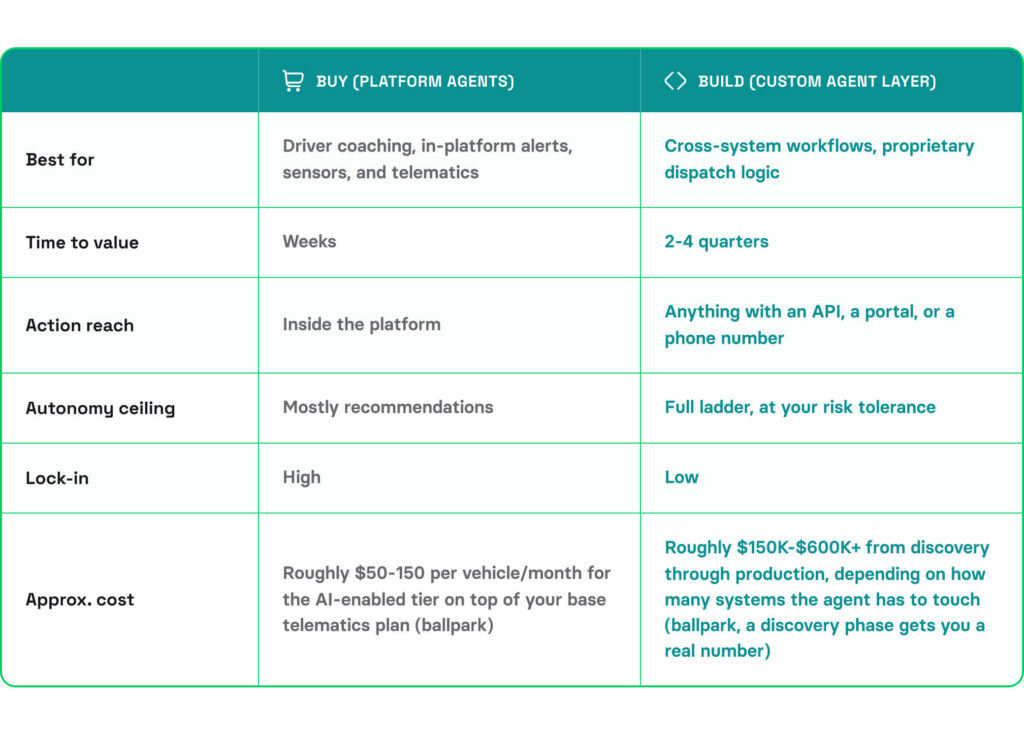
Those cost ranges are for setting expectations, not a quote. Actual cost depends on fleet size, how many systems the agent needs to reach, and how much of the action layer already exists versus needs to be built.
Rule of thumb: buy the sensors and the commoditized use cases, and build the decision-and-action layer that touches more than one system. If your systems can’t yet expose the data an agent would act on, you’re not choosing between build and buy. You’re in the readiness phase, which the checklist below makes obvious.
We’ve seen the same pattern up close. Building Rand One for Rand McNally, a company that’s guided commercial drivers since 1856, taught us that the agent logic has to fit how dispatchers already think, not the other way around.
Where to start: prioritizing by fleet size
Where you start depends mostly on fleet size:
| Fleet size | Recommended first agent | Why it pays back fast |
|---|---|---|
20-50 vehicles | Driver coaching (buy) | Low data requirements; immediate safety and insurance impact |
50-150 vehicles | Compliance automation | Categorical risk reduction; starts on day one with ELD feeds |
150-500 vehicles | Predictive maintenance | Breakdown frequency makes ROI visible within one quarter |
500+ vehicles | Multi-agent dispatch and routing | Route complexity creates compounding savings |
This isn’t a strict rule; a 30-vehicle EV fleet will prioritize charging-aware routing over coaching. But for fleets without a clear starting point, this sequence avoids the most common mistake: building the most complex use case first and running out of budget before it delivers. That cancellation is number one on Gartner’s list.
- Do you have active telematics or GPS tracking across your fleet?
- Is vehicle maintenance history recorded digitally, not in spreadsheets or paper logs?
- Are drivers using ELD devices that generate structured HOS data?
- Do you have at least 6-12 months of historical route and fuel data?
- Is there a defined owner responsible for fleet data quality?
- Can your current systems expose data via API to a third-party agent layer?
- Do your service partners accept bookings electronically or by phone only? This one decides whether a maintenance agent can act on its own or will forever just write recommendations.
- Do dispatchers have a system of record for decisions, or are decisions made verbally?
Scoring: six or more checks and your infrastructure supports agent deployment now. Four to five, plan a 6-12 week data-readiness phase before agent development. Fewer than four, start with IoT and telematics foundation work before any AI layer.
Ready to build the layer, no platform ships?
I won’t sell you anything you can get off the shelf. My team builds the cross-system decision-and-action layer that ties your CMMS, service networks, dispatch, and customer notifications into one agent with a written autonomy ladder mapped to your risk tolerance. It starts with a discovery session on your data and service-partner landscape.
Final word
An AI agent earns its place in a fleet by acting, not just alerting, but only when the authority it’s given matches the track record it’s built. Start narrow, measure the override rate, and let the agent climb the autonomy ladder one action at a time. The fleets that land in Gartner’s surviving 60% will be the ones that treated this as a management discipline as much as a technical build.
Volpis is a fleet management software development company with 10 years of experience building custom telematics, tracking, and AI-powered fleet systems for operators across Europe and the United States. My team has shipped 15+ fleet projects, including navigation platforms for Rand McNally and NFC-based fleet tracking tools in active commercial operation.
Questions & Answers
FAQ
Are AI agents reliable enough for safety-critical fleet decisions?
Agents are proven in maintenance scheduling, routing, and compliance. Safety-critical calls, like pulling a loaded truck off an active route, stay with humans in well-designed deployments, permanently. The agent’s job is to escalate within seconds with the context assembled; that’s intentional design, not a limitation.
What types of AI agents exist?
Vendors and researchers don’t fully agree on this. One common framework, from IBM, breaks agents down by how they reason: simple reflex, model-based reflex, goal-based, utility-based, learning, and hierarchical or multi-agent systems for coordinating several of the above. In fleet software, what matters more than the label is what triggers the agent, what it can decide alone, and when it escalates to a human, see the four use cases I mentioned in this post for how that plays out in practice.
How much data does a fleet need before AI agents deliver value?
It depends on the use case. Predictive maintenance typically needs 12-24 months of telemetry per vehicle model. Route optimization works with weeks of delivery history. Compliance agents start on day one with structured ELD feeds.
What does it cost to implement AI agents in fleet management?
Buying an AI module on top of an existing telematics platform runs roughly $50-150 per vehicle per month. A custom cross-system agent layer typically runs $150K-$600K+ from discovery through production, depending on scope. A discovery phase gets you a firm number.
How to use AI agents for fleet management
Run the self-assessment above. Score six or more and pick the highest-value use case for your fleet size. Score lower, and spend 6-12 weeks closing the data or integration gap first; that groundwork determines whether an agent can act at all.
Should I build AI agents or buy them from my telematics vendor?
Buy commoditized use cases like coaching. Build when the agent must act across systems: your CMMS plus service networks plus dispatch plus customer notifications. That cross-system layer is where custom development earns its cost.