

- Unplanned downtime doesn’t just cost you repair bills – it costs you idle wages, missed deliveries, and contract penalties. Most fleet managers are only tracking a fraction of what it’s actually costing them.
- There are different types of fleet downtime: planned, unplanned, and personnel-related. Among these, unplanned downtime typically associated with unexpected machine issues or vehicle damage is the most problematic for businesses.
- To control and reduce commercial fleet downtime efficiently, track critical metrics like downtime rate, MTBF, MTTR, planned vs unplanned ratio, etc.
- Lower downtime starts with basics: efficient fleet maintenance schedule, improved driver training and retention strategies, clear breakdown procedures and vehicle management, improved operational workflows, and more efficient finance and documentation management.
- Most fleet software is built for standard operations. If your workflows are different, you’ll likely need a custom system.
An expert article from Speedway Tire & Service reveals that downtime costs a fleet about $448–$760 per vehicle per day.
In a 20-vehicle fleet, just two unplanned days a month can add up to around $215,040-$364,800 a year. That’s before missed deliveries, penalties, or idle driver costs.
The real question isn’t whether downtime is expensive. It’s whether your setup is actually built to control it.
In this guide, I break down how to measure commercial fleet downtime, find the main causes, and reduce it using better maintenance practices, AI tools, and fleet management software.
What is fleet downtime?
Fleet downtime is any time a vehicle isn’t available for use. It falls into three types: planned servicing, unexpected breakdowns, and driver-related downtime when the vehicle is ready but no one is available to drive it.
| Type | Definition | Predictability |
|---|---|---|
Planned downtime | A vehicle is taken off the road on a fixed schedule for routine servicing | High; can be scheduled during low-demand periods |
Unplanned downtime | A vehicle stops operating without warning due to unexpected mechanical failure or damage | Low; occurs without warning |
Personnel downtime | A road-ready vehicle sits idle because no qualified driver is available to operate it | Medium; partially predictable with workforce planning |
The goal of fleet downtime management isn’t to eliminate downtime entirely. Planned maintenance is part of the job. The goal is to reduce unexpected breakdowns and keep all downtime as short as possible.
Based on our experience of cooperation with logistics companies, a healthy fleet targets 80% planned maintenance and 20% or less unplanned incidents.
How much does fleet downtime cost?
The real cost of vehicle downtime goes well beyond the repair bill. Direct costs are easy to track; indirect costs are where most fleet managers underestimate the damage. Here’s how to calculate the true figure for your operation.
The fleet downtime cost formula
Annual Downtime Cost = Number of vehicles × Average unplanned down days per vehicle per month × 12 × Daily cost per vehicle
With an average truck downtime cost of $448 to $760 a day, per vehicle, we get the following picture:
| Fleet іize | Unplanned Days/Vehicle/Month | Annual сost (low) | Annual сost (high) |
|---|---|---|---|
10 vehicles | 2 days | $107,520 | $182,400 |
20 vehicles | 2 days | $215,040 | $364,800 |
50 vehicles | 1.5 days | $403,200 | $684,000 |
Direct vs indirect cost breakdown
| Cost category | What it includes |
|---|---|
Direct costs | Parts, labor, towing, replacement vehicle hire |
Operational costs | Idle driver wages, missed delivery revenues, overtime to catch up |
Indirect costs | Contract penalty clauses, customer churn, reputation damage |
Fixed costs (continuing) | Insurance, depreciation, lease payments (paid whether the vehicle runs or not) |
Across industries, preventive maintenance can save at least 12-18% of costs, compared to emergency repairs, according to the Department of Energy report. However, the emergency spending becomes even worse once you add indirect costs. A tire issue that could’ve been fixed for $250 during an inspection can turn into $2,500–$5,000 in towing, emergency repairs, missed deliveries, and contract penalties. Detecting and fixing such problems fast is crucial if you want to maximize your fleet ROI.
Most fleet managers track repair costs. Few track the full downtime cost, including idle wages, missed revenues, and fixed costs on non-operating vehicles. Until you measure the real number, it’s impossible to justify investment in better maintenance systems.
For more practical tips on cost-effective fleet management, check our article on the best way to reduce fleet costs.
What causes fleet downtime?
Reducing fleet downtime starts with understanding what’s actually driving it in your operation. The five root causes below account for the vast majority of unplanned downtime events. Two of them rarely show up on standard maintenance reports.
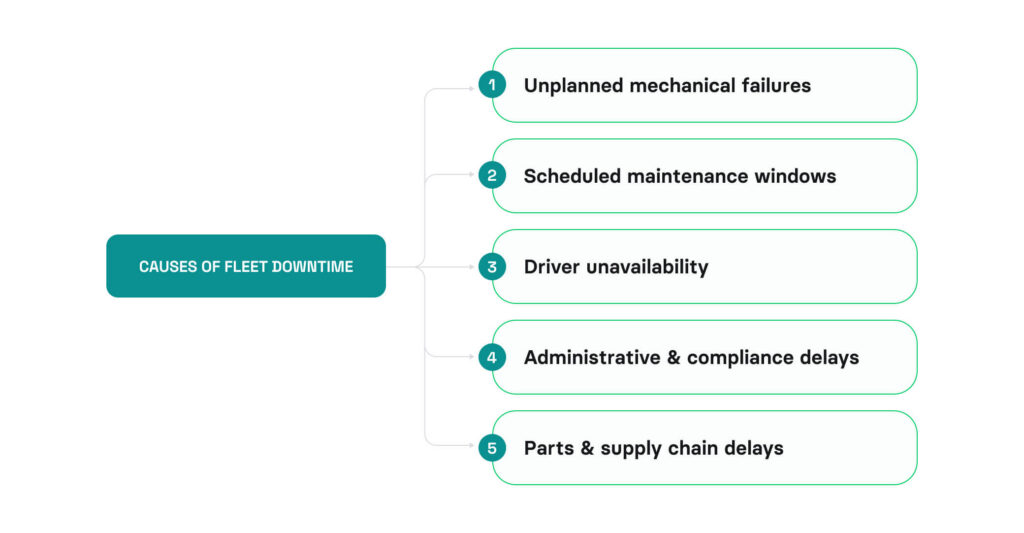
- Unplanned mechanical failures. The most costly and most avoidable cause. Components fail when wear builds up past safe limits. With proper monitoring, you can usually see it coming weeks or even months in advance. Common issues include tire wear, brake degradation, cooling system faults, battery failure.
- Scheduled maintenance windows. Planned maintenance is unavoidable. However, scheduling makes a big difference. When fleets group annual inspections into the same period, too many vehicles can end up off the road at once.
- Driver unavailability. A vehicle ready to roll but without an available, qualified driver counts as downtime. A driver turnover rate can reach 92% annually for large logistics operators, as per PR Newswire. Illness, vacation clustering, and hours-of-service limits are predictable, but only if workforce planning is integrated with vehicle scheduling.
- Administrative and compliance delays. This cause is consistently underreported. Vehicles held at weigh stations for missing documentation or grounded by expired certifications are in downtime, even though nothing is mechanically wrong.
- Parts and supply chain delays. A vehicle might be diagnosed and repair-ready within hours, but wait days for a part. Strategic parts inventory management directly reduces this waiting time. Fleets with vendor relationships that include guaranteed parts delivery windows see significantly shorter MTTR figures.
When we audit a client’s fleet management system, causes 4 and 5 (compliance delays and parts waiting) almost never appear in their maintenance reports. They show up in operational logs as “vehicle unavailable” with no further detail. Building a downtime classification field into your system, even just three categories, gives you the data to act on each cause separately.
How do you measure fleet downtime? Key metrics every fleet manager needs
You can’t reduce what you don’t measure. Commercial fleet downtime management requires six specific KPIs tracked at the individual vehicle level, not just as fleet-wide averages. Here’s the framework.
Fleet downtime rate formula
Fleet Downtime Rate (%) = (Total downtime hours ÷ Total available operating hours) × 100
Example: A 20-vehicle fleet, each with 200 available operating hours per month, has a total availability pool of 4,000 hours. If vehicles collectively logged 400 downtime hours, the fleet downtime rate is 10%.
From our industry experience, high-performing fleets target a downtime rate below 8%.
The six KPIs that drive downtime reduction
| KPI | What it measures | Formula | Target (based on our clients’ experience) |
|---|---|---|---|
Fleet Downtime Rate | Overall availability of your fleet | (Downtime hours ÷ Available hours) × 100 | <8% |
MTBF | How long vehicles operate between unplanned breakdowns | Total operating hours ÷ Number of failures | Higher is better; benchmark by vehicle type |
MTTR | How fast your team diagnoses and fixes issues | Total repair time ÷ Number of repair events | <4 hours for critical vehicles |
Planned vs Unplanned Ratio | How much maintenance is proactive vs reactive | Planned events ÷ Total maintenance events | 80:20 or better |
Vehicle Utilization Rate | What percentage of available capacity is actually used | (Active hours ÷ Available hours) × 100 | >85% |
Maintenance Cost per Vehicle | Average monthly spend per vehicle | Total monthly maintenance cost ÷ Fleet size | Flag vehicles trending >150% of fleet average |
How to reduce fleet downtime: best practices
Reducing fleet downtime isn’t just a checklist of tactics. Start with your data. Take the last 90 days of maintenance and availability records. Break every event into planned, unplanned, or personnel-related. Set a baseline: downtime rate and planned-to-unplanned ratio.
Once you’ve analyzed your downtime patterns, address the key problems with best practices.
1. Maintenance and repair strategies
Downtime reduction starts with efficient logistics fleet maintenance strategies. Here are certain tips that will help you maintain and repair your fleet more efficiently.
- Conduct regular vehicle inspections (DVIRs)
Daily Vehicle Inspection Reports are your first line of defense against unplanned breakdowns. Electronic DVIRs flag defects immediately to the workshop and create a real-time audit trail. For example, Transport Topics reports that truck tires lose about 1–2 pounds of pressure per month. At around 5 pounds below the fleet standard, the risk of failure goes up sharply. Efficient fleet maintenance scheduling with regular inspections catches it early and prevents it from becoming a real problem.
- Run a fleet predictive maintenance program
Predictive maintenance on fixed fleet service intervals – every 10,000 km, every 6 months, or every 250 engine hours – keeps wear items replaced before they fail. In fact, the article from the Brainae Journal of Business, Sciences and Technology reveals that a structured predictive maintenance program can reduce fleet downtime by 50%. It can also lower maintenance costs by 40% and decrease equipment failure rates by 60%.
- Deploy telematics for real-time vehicle health visibility
Modern telematics systems pull engine diagnostics (OBD-II / J1939 data), monitor battery state-of-charge, track idle time, and detect driving events that accelerate wear. Connect fault alerts directly to your fleet maintenance checklist so fault codes automatically create work orders – not just notifications. In one of our custom fleet systems, this change reduced the time between fault detection and repair scheduling from 3.2 days to under 4 hours.
- Keep meticulous performance records
A vehicle’s maintenance history is its most valuable diagnostic dataset. Digital maintenance logs tagged by vehicle ID, component, and date make it possible to spot chronic problem vehicles before they produce your most expensive downtime events.
2. Driver management and safety strategies
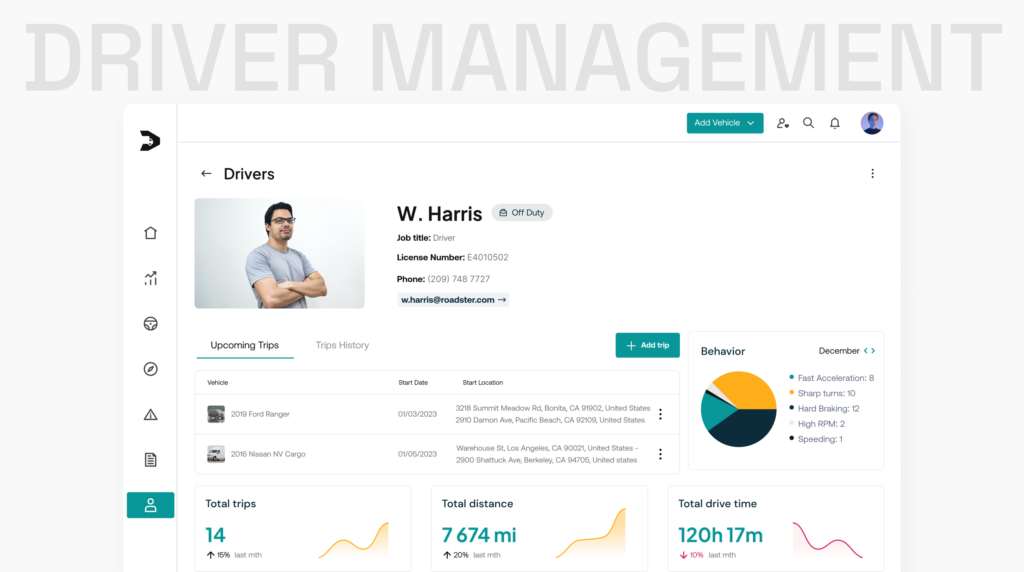
Driver skill and availability also impact your fleet downtime directly. To ensure efficient driver management, follow the practices outlined below.
- Invest in driver training
Aggressive driving patterns, such as hard braking, rapid acceleration, and long idling, wear out brakes, tires, and the drivetrain faster, which is emphasized in an MDPI article. These habits are also linked to a higher risk of serious road incidents. Fleet management software with driver training functionality can help. Focus on vehicle care, fuel-efficient driving, and spotting early warning signs. It reduces maintenance costs and breakdowns. Keep it practical, specific to the vehicle, and refreshed yearly.
- Use telematics to monitor and coach driving behavior
Telematics platforms score driver behavior individually. They track harsh braking, rapid acceleration, idling, and speed variance. For example, in the Cambridge Mobile Telematics program, the highest-risk engaged drivers cut distracted driving time by 20%, hard braking by 9%, and speeding time by 27% between month one and month three.
- Prioritize driver retention
High driver turnover increases downtime. Sometimes there simply aren’t enough drivers available. New drivers also tend to handle vehicles more aggressively and miss early warning signs. Drivers who stay with the same vehicle learn its quirks and report problems sooner. Lower turnover usually means lower maintenance costs. A solid driver reward program that offers drivers solid incentives, encouraging them to follow performance and safety goals, may also help you improve retention.
- Build a downtime response protocol
Document the decision tree for unexpected breakdowns: which routes get a replacement vehicle, who authorizes emergency repairs, and who communicates with affected customers. A well-defined fleet breakdown response plan will allow you to accelerate the coordination in case of an unexpected failure.
3. Vehicle management strategies
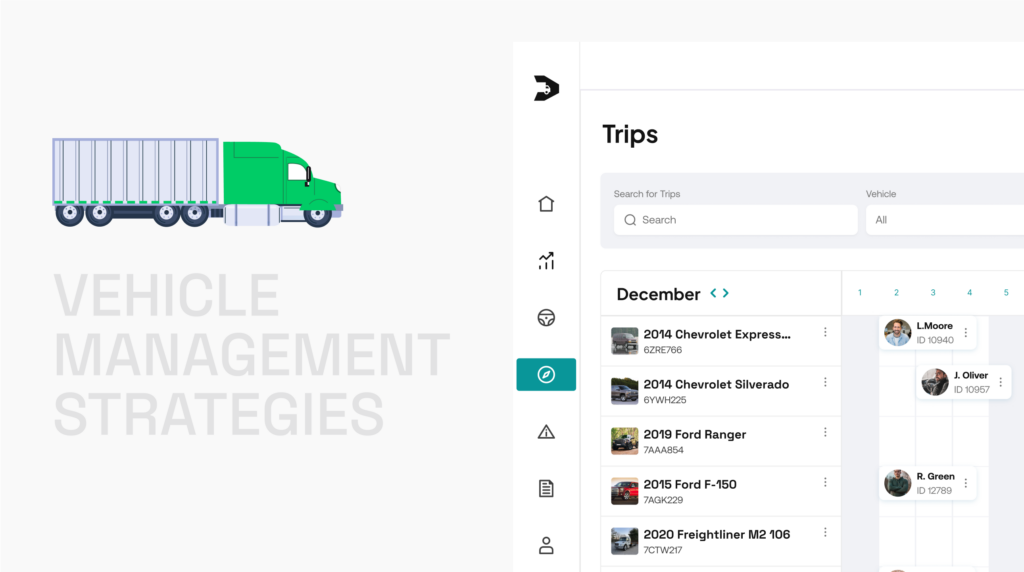
Track all your vehicles to reduce unexpected breakdowns and downtime. Here are a few key steps for better vehicle management.
- Standardize your fleet around proven models
Standardize around two or three low-maintenance vehicle models. This simplifies parts stocking, reduces technician training requirements, and makes it easier to negotiate volume maintenance contracts.
- Know when to replace fleet vehicles
Every vehicle reaches a point where continued repair costs more than replacement. Replace a vehicle when annual downtime costs pass 50% of its replacement value. Other signs matter too: the same part failing more than twice in a year, MTBF dropping for three straight months, fuel efficiency down more than 15% from baseline, or monthly maintenance costs over 150% of the fleet average. Use scorecards with such data to make replacement decisions easier to justify and avoid replacing vehicles too early or keeping them too long.
4. Operational efficiency strategies

Operational gaps can also build up into downtime. Here are a few ways to speed up workflows and spot issues earlier.
- Identify your top downtime causes and act on them first
Sort unplanned events by frequency and cost. If 20% of problems cause 80% of your downtime, focus on fixing these causes first and reduce the total downtime significantly.
- Stagger your maintenance schedule
A staggered maintenance calendar can reduce your simultaneous planned downtime significantly. Optimize your fleet maintenance scheduling to when you reach an optimal downtime in your business context. Spread inspections evenly across the year based on each vehicle’s registration or last service date. Use maintenance windows to inspect adjacent systems, replace components nearing end-of-life, and address minor defects flagged in recent DVIRs. Grouping repairs during a single planned window prevents a separate unplanned vehicle downtime event weeks later.
- Optimize route planning
Route optimization is an efficient way to reduce unnecessary mileage and find the safest path from point A to point B. This, in turn, means slower component wear and lower incident threat. Routing software that factors in vehicle health scores prevents high-risk vehicles from accumulating mileage or choosing hazardous paths.
We built a convenient mobile app with logistics management functionality for Rand McNally, a pioneering company in the U.S. fleet management technology domain. The solution includes route optimization across the U.S., Canada, and Mexico. It builds compliant routes based on weight limits, bridge heights, and other road restrictions. This helps drivers navigate more safely and avoid violations.
- Streamline parts inventory management
Identify the 20 components that account for most of your repair events and stock them on-site. With a consignment stock agreement, parts stay in your workshop, and you only pay when you use them. Repairs stay fast without tying up extra money in inventory.
- Build strong supplier relationships
Formalize supplier relationships with priority service agreements, fixed labor rates, and guaranteed parts availability windows. During supply chain disruptions, preferred customer status determines who gets parts first.
5. Financial and contractual strategies

Finally, more efficient financial management and documentation management can also play a critical role in minimizing commercial fleet downtime. Some vital practices are presented below.
- Contract vehicles during peak seasons
For seasonal demand peaks, such as holiday delivery surges, construction season ramp-ups, harvest transport, short-term vehicle hire avoids the downtime risk of running aging assets at maximum utilization.
- Use full-service leases for maintenance outsourcing
Full-service leases combine vehicle hire, maintenance, tires, and breakdown support into one monthly payment. For fleets without their own workshop, this shifts maintenance work to the leasing company and makes costs more predictable.
- Rely on courtesy vehicles as a backup
When a critical vehicle breaks down, a pre-arranged loaner or courtesy vehicle keeps the route running instead of waiting for repairs. Having standby agreements with dealers or rental providers ensures backup is available when it matters.
How AI and machine learning reduce fleet downtime
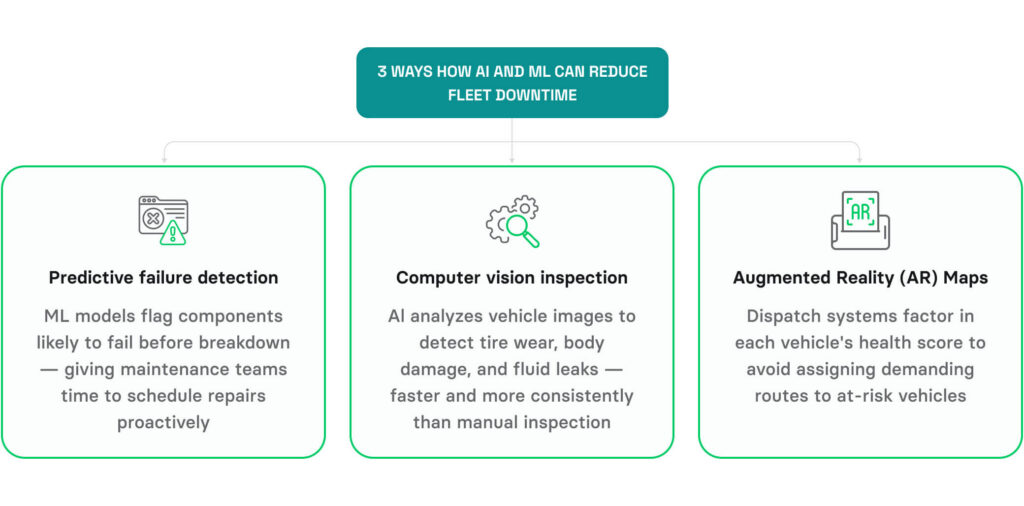
Around 70% of logistics industry leaders are willing to invest in artificial intelligence, according to a Hyperscience survey. Downtime reduction takes an important place among the most critical benefits of using AI in logistics. In particular, three distinct AI applications are now delivering measurable results for commercial fleets.
Predictive failure detection
ML models integrated in a Computerized Maintenance Management System (CMMS) use historical sensor data to spot components that are likely to fail soon. They flag these issues and deliver notifications to the operators. As a result, maintenance teams get clear work orders early enough to schedule repairs in advance.
Computer vision for inspection acceleration
AI-powered computer vision systems analyze images from cameras and driver-submitted photos to detect tire wear, body damage, and fluid leaks. What takes a technician 20 to 30 minutes to inspect manually can be assessed in under 60 seconds – and catches defects that get missed in a rushed manual inspection.
AI-powered dispatch optimization
Dispatch systems that factor in each vehicle’s health score assign routes intelligently. A vehicle flagged at 85% brake life doesn’t get scheduled for a mountain delivery route. This integration between vehicle health data and route assignment prevents the class of breakdown that occurs when an at-risk vehicle takes on a demanding assignment.
For a deeper look at how AI and ML are reshaping fleet operations, read our guide to AI and ML in fleet management.
We’ve integrated predictive failure detection, computer vision inspection, and health-aware dispatch into custom fleet management systems. The combination doesn’t just reduce unplanned vehicle downtime; it shifts how fleet managers think about their role. Instead of responding to problems, they’re managing a risk profile across every vehicle in the fleet simultaneously.
How fleet management software prevents downtime
A fleet management system ties together vehicle data, maintenance scheduling, driver behavior, and compliance tracking into a single operational platform. Here’s how each capability maps to a specific downtime cause.
| Software capability | Downtime type it addresses | Mechanism |
|---|---|---|
Automated maintenance reminders | Planned downtime scheduling failure | Triggers service alerts at mileage/time thresholds; escalates if ignored |
Real-time telematics alerts | Unplanned mechanical failure | Fault codes and sensor anomalies trigger work orders before breakdown |
Driver behavior monitoring | Wear-related failures from aggressive driving | Scores driving events; enables coaching before wear accumulates |
Parts and inventory management | Parts delay downtime | Tracks stock levels; reorders high-use components automatically |
Compliance documentation tracking | Administrative/compliance downtime | Alerts on expiring certifications before vehicles are grounded |
Downtime analysis reporting | All types | Classifies events, tracks KPIs, identifies recurring patterns by vehicle |
How maintenance software prevents equipment downtime comes down to this: it moves information faster than the problem. A fault code that used to travel from driver to dispatcher to workshop manager over three days now creates a work order in under an hour. That speed difference is where downtime is saved.
Best fleet management software for reducing downtime
The right tool for improving fleet management workflow on your fleet size, vehicle types, and what matters most to you: telematics, maintenance, or full fleet operations. Examples below illustrate how different fleet management systems approach downtime reduction in varying ways.
| Platform | Best for | Key downtime features | Fleet size |
|---|---|---|---|
Samsara | Mid to large fleets needing full telematics | Real-time fault detection, AI dashcam, predictive maintenance alerts, compliance monitoring | 20+ vehicles |
Fleetio | Maintenance-focused operations | Automated PM scheduling, DVIR management, parts inventory tracking | 5–500 vehicles |
Verizon Connect | Fleets needing GPS + compliance | Real-time tracking, maintenance scheduling, ELD compliance | 10+ vehicles |
Rand McNally | Trucking and long-haul operations | Route optimization, ELD integration, navigation with maintenance stop planning | Any |
Onfleet | Last-mile delivery fleets | Route optimization, real-time tracking, driver performance analytics | Small to mid |
Custom-built solution | Fleets with unique workflows or multiple vehicle types | Built to your exact downtime reduction workflow; integrates with your existing systems | Any |
If you would like to develop a custom fleet management system tailored to your business goals, including fleet downtime reduction, you can find useful tips in our complete guide to fleet management software development.
Reduce fleet downtime with custom software
Fleet downtime is expensive, and it comes from a mix of factors.
Good results usually come from tightening maintenance, driver management, vehicle tracking, and day-to-day operations, along with keeping financial and paperwork processes in order.
But every fleet is different. What works for one setup won’t always fit another, so downtime reduction needs to match how your operation actually runs.
Generic fleet management software is built for the average fleet. If your operations are non-standard – mixed fleets, custom dispatch logic, logistics integrations, or industry-specific compliance – off-the-shelf tools often create more problems than they solve.
Consider developing a custom fleet management system. It will fit your workflows better and may cost less over time than the operational friction you deal with today.
Questions & Answers
FAQ
How to improve fleet uptime with predictive maintenance software?
With predictive maintenance software, you can catch issues before they turn into breakdowns. Such a solution can track signals like:
– Engine load
– Temperature
– Brake wear
– Fluid levels
– Battery voltage
– Tire pressure
– Transmission performance
– Fuel consumption patterns
– Exhaust emissions
– Coolant levels
– Oil pressure
– Mileage and usage cycles
Continuous tracking of vehicle conditions allows operators to plan repairs in advance instead of waiting for operational disruptions. This results in fewer unexpected breakdowns, lower repaired costs, longer vehicle lifespan, and better fleet availability.
When should you replace a fleet vehicle instead of repairing it?
Repeated part failures, falling MTBF, fuel efficiency down 15% or more, and maintenance costs far above the fleet average. These are usually signs that a vehicle is nearing replacement time. A common benchmark: yearly downtime costs exceeding 50% of the vehicle’s replacement value. Fleet management software can track these patterns automatically and flag vehicles before costs spiral further.
Can I use a custom fleet vehicle replacement calculator to reduce downtime?
Yes – and it’s usually more accurate than generic tools. A custom calculator can use your real cost per vehicle per day, MTBF trends, repair frequency, and fuel efficiency baselines instead of industry averages.
That makes replacement decisions easier to defend and based on your actual fleet data.
How can fleet telematics AI help reduce fleet downtime?
Fleet telematics AI analyzes vehicle data like engine diagnostics, brake wear, and tire pressure to spot failures before breakdowns happen. It can trigger maintenance tasks automatically, improve route planning, and flag driving habits that increase vehicle wear and downtime.