
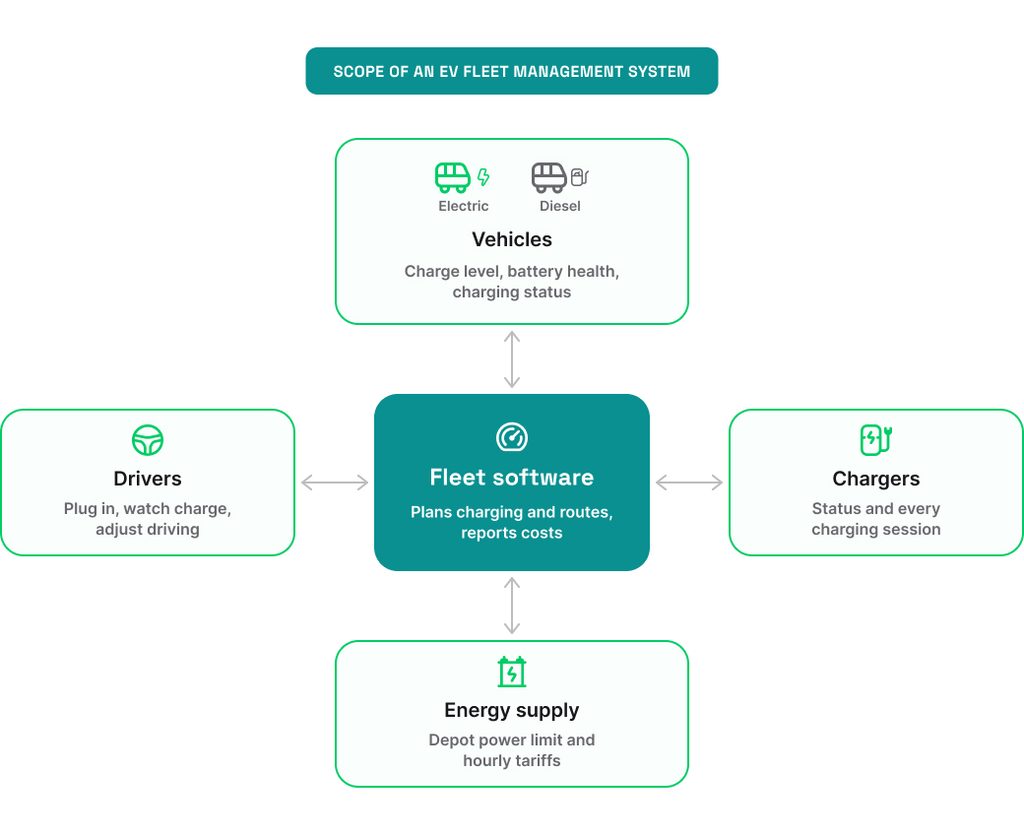
- EV fleet management runs vehicles, energy, chargers, drivers, and data as one system.
- Compared with internal combustion engine (ICE) fleets, EVs add hours-long charging, weather-dependent range, and battery health to track.
- Software turns charging, range, and battery health into routine work. It plans where and when each vehicle charges: at the depot, at public stations along the route, or at a driver’s home. It also matches trips to range and tracks energy costs and battery health.
- Mixed fleets don’t need a separate EV platform. They need EV features inside the fleet system that already runs their ICE vehicles.
- Off-the-shelf tools fit when they support your vehicles, chargers, and daily processes without workarounds. Custom software pays off for specific charging or dispatch rules, complex integrations, or your own fleet product.
A diesel van refuels in minutes at any station. An electric van needs hours on a charger. Someone has to fit those hours around routes, shifts, and the depot’s power limit.
That planning runs on data: state of charge, charger status, energy prices, and battery health. Vehicle tracking alone won’t run an EV fleet. Energy now needs the same tracking and planning as location.
This article covers what EV fleet management is, which challenges EVs add compared with ICE, and what software it needs. It draws on our 10 years of building fleet management software for fleet operators and fleet-tech companies. It’s written for fleet managers and product teams choosing their tools.
What is EV fleet management?
Electric vehicle (EV) fleet management is the process of planning, monitoring, and controlling electric vehicles and the energy they run on. It includes charging, energy consumption and costs, range planning, battery health, and maintenance, alongside standard fleet tasks such as tracking, dispatch, and driver management.
The main difference from an ICE fleet is energy. Before each job, the team needs to know whether the vehicle has enough charge, and where, when, and at what cost it will charge next.
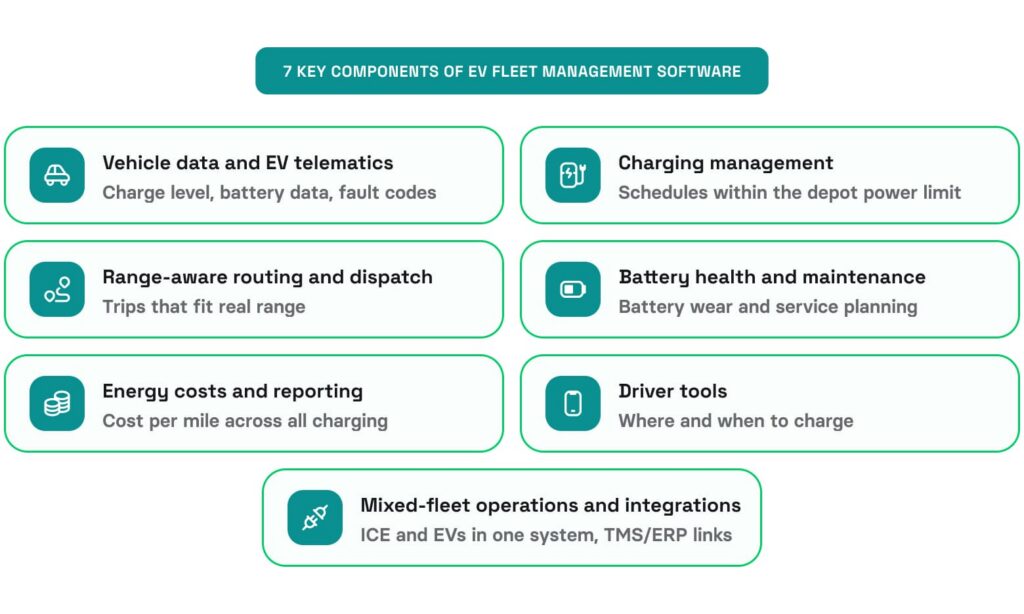
Key components of EV fleet management software
EV fleet management software brings seven components into one system. Each one handles a specific job and solves a specific operational problem. Where a component has its own article in this series, we link to it.
Vehicle data and EV telematics
The software collects location, state of charge (SoC), available battery data, and fault codes from each vehicle. Data comes from original equipment manufacturer (OEM) platforms or telematics devices, and each reading carries a timestamp. Dispatch sees which vehicles are ready and knows when data is too old to trust. More in our article on EV telematics and on how to implement IoT in fleet management.
Charging management
The software schedules charging sessions, sets priorities between vehicles, and keeps the depot under its power limit. It alerts the team when a session fails. Vehicles leave on time, and the depot avoids costly peak demand. Chargers can connect over OCPP, the open protocol between chargers and management software. More in our article on EV fleet charging management and on predictive charging for EV fleets.
Range-aware routing and dispatch
The software assigns routes based on each vehicle’s charge, outside temperature, payload, and available charging stops. Dispatch only sends a vehicle on a trip it can finish, so drivers don’t run low mid-route.
Battery health and maintenance
The software tracks state of health (SoH), the battery capacity left compared to new, and flags unusual wear. Teams can adjust charging habits and plan service before reduced range disrupts routes. More in our article on EV fleet maintenance and in our guide to predictive fleet maintenance.
Energy costs and reporting
The software combines depot, public, and home charging costs per vehicle and per session, using your electricity tariffs. Managers see cost per mile or kilometer instead of piecing it together from separate bills.
Driver tools
The driver app tells each driver where and when to charge, shows vehicle status, and lets them report problems. Drivers follow clear instructions, and dispatch learns about issues right away.
Mixed-fleet operations and integrations
The software keeps ICE vehicles and EVs in one data model, with the same views and reports. It also connects to your transportation management system (TMS), enterprise resource planning (ERP), and other business systems. Orders, routes, and costs move between systems without manual exports.
Challenges that EV fleet owners face
EV fleets run into seven challenges that ICE fleets don’t have, or have in a milder form. For each one, we show which part of the system handles it.
Challenge 1: Charging access and depot power limits
A depot has a fixed power connection, and every charger shares it. Plug in too many vehicles at once, and some won’t finish charging before the morning shift. Public chargers add queues and detours on top of that.
Solution: charging management software builds a schedule around routes and shifts. It balances power across chargers, so the depot stays under its limit.
Challenge 2: Real-world range in cold weather
The range on the spec sheet assumes mild weather and an empty cargo area. AAA tested three EVs in a lab in 2026. The cabin was heated to 72°F (22°C). At 20°F (-7°C), range fell 39% compared with 75°F (24°C). Recurrent’s real-world data from 30,000+ vehicles shows a smaller loss. EVs keep about 78% of their range at 32°F (0°C).
ICE vehicles lose efficiency in the cold too, but less. FuelEconomy.gov puts a gasoline car’s city mileage about 15% lower at 20°F (-7°C) than at 77°F (25°C). In an EV, about two-thirds of the extra energy used in the cold goes to heating the cabin.
Solution: range-aware routing that factors in temperature, payload, and the route, so dispatch only assigns trips a vehicle can finish. Dispatch can also schedule cabin preheating while the van is still plugged in.
Challenge 3: Charger downtime at the depot and on the road
If a depot charger fails overnight, the vehicle on it may miss its morning shift. Public chargers fail too. J.D. Power’s 2026 U.S. EVX Public Charging Study found that 12% of public charging visits ended without a charge. A year earlier, it was 14%.
Solution: charging management that monitors chargers and alerts dispatch. A failed charger then triggers a new plan before the shift starts. On the road, the driver app can show which nearby public chargers are available.
Challenge 4: Clear charging instructions for drivers
With fuel, drivers decide when and where to refuel. With EVs, that decision affects depot power, energy costs, and the next shift. Without clear instructions, drivers fast-charge “just in case” and pay peak prices.
Solution: the driver app gives each driver a concrete plan: where to charge, when, and for how long. Dispatch updates it when routes or charger availability change.
Challenge 5: Tracking energy costs across depot, public, and home charging
In an ICE fleet, fuel cards put every purchase in one place. EV energy arrives three ways: the depot’s utility bill, public networks, and home charging you repay drivers for. Demand charges sit on yet another line.
Solution: energy cost reporting: one ledger per vehicle and per charging session, with cost per mile calculated automatically.
Challenge 6: Battery degradation
Batteries lose capacity slowly, and the pace depends on how you use them. Geotab’s January 2026 analysis of 22,700+ EVs puts the average loss at 2.3% of capacity per year.
Solution: battery health monitoring plus charging rules that protect the battery, for example, limits on daily fast charging.
Challenge 7: Running a mixed ICE and EV fleet
Fleets replace vehicles as leases end and old vans wear out. So ICE vehicles and EVs share the fleet for years. Running two separate systems doubles the work and splits your data.
EV data adds another layer. Each OEM reports battery health in its own way, so the same number can mean different things. TÜV SÜD notes that there is no standard way to calculate state of health. One method may base it on gross battery capacity, another on usable capacity. On a VW ID.3, that’s 62 kWh versus 58 kWh.
Solution: mixed-fleet software that shows ICE vehicles and EVs in the same views and reports, on one data model.
Benefits of EV fleet management software
EV fleet management software helps operators cut charging costs, keep vehicles ready for work, and coordinate daily operations faster.
Lower charging costs
Schedule charging around electricity tariffs, departure times, and depot power limits. This cuts expensive peak demand and avoids unnecessary public fast-charging sessions. RMI modeled a Los Angeles depot with about 100 medium- and heavy-duty trucks in 2025. There, off-peak charging could cut charging costs by up to 30%.
Fewer missed routes and delayed departures
Track whether each vehicle will have enough charge for its next assignment. If charging fails or a vehicle falls behind schedule, dispatch can act before the driver’s shift starts.
More vehicles served by existing charging infrastructure
Allocate available power based on which vehicles need it most and when they leave. The depot can then support more EVs within its existing power limit and postpone a grid upgrade. The Mayor of London’s 2017-2019 trial with Gnewt Cargo covered a 26-van electric fleet. Without smart charging, its depot would have needed 130% more grid capacity.
Better control over battery wear
Monitor battery health trends and identify vehicles losing capacity faster than expected. Fleet teams can adjust charging practices and plan maintenance or replacement before reduced range disrupts operations. In Geotab’s study, vehicles charged mainly on AC or lower power lost about 1.5% of capacity per year. Vehicles that relied heavily on DC fast charging above 100 kW lost up to 3.0%.
Less manual work for fleet teams
Bring vehicle status, charging sessions, and energy costs into one workflow. Dispatchers spend less time checking separate dashboards, coordinating charging, and combining spreadsheets for reports.
Clearer costs for every vehicle and route
Combine depot, public, and home charging expenses to see energy cost per mile or kilometer. Managers can spot expensive charging habits and compare vehicle performance. They can also make better decisions about vehicle assignments and future fleet purchases.
Off-the-shelf vs custom EV fleet management software
The choice depends on how well available software supports your operations. It also depends on how much control you need over features and the roadmap.
Off-the-shelf options include OEM platforms, telematics systems, and charging management software. Some focus on vehicle data; others on charging operations. Their features can overlap, so check what each product actually covers and whether you need more than one.
The table compares the two approaches.
| Criteria | Off-the-shelf software | Custom software |
|---|---|---|
Best fit | Fleets whose needs match existing features and workflows. | Fleet operators with specific requirements, or companies building their own fleet product. |
Functionality | Features and configuration options provided by the vendor. | Workflows, interfaces, and features built around your requirements. |
Integrations | Available connectors and the vendor’s API capabilities. | Connections developed for your systems, subject to external API and data access. |
Implementation | Faster to launch, with setup, configuration, and onboarding. | Requires discovery, development, testing, and rollout. |
Costs | Subscription fees, plus any hardware, setup, and integration costs. | Development investment, infrastructure, external services, and ongoing maintenance. |
Product control | Major changes depend on the vendor’s roadmap. | You prioritize what gets built and when. |
When to choose off-the-shelf software
A ready-made solution is a good fit when it supports your core operations without major workarounds. Test it against your actual fleet: vehicle models, chargers, shift patterns, reporting needs, and existing systems.
Can dispatch see which vehicles are ready for their next route? Can charging be scheduled within the depot’s power limit? Can finance track energy costs without combining reports by hand? If the product handles these tasks reliably, custom development may add little value.
When to choose custom software
Custom development makes sense when available tools can’t meet a clear operational or product requirement. Common reasons include:
- Specific charging and dispatch rules. Vehicle priorities depend on shifts, delivery commitments, or other rules that standard configuration can’t support.
- Complex integrations. Orders, routes, vehicle status, and charging costs need to flow between systems in ways existing connectors can’t handle.
- Your own fleet software product. You need control over the customer experience, features, and roadmap to serve your users.
- Costly operational workarounds. Teams repeatedly transfer data, coordinate tasks manually, or keep spreadsheets because the software doesn’t support the process.
Custom development can cover a specific module or a complete platform. The scope should follow the problem you need to solve.
Before deciding, compare the full cost of both approaches: implementation, subscriptions, integrations, internal administration, and long-term support. A large fleet or several vehicle brands alone doesn’t justify a custom build.
The hard part of a custom build is data plumbing. Vehicle data arrives from different sources, at different rates, in different formats. It has to land in one model that dispatch, reports, and the driver app can trust. We cover the full build process in our fleet management software development guide.
We build real-time data pipelines on MQTT, Kafka, RabbitMQ, and WebSocket, and connect other systems through REST APIs. For Rand McNally’s Rand One app, we delivered a minimum viable product (MVP) for hardware-free fleet tracking in 6 months. We’ve worked on the product for over 2.5 years.
Need software built around your fleet operations? Volpis develops custom fleet platforms, driver apps, and integrations. See our fleet management software development services.
Conclusion
EV fleet management comes down to planning energy as carefully as you plan routes. Charge levels, charger status, energy costs, and battery health now drive daily decisions.
Start with the software you have and add the EV features you actually need. Then watch where standard tools stop fitting. Still planning the switch? Our guide to fleet electrification strategy covers the steps from audit to pilot.
About Volpis
Volpis is a software development company that builds custom fleet management software. In 10 years, we’ve delivered 15+ fleet projects, from driver apps to real-time tracking platforms. We work with fleet operators and fleet-tech companies that need software built around their own operations.
Questions & Answers
FAQ
How many EVs do I need before EV fleet software pays off?
There’s no fixed number. A practical trigger is your first shared depot charger or your first demand charge. Once several vehicles compete for the same power connection, manual charging plans stop working.
What is vehicle-to-grid (V2G), and do fleets need it?
V2G lets an EV send power back to the grid or the building when it’s parked. It can earn money or cut peak costs, but it needs compatible vehicles, chargers, and a utility program. Treat it as a later step, not a starting requirement.
Can I add EV features to an existing fleet management platform?
It depends on the platform. The effort comes down to how open the platform’s data model and APIs are. A short technical review shows whether to extend it or build a separate module.
How much does EV fleet management software cost?
Major vendors such as Samsara, Geotab, and Motive don’t publish prices. Public procurement records and buyer reports put telematics at about $20-$60 per vehicle per month, plus $100-$400 for hardware. Custom software has a build cost, then ongoing support. Its cost depends on the data sources you connect, the apps you need, and real-time requirements.